



New York MTA Strikes Deal for Second Avenue Subway Phase 2 Tunneling
The $1.97 billion contract will extend the Q train to 125 Street, bringing long-promised subway access to East Harlem by 2032.

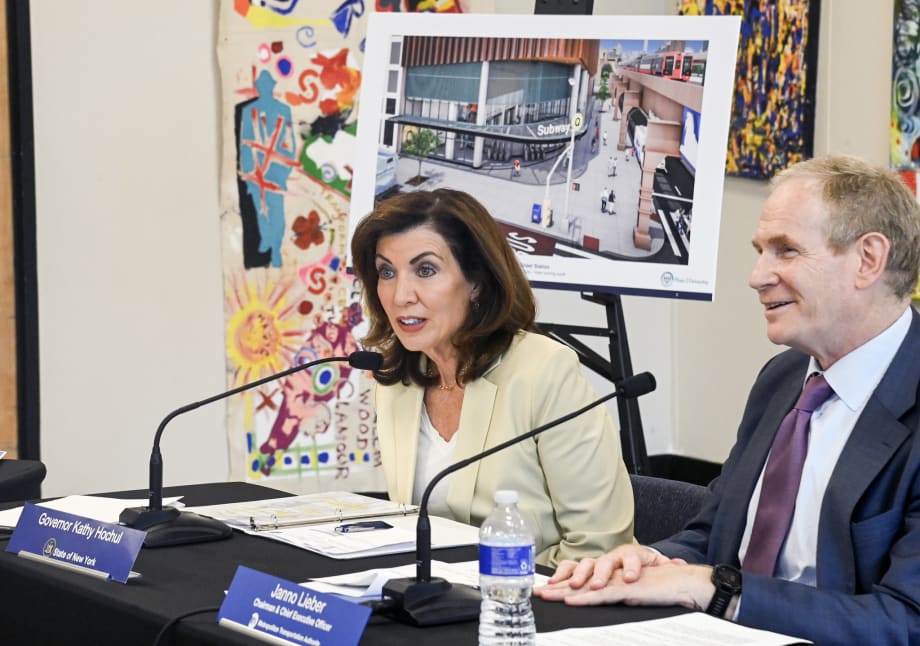
New York Governor Kathy Hochul and MTA Chair and CEO Janno Lieber announce the approval for the tunnel-boring contract for Phase 2 of the Second Avenue Subway.
Photo: MTA
New York Governor Kathy Hochul recently announced that the Metropolitan Transportation Authority (MTA) Board has approved the tunnel-boring contract for Phase 2 of the Second Avenue Subway, the project extending the Q train from 96 Street to 125 Street that will deliver new transit access to East Harlem residents.
The new tunnel will extend from 116 Street to 125 Street. Crews under this contract will also excavate space for the future 125 Street Station, and in a cost-containment measure that saves the MTA $500 million, will outfit the tunnel along the route that was built in the 1970s to accommodate the future 116 Street Station.
Early work will commence later this year, with heavy civil construction starting in early 2026 and the tunnel boring itself expected to begin in 2027.
"It's been a century since the people of East Harlem were promised the new subway they deserve — and we are finally getting it done," Governor Hochul said. "East Harlem is one of the most transit-reliant neighborhoods in New York, but every day, tens of thousands of commuters lack subway access."
"The Second Avenue Subway will change everything; it will shorten commutes for over 100,000 daily riders and make East Harlem more vibrant than ever," Governor Hochul added.
According to an agency release, the contract, valued at $1.972 billion, is being awarded to Connect Plus Partners, a joint venture between Halmar International and FCC Construction. It is the second of four construction contracts for the Q train extension.
Second Avenue Subway Phase 2 Moves Forward With Record Contract
Despite New York City's high construction costs, the Second Avenue Subway Phase 2's cost-benefit is significant and is projected to have the lowest cost per rider of any active heavy rail project in the country.
"This is a meaningful step forward not only for the project but for everyone in East Harlem and Central Harlem," MTA Chair and CEO Janno Lieber said in a release. "Thanks to investments from Governor Hochul and our partners in Washington, today the new MTA is moving forward with the largest tunneling contract in agency history, but – more important – with a project that pencils at the lowest cost per rider of any heavy rail project in America."
The line's first construction contract was awarded in January 2024 for utility relocation work. Crews working under that contract are relocating underground utilities from 105 Street to 110 Street on Second Avenue at the site of the future 106 Street Station, in order to facilitate the subsequent construction of the station.
Crews working under the third contract will build the underground space for the future station at 106 Street and Second Avenue. That contract is currently in procurement. The fourth and final contract will cover the fit-out of the three stations, at 106, 116, and 125 Streets, and the systems needed to run train service, such as track, signal, power, and communications. This contract is currently in design.
Second Avenue Subway Phase 2 is on schedule with a revenue service date of September 2032. The project budget is $6.99 billion and is funded in part by revenues from the Congestion Relief Zone tolling program.
In 2023, the MTA unveiled new conceptual renderings of the proposed stations for the extension, providing future riders with a glimpse into the potential station interior and exterior designs.
"After generations of promises, the new MTA is delivering," MTA Construction and Development President Jamie Torres-Springer said in a release. "Today's contract award brings us closer to world-class transit service in East Harlem. Using lessons learned from Phase 1, we're excited to keep our momentum going and complete this contract better, faster, and cheaper than ever."
More Management

METRO Opens Submissions for 2026 Motorcoach Awards
Nominations are now being accepted for METRO Magazine’s Operator of the Year and Innovative Operator of the Year awards.
Read More →
New York MTA Advances Final Contract for Second Avenue Subway Expansion
Contract Four is the largest in the Second Avenue Subway Phase 2 project and includes construction of station infrastructure, tracks, and signals for the subway expansion, MTA officials said. Work on Contract Four will begin in 2027.
Read More →
Transit Agencies Highlight Safety Gains at National Summit
Leaders from 15 major transit systems shared crime-reduction results and safety initiatives while discussing the role of continued federal support.
Read More →

NITA Names New Leadership, Expands Reduced-Fare Program at First Board Meeting
The new regional transit authority appointed its first board chair and interim executive director while extending reduced fares across CTA, Metra, and Pace for eligible riders.
Read More →
Beyond the Checklist: A Structured Approach to Transit Maintenance
Reliability-Centered Maintenance helps transit agencies move beyond routine checklists to focus limited resources on the assets and failures that have the greatest impact on safety, reliability, and service.
Read More →
APTA 2026 Nominating Committee Selects Leadership Slate, Names Chair and Vice Chair Nominees
Leadership changes will help shape the association’s priorities and its representation of the transportation industry during the 2026–2027 term.
Read More →
DART Launches Major Security, Fare Enforcement Initiative
The 90-day demonstration will deploy coordinated security teams at five light rail stations while testing controlled access and gathering data to guide future investments.
Read More →
Advancing Fare Collection Through Technology and Innovation
Learn about delivering 1300 gates at 91 stations while managing fare evasion. Explore the large scale deployment, solution customization and real-world results that affect the region. Prepare for deployment in your region now.
Read More →
Game Day in Motion: Moving Millions During the 2026 World Cup
Between packed transit stations and team motorcoaches, see how agencies and operators across North America tackled the transportation demands of the 2026 FIFA World Cup.
Read More →
Surface Transportation Extension Averts Shutdown, Leaves Transit Funding Gap
The stopgap keeps federal transportation programs moving, but missing advance funding could complicate the transit and rail projects agencies are planning next.
Read More →