



New York MTA Issues RFI for New, Modern Fare Gates
The MTA seeks to replace its legacy fare arrays and strategically deploy next generation fare gates that better align with the authority’s goals of promoting fare compliance, preventing fare evasion, and more.

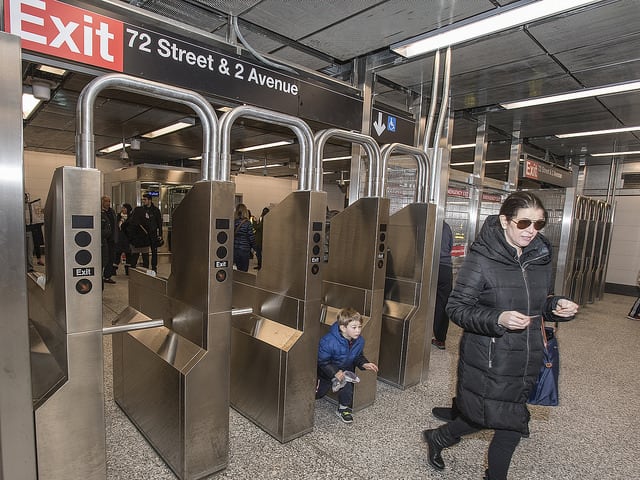
Fare evasion on NY MTA's system has reached crisis levels in the transit system, with a loss of $285 million in revenue due to subway fare evasion in 2022 alone.
Photo: MTA/Patrick Cashin
New York Gov. Kathy Hochul said the Metropolitan Transportation Authority (MTA) is seeking to pre-qualify vendors of secure, accessible, and modern fare gates to be deployed in the New York City subway system.
The MTA seeks to replace its legacy fare arrays and strategically deploy next generation fare gates that better align with the authority’s goals of promoting fare compliance and preventing fare evasion, enhancing accessibility for people with disabilities and people utilizing strollers, and improving the overall customer experience.
The Request for Information is the first phase of a multi-step procurement process to modernize the fare gates.
“The safety of all New Yorkers is my top priority,” Gov. Hochul said. “These new fare gates will improve the safety and accessibility of the Subway system, while ensuring riders have an easier time entering and exiting stations.”
The Need for New Fare Gates
Fare evasion has reached crisis levels in the transit system, with a loss of $285 million in revenue due to subway fare evasion in 2022 alone. A key recommendation from the MTA’s Blue-Ribbon Panel report on fare evasion was modernizing fare gates in the subway.
In November, the MTA replaced an entire fare array at the Sutphin Blvd-Archer Av-JFK Airport station with more secure and accessible wide-aisle fare gates following a pilot at Atlantic Av-Barclays Center subway station in March 2023 and Sutphin-Archer in April 2023.
“There is not much to debate, fare evasion is a problem. On subways we lost close to $300 million in 2022 in fares that we rely on to deliver better, faster service. Customers tell us fare evasion is a key factor for their lack of satisfaction, and I get it — everyone should pay their fair share to ride mass transit,” said NYC Transit President Richard Davey. “Modernized fare gates are the natural starting point for subways to address this problem. While there is no one blanket solution, new designs can trim down on riders skipping out on paying while making it easier and more accessible for customers to enter the system.”
Moving to Modern Fare Tech
The installation of modern fare gate technology reflects the MTA’s commitment to reimagining fare arrays in the subway system, enhancing accessibility, and improving the station environment.
The new fare gates at Sutphin Blvd-Archer Av-JFK Airport replaced both the turnstiles and the emergency exit gate at the south side of the station, which was a major contributor to subway fare evasion.
The wide-aisle design of the new fare gates allows customers with strollers, wheelchairs, and luggage to smoothly enter the system, and replaces the emergency exit gate which has been identified as a major source of fare evasion. The new array will allow the MTA to examine the feasibility of placing new fare gates at other stations in the future.
Through this RFI process, the MTA will prequalify viable gates to establish an MTA Qualified Products List for its next generation of fare gates. Interested companies should submit relevant product and other information in the form of a proposal.
Other MTA Measures Taken to Deter Fare Evasion to Date
Modernizing the fare array in subway stations is just one of the many initiatives undertaken by MTA agencies since the release of the Blue-Ribbon Panel report in May 2023. Since then, MTA agencies have taken the following actions:
Modified 777 turnstiles at 95 fare arrays in 42 stations to prevent customers from back-cocking.
Deployed 432 unarmed gate guards and re-keyed all 1,620 emergency exit access key locks.
Launched a pilot to delay egress on emergency exit gates to discourage opportunistic evasion.
Piloting fins on turnstiles to deter riders from attempting to jump the turnstiles.
Deployed NYC Transit EAGLE teams, with support from the NYPD, to local and Select Bus Service (SBS) bus stop hubs with high rates of fare evasion. Over the past three months, with targeted enforcement at three hubs, EAGLE teams have had over 30,000 customer contacts that include 14,240 customers assisted with fare payment, 4,017 verbal warnings and 6,670 evasion summonses.
Collaborated with New York City on Fair Fares outreach with enhanced digital messaging and additional enrollment opportunities at Transit Talk events.
Formed partnerships between the Metro-North Railroad and Labor members to focus on increasing conductor fare collection using on-board video technology to review and correct performance.
Launched a pre-boarding inspection pilot program on Long Island Rail Road and Metro-North at their major Midtown hubs, Grand Central and Penn Station. Crews check tickets before customers board to discourage delayed e-tickets activation and boarding without a ticket. So far, both railroads have held two trial runs, reaching over 7,000 customers, which confirmed a substantial number of customers are boarding without pre-purchased or activated e-tickets.
The MTA Police Department has recorded a 210% increase in fare evasion arrests and 104% increase in fare evasion summonses between 2022 and 2023, thanks to enhanced train patrols and patrolling subway stations located at commuter railroad hubs.
MTA Bridges and Tunnels has further enhanced their crackdown efforts on scofflaws with the deployment of Portable License Plate Readers, which have increased license plate reads.
Between Jan. 1 and Dec. 15, 2023, Bridge and Tunnel officers intercepted 2,718 vehicles – a 50% increase from the same time in 2022 and surpassed the total of 1,880 vehicles that were interdicted in all of 2022. Bridge and Tunnel officers have also issued 2,933 summonses for covered or obstructed license plates since the beginning of the year.
The MTA plans to coordinate with the NYPD for enhanced toll evasion enforcement for congestion pricing.
More Technology

From Hardware to Digital Partner: Luminator Charts Its Next Chapter
CEO Magnus Friberg discusses Luminator’s shift toward becoming a digital partner, the growing importance of software and interoperability, and how AI can help agencies improve operations and passenger experience.
Read More →
Beyond the Checklist: A Structured Approach to Transit Maintenance
Reliability-Centered Maintenance helps transit agencies move beyond routine checklists to focus limited resources on the assets and failures that have the greatest impact on safety, reliability, and service.
Read More →
NJ TRANSIT Advances Bus Technology Upgrades Across Statewide Fleet
More than 1,500 buses now feature upgraded technology designed to improve arrival predictions and provide free Wi-Fi, with deployment expected to reach nearly 2,000 buses by the end of 2026.
Read More →

Building a Flexible Path to Transit Electrification
John Hroncich discusses BAE Systems’ modular and scalable approach, lessons learned from decades of real-world operations, and how agencies can identify electrification strategies that fit their fleets.
Read More →
Biz Briefs: Alstom Lands Canadian Contract, LYT to Supply California TSP, and More
In METRO's latest installment, we take a look at recent news from Complete Coach Works, Beep, FlixBus, and more partnerships making headlines across the transportation sector.
Read More →
From Legacy Silos to Conversational Intelligence
What if transit leaders could ask any operational question and get a trusted answer in seconds? Conversational AI is transforming how agencies use their data.
Read More →
USDOT Announces Rail Vehicle Replacement Grants, Chattanooga AV Shuttle Funding
More than $191 million in federal funding will help three transit agencies replace aging rail vehicles and support a new autonomous shuttle service in Chattanooga.
Read More →
Bus Tech Talk: Keeping Transit Technicians Ahead of the Technology Curve
LA Metro’s Obed Mejia discusses technician training, evolving maintenance technology, fleet replacement, and strategies for getting the most out of today’s transit fleets.
Read More →
Biz Briefs: RIPTA Unveils New Frontrunners, Clevland RTA Adds New Siemens, and More
In METRO's latest installment, we take a look at recent news from Siemens, Prevost, Dodge, and more partnerships making headlines across the transportation sector.
Read More →
Why Simulating Pedestrian Movement Has Become Essential for Modern Rail Stations
Pedestrian microsimulation is helping rail planners identify bottlenecks, test station designs, and prepare complex transit hubs for growing passenger volumes.
Read More →