




Keep Reading: MTA Board Adopts Fare and Toll Increases Taking Effect in 2026
New York MTA Opens New Railcar Acceptance and Testing Facility
The agency’s new Sunset Park facility speeds testing and delivery of 1,500 next-gen subway cars, getting upgrades into service faster.
November 24, 2025
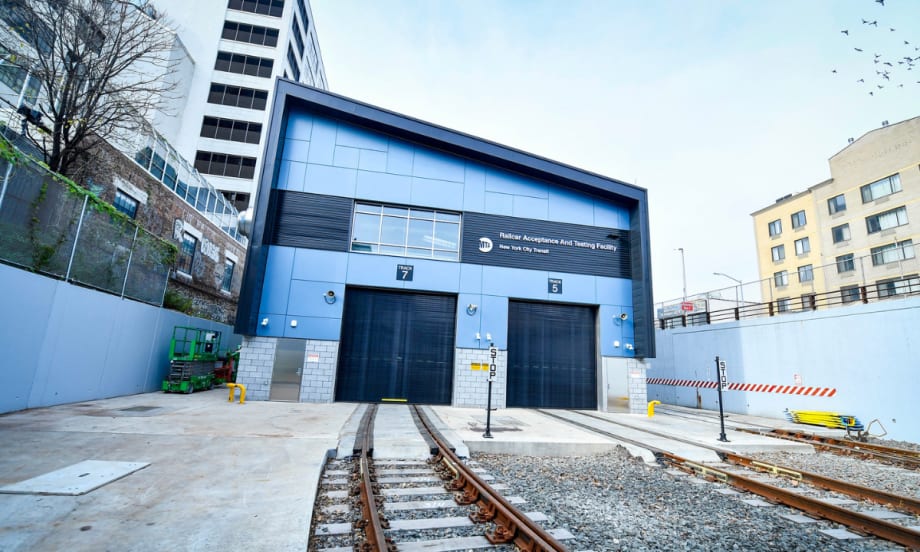
The American Council of Engineering Companies of New York recently awarded the facility the silver medal in the Transportation category at the 2026 Engineering Excellence Awards Competition.
Photo: Marc A. Hermann / MTA
3 min to read
The Metropolitan Transportation Authority (MTA) recently opened a Railcar Acceptance and Testing Facility to serve as the first stop for all new subway cars before they are put into service.
According to an agency release, this facility will help the MTA process new subway cars, work locomotives, and other rolling stock more efficiently, enabling on-site testing and quicker entry into service.
The announcement comes as the MTA prepares to receive the biggest infusion of new rail cars since systematic capital planning was first introduced more than a generation ago.
“Thanks to funding from congestion pricing and the MTA’s 2025-29 Capital Plan, we are making generational upgrades to our subway fleet,” New York Governor Kathy Hochul said. “By streamlining the process needed to get these new cars on the rails and into service, this new facility will ensure that riders feel the benefits of a new and improved subway fleet faster than ever.”
New Facility Speeds Subway Car Testing and Delivery
Located near the South Brooklyn Marine Terminal in Sunset Park, the facility can accept rolling stock delivered by truck, rail, or boat. Once accepted, individual cars will be linked together for testing and commissioning on the facility’s in-house tracks.
The newly created trains will then be sent via the facility’s direct connection to the subway network for further testing and will enter revenue service once they pass final inspection.
“With streamlined inspections and a direct connection to transit tracks, NYC Transit has never been more prepared to keep up with the historic 2025-29 Capital Plan and the unprecedented investment it provides in rolling stock,” said New York City Transit President Demetrius Crichlow.
This is the first brand-new, full-scale subway car facility on a new property added by the MTA since the Pitkin Yard opened in Brooklyn in 1948.
“Our historic $11 billion investment in rolling stock calls for a top-of-the-line new testing facility,” MTA Chair and CEO Janno Lieber said. “Now we’re ready to start processing the 1,500+ rail cars included in the Capital Plan, no matter how they’re delivered — by land or by water.”

The newly created trains will then be sent via the facility’s direct connection to the subway network for further testing and will enter revenue service once they pass final inspection.
Photo: Marc A. Hermann / MTA
“This facility consolidates work that was once spread amongst different yards and unites it all under one roof,” said MTA Construction and Development President Jamie Torres-Springer. “It’s another example of the MTA delivering a critical project on time and under budget to improve subway reliability for decades to come.”
The American Council of Engineering Companies of New York recently awarded the facility the silver medal in the Transportation category at the 2026 Engineering Excellence Awards Competition.
On-Time, Under-Budget Build Supports Fleet Upgrade
The Railcar Acceptance and Testing Facility was completed within its three-year timeline and $5.5 million under budget, with the MTA realizing savings through prefabricated building components and precast concrete for the track pit construction, “speeding the project’s completion and minimizing cost.”
The opening of the facility comes as the MTA is actively buying hundreds of modern R211 and R268 subway cars that will eventually replace all R46 and R68 subway cars, which have been in service for decades.
The $68 billion 2025-29 Capital Plan includes the purchase of 1,500 new subway cars, which is the largest new investment in rolling stock since the 1980s. Approximately 750 new R211 cars are being delivered, with another 860 still to arrive.
The R211 is currently in service on the Staten Island Railway, as well as the A, B, C, and G lines.
More Rail

New York MTA Advances Final Contract for Second Avenue Subway Expansion
Contract Four is the largest in the Second Avenue Subway Phase 2 project and includes construction of station infrastructure, tracks, and signals for the subway expansion, MTA officials said. Work on Contract Four will begin in 2027.
Read More →
San Diego MTS Breaks Monthly Trolley Ridership Record
Agency officials said July’s ridership indicates MTS’s continued recovery from the pandemic.
Read More →
Report Examines NJ TRANSIT Reliability, Funding Challenges
The Garden State Initiative analysis examines the roles of Amtrak infrastructure, fleet management, and agency operations while recommending a more performance-based approach to improving reliability.
Read More →
Stadler, CapMetro Sign Long-Term Rail Fleet Support Agreement
Beginning in 2027, Stadler will provide on-site technical expertise, spare parts support, training, and obsolescence management to help extend the reliability and longevity of CapMetro’s GTW fleet.
Read More →
Biz Briefs: Alstom Lands Canadian Contract, LYT to Supply California TSP, and More
In METRO's latest installment, we take a look at recent news from Complete Coach Works, Beep, FlixBus, and more partnerships making headlines across the transportation sector.
Read More →
CATS Gold Line Marks 5 Years of Service, 2.8M Passenger Trips
With a six-mile expansion planned, the Charlotte streetcar is positioned to connect more neighborhoods and major transit hubs across the region.
Read More →
Why Simulating Pedestrian Movement Has Become Essential for Modern Rail Stations
Pedestrian microsimulation is helping rail planners identify bottlenecks, test station designs, and prepare complex transit hubs for growing passenger volumes.
Read More →
Amtrak Begins Major Construction at New York’s Sunnyside Yard
The new maintenance facility will support Amtrak’s Airo trainsets while improving maintenance efficiency and turnaround times in New York.
Read More →
Chicago Leaders Unveil Plans for O’Hare Airport Express Train
The privately developed project would offer a 15-minute trip between downtown and O’Hare’s Terminal 2, with trains operating every 15 minutes on a dedicated track. The service would use battery-electric trains and three existing freight rail rights-of-way.
Read More →
OCTA Maps Out 30-Year Strategy to Protect Coastal Rail Corridor
The draft feasibility report identifies strategies to protect the coastal rail line for decades as the agency continues near-term stabilization and sand placement efforts.
Read More →