



NTSB: Lack of oversight, sleep-deprived driver led to 2016 Calif. bus crash
A motorcoach operated by Fresno-based Autobuses Coordinados USA Inc., traveling from Los Angeles to Modesto on State Route 99, drifted out of its travel lanes, striking a barrier system and a highway signpost shortly after 3 a.m., Aug. 2, 2016, near Livingston, Calif.

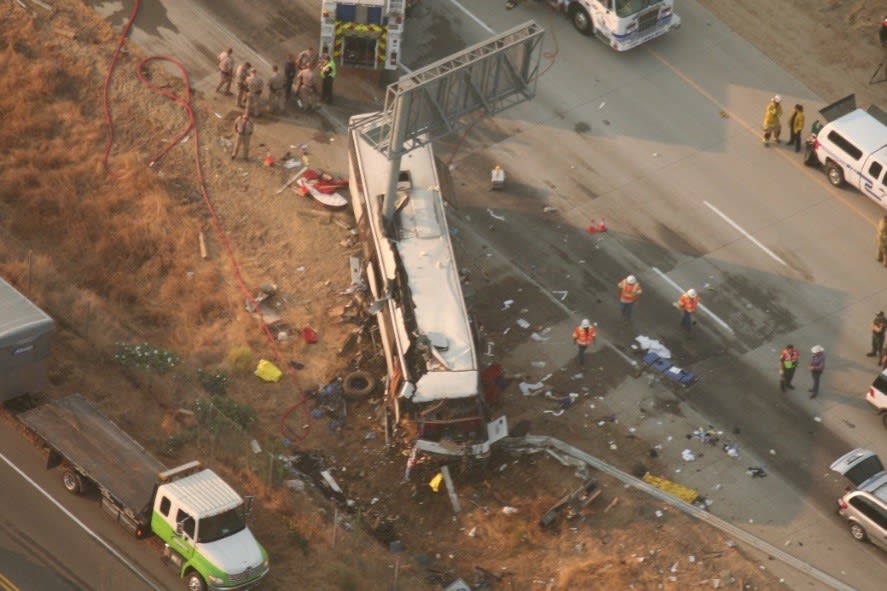
Aerial view of SR-99 northbound lanes, showing motorcoach at final rest and impact damage caused by 14-inch-diameter signpost penetrating two-thirds of vehicle, from front to back. (Photo: California Highway Patrol)
Aerial view of SR-99 northbound lanes, showing motorcoach at final rest and impact damage caused by 14-inch-diameter signpost penetrating two-thirds of vehicle, from front to back. (Photo: California Highway Patrol)
A sleep-deprived driver operating a motorcoach during early morning hours on a California highway caused a crash that killed four of the 24 passengers, the National Transportation Safety Board said in a report released this week.
“Here’s yet another fatal crash involving both a motorcoach carrier with a starkly evident history of safety problems and a severely fatigued driver,” said NTSB Chairman Robert L. Sumwalt. “It’s time that the Federal Motor Carrier Safety Administration (FMCSA) move more aggressively to keep these unsafe carriers off American roadways.”
A motorcoach operated by Fresno-based Autobuses Coordinados USA Inc., traveling from Los Angeles to Modesto on State Route 99, drifted out of its travel lanes, striking a barrier system and a highway signpost shortly after 3 a.m., Aug. 2, 2016, near Livingston, Calif. The crash forces resulted in the signpost entering the passenger compartment and tearing through almost the entire length of the vehicle. The surviving passengers received serious-to-minor injuries.
Investigators determined the driver, who was seriously injured, had only about five hours of opportunity for sleep in the 40 hours preceding the crash, leaving him in a state of “acute sleep loss” at the time of the crash. There were no tire marks or other indication the driver took any action to avoid the barrier after the motorcoach drifted out of its travel lane.
According to FMCSA records Autobuses Coordinados vehicles failed eight of 29 federal inspections in just under two years, pushing its out-of-service rate to 38%, almost five times greater than the national average of 8%.
After determining that inadequate safety practices of Autobuses Coordinados and the FMCSA’s lack of oversight of contributed to the crash, the NTSB called on the FMCSA to change its motor carrier safety rating system to ensure carriers with serious safety issues either mitigate those risks or be placed out of service.
In its report the NTSB cited two 2011 motorcoach crashes it investigated that also occurred during early morning hours involving sleep-deprived drivers — a 15-fatality crash in New York City at 5:38 a.m., and a four-fatality crash in Doswell, Va., at 4:55 a.m. — and said those driving during early morning hours, when human performance is often degraded, present a unique risk to safety. To address that risk the NTSB reiterated an earlier recommendation that the FMCSA incorporate scientifically based fatigue mitigation strategies into hours-of-service regulations for passenger-carrying drivers operating overnight.
The NTSB also determined that the guardrail, which did not prevent the motorcoach from colliding with the signpost, and was not designed to do so, contributed to the severity of the crash.
The NTSB also issued two new recommendations aimed at developing risk-based guidelines to determine where high-performance barrier systems should be installed to shield heavy vehicles, such as motorcoaches, from roadside obstacles and hazards.
More Motorcoach

METRO Opens Submissions for 2026 Motorcoach Awards
Nominations are now being accepted for METRO Magazine’s Operator of the Year and Innovative Operator of the Year awards.
Read More →
Biz Briefs: Alstom Lands Canadian Contract, LYT to Supply California TSP, and More
In METRO's latest installment, we take a look at recent news from Complete Coach Works, Beep, FlixBus, and more partnerships making headlines across the transportation sector.
Read More →
Biz Briefs: RIPTA Unveils New Frontrunners, Clevland RTA Adds New Siemens, and More
In METRO's latest installment, we take a look at recent news from Siemens, Prevost, Dodge, and more partnerships making headlines across the transportation sector.
Read More →
People Movement: Holly Arnold Joins Transdev and More
In this edition, we also cover recent appointments and announcements at Pace, CamTran, MCI, and more, showcasing the individuals helping to shape the future of transportation.
Read More →
ABA Report: Motorcoach Travel Generates $161.6B Economic Impact
The 2025 analysis finds motorcoach travel supported nearly 900,000 jobs and generated $28 billion in federal, state, and local taxes.
Read More →
CharterUP’s Armir Harris on Technology, AI, and the Future of Group Mobility
In a recent episode of METROspectives, CharterUP Founder/CEO Armir Harris discussed the company’s evolution from an online charter bus marketplace into a technology platform supporting public- and private-sector mobility and much more.
Read More →
People Movement: ABC Names John Walsh as Chief Commercial Officer
In this edition, METRO also covers recent appointments and announcements at the DART, STV, and more, showcasing the individuals helping to shape the future of transportation.
Read More →
From Surviving to Thriving: Building Stronger Transportation Organizations
Bus Business Consultants founder Brian Dickson shares lessons on leadership, organizational health, and creating options for long-term success in a changing transportation industry.
Read More →
Biz Briefs: Luminator Marks Milestone and More
From manufacturers and suppliers to transit agencies and motorcoach operators, these updates offer a snapshot of the projects, partnerships and business moves driving the industry forward.
Read More →
ABAF Study Reveals Growing Insurance Crisis for Motorcoach Operators
Preliminary findings show 98% of operators faced premium increases over the past five years, while shrinking insurer participation is putting added pressure on businesses and customers.
Read More →