Following entry into a tolling agreement with the FHWA, congestion pricing could begin up to 310 days later, during which contractors would design, build, test and activate tolling equipment.
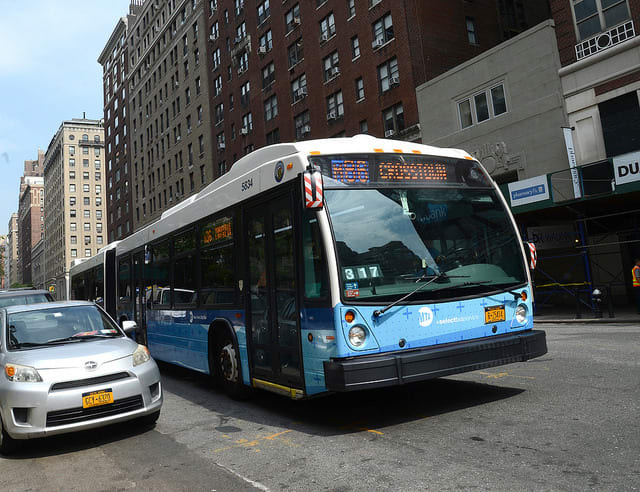
Local bus speeds have declined 28% in the Central Business District since 2010 and Select Bus Service in Manhattan is 19% slower than Select Bus Service in other boroughs.
Photo: Marc A. Hermann
5 min to read
New York Gov. Kathy Hochul announced that the Metropolitan Transportation Authority, New York State Department of Transportation, and New York City Department of Transportation released the Final Environmental Assessment for the Central Business District Tolling Program and a draft "Finding of No Significant Impact," prepared by the Federal Highway Administration (FHWA).
"This is a significant milestone, bringing us closer to a future where New Yorkers have cleaner air, better public transit, and less traffic clogging our streets," Gov. Hochul said. "This program is critical to New York City's long-term success, ensuring our commuters and businesses are able to grow and thrive."
Ad Loading...
The release of the documents begins a 30-day period in which they are formally available for public review. After the 30 days elapse, the FHWA will make its final decision, completing its review of the potential environmental effects of allowing the Central Business District Tolling Program, or more popularly known as congestion pricing.
Following entry into a tolling agreement with the FHWA, tolling could begin up to 310 days later, during which contractors would design, build, test and activate tolling equipment.
During that period, a six-member Traffic Mobility Review Board (TMRB) would develop recommended toll rates along with any potential discounts, crossing credits, and/or exemptions. The recommendation would be presented to the MTA board acting in its legal capacity as the board of the Triborough Bridge and Tunnel Authority, the MTA agency that would collect the tolls.
Following the filing and publication of a proposed tolling structure and a public comment period, the MTA would hold a public hearing before any tolling structure is adopted.
"Congestion pricing means less traffic, safer streets, cleaner air, more economic opportunity, and better transit," said MTA Chair/CEO Janno Lieber.
Ad Loading...
Background on the Central Business District Tolling Program
The Central Business District Tolling Program was mandated by the State in April 2019 and modeled on urban congestion pricing programs around the world to reduce traffic congestion and raise needed revenue to improve public transportation. The program would charge vehicles a toll for traveling in Manhattan south of and inclusive of 60th Street, excluding through-traffic on the Franklin D. Roosevelt Drive, West Side Highway, Battery Park Underpass, and roadway portions of the Hugh L. Carey Tunnel connecting to West Street.
Congestion Pricing Benefits
Across the 28-county area studied in the environmental review, the assessment finds that of those who commute to work in Manhattan's Central Business District (CBD), only 11% drive and 85% use public transportation. By reducing congestion and creating revenue for public transportation, the program would benefit millions of people every day. Through the new package of mitigations, the program will also significantly invest in air quality in environmental justice communities.
Following entry into a tolling agreement with the FHWA, tolling could begin up to 310 days later, during which contractors would design, build, test and activate tolling equipment.
Photo: C&J Bus
Less traffic congestion
New York is among the most congested cities in the U.S. Congested streets slow down buses, delay delivery services, raise the cost of doing business, and degrade quality of life.
The Environmental Assessment estimates a roughly 15% to 20% reduction in the number of vehicles entering the Central Business District, or about 110,000 to 143,000 fewer vehicles daily, about as many as enter Manhattan on the Brooklyn Bridge today.
New York City buses serve a greater share of low-income and minority households compared to other modes of transportation, including subways. Local bus speeds have declined 28% in the Central Business District since 2010 and Select Bus Service in Manhattan is 19% slower than Select Bus Service in other boroughs. While ongoing MTA initiatives such as the bus network redesigns have shown improvement in speeds, congestion pricing would not only improve travel times for bus service, but also paratransit service.
Ad Loading...
A more equitable, accessible transit system
The program would generate net revenues sufficient to leverage $15 billion for the MTA's 2020-2024 Capital Program, which includes transformational projects.
The MTA's transit system, and particularly the bus network, promotes equity by serving low-income and minority communities. The funding would allow the MTA to progress on its aggressive timeline of completing accessibility improvements, along with performing necessary state-of-good repair work to the more-than-a-century old transit system.
A healthier, more sustainable future
Congestion pricing would improve overall regional air quality with one of the most comprehensive plans the region has implemented to support a greener future. The environmental assessment found in all tolling scenarios an overall decrease in vehicle-miles traveled in the Central Business District and region overall, and that the program would encourage some commuters to shift from their vehicles to transit.
Outreach and Community Engagement Unprecedented in Scope
Over the course of the environmental review process, the Project Partners held 19 early outreach sessions, of which nine were focused on environmental justice communities, 10 meetings with Environmental Justice Technical Advisory and Stakeholder Working Groups, and six public hearings after the release of the draft Environmental Assessment in August 2022. Nearly 950 speakers participated in early outreach sessions and public hearings, combined. Additional meetings were held separately for elected officials, community boards, transit and environmental advocates, and other interested parties.
The MTA and two departments of transportation received and responded to more than 22,000 individual comments and more than 55,000 form submissions. There were more than 25,000 views cumulatively of online videos of the public hearings.
Ad Loading...
The Environmental Assessment's Study Area
Incorporating and documenting all public input, the Final Environmental Assessment analyzes the impact of Central Business District Tolling on traffic congestion, transit, air quality, and numerous other environmental indicators in 28 counties across New York, New Jersey, and Connecticut. The Study Area contains 22 million people, including 12.3 million residents residing in environmental justice communities, and five Tribal Nations.
The Environmental Assessment assesses impacts to traffic and public transportation for a regional transportation network with 28.8 million journeys per average weekday, 61,000 highway linkage points, 4,600 traffic analysis zones, 44,267 bus stops or transit stations, 4,170 transit routes, and more than a dozen public transportation providers in addition to the MTA, including NJ TRANSIT, PATH, ferries, and regional bus systems including Westchester County Bee-Line, NICE, and Suffolk County Transit.
Contract Four is the largest in the Second Avenue Subway Phase 2 project and includes construction of station infrastructure, tracks, and signals for the subway expansion, MTA officials said. Work on Contract Four will begin in 2027.
The new regional transit authority appointed its first board chair and interim executive director while extending reduced fares across CTA, Metra, and Pace for eligible riders.
Reliability-Centered Maintenance helps transit agencies move beyond routine checklists to focus limited resources on the assets and failures that have the greatest impact on safety, reliability, and service.
The 90-day demonstration will deploy coordinated security teams at five light rail stations while testing controlled access and gathering data to guide future investments.
Learn about delivering 1300 gates at 91 stations while managing fare evasion. Explore the large scale deployment, solution customization and real-world results that affect the region. Prepare for deployment in your region now.
Between packed transit stations and team motorcoaches, see how agencies and operators across North America tackled the transportation demands of the 2026 FIFA World Cup.
The stopgap keeps federal transportation programs moving, but missing advance funding could complicate the transit and rail projects agencies are planning next.