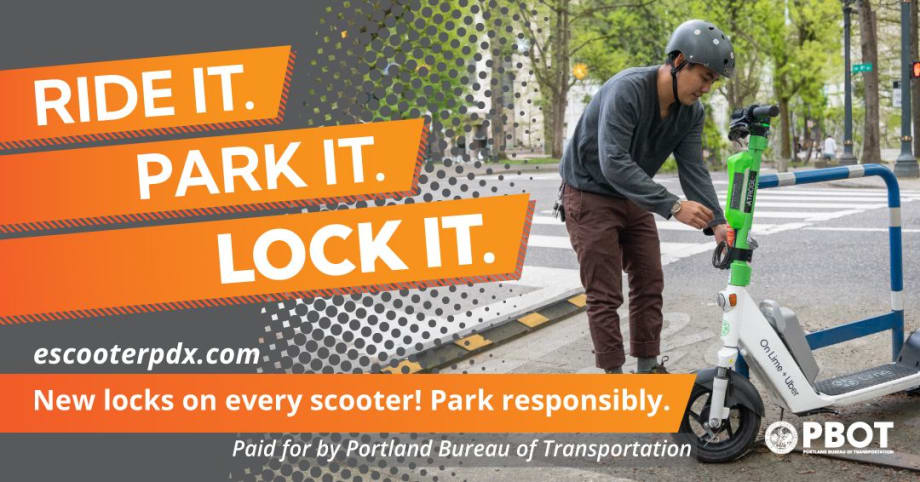
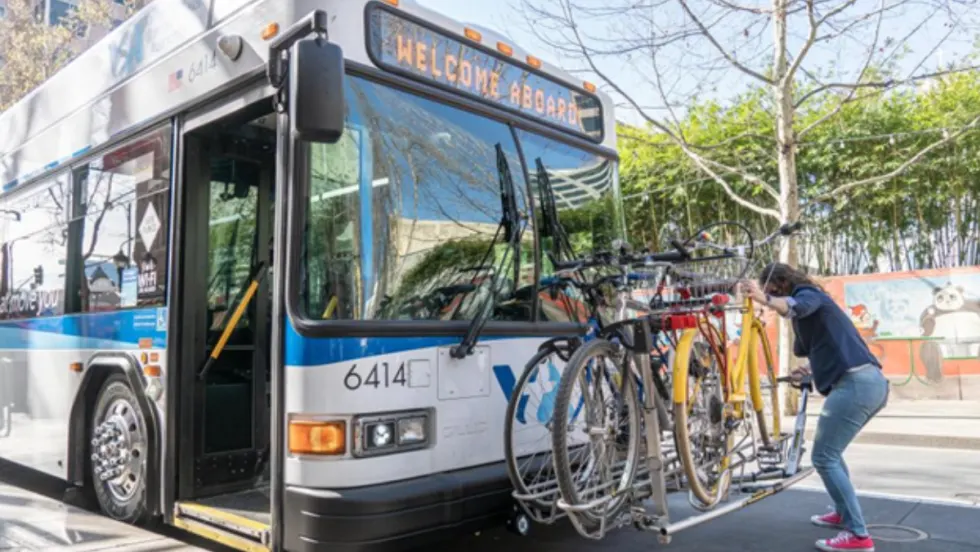
This image shows the advertisement planned for display on TriMet buses.
Photo: PBOT
3 min to read
Oregon’s Portland Bureau of Transportation (PBOT) announced new partnerships designed to make shared e-scooters a permanent part of the city's transportation environment, with more options and more accessible service than ever before.
After a competitive process, PBOT awarded multiyear contracts to Lyft and Lime to provide up to 3,500 e-scooters combined among the two companies.
Ad Loading...
PBOT’s Scooter Agreement
The public-private partnership requires the companies to deploy scooters across the city each day, to make sure Portlanders don't have to go far to find a ride.
PBOT also requires Lyft and Lime to provide scooters with seats, a feature that makes them more accessible for people who may not be comfortable riding a conventional scooter that requires standing.
The companies are also required to offer discounts for people living on low incomes. Discounts are available through the Lime Access and BIKETOWN's Community Pass programs.
New Safety Measures
A new locking requirement will make sure every e-scooter has a built-in locking mechanism. All e-scooter riders will be required to end their trip by locking the device to a bike rack, signpost, or BIKETOWN station (BIKETOWN scooters only).
The requirement should reduce the instances of scooters blocking sidewalks or corner ramps, said PBOT officials. A public information campaign and centralized dispatch number will make it easy for the public to report e-scooters that are blocking the sidewalks.
Ad Loading...
PBOT’s hope is to make shared e-scooters and shared e-bikes — known as “micromobility” — reliable, accessible, and sustainable options for transportation now and in the future, PBOT Director Millicent Williams said.
“Portlanders have long embraced biking, walking, and public transit, and since the end of the pandemic, we have seen them embrace shared e-bikes and shared e-scooters at record levels,” Williams said. "We’re supporting these sustainable transportation options with our growing network of over 400 miles of bikeways and by committing to a permanent program for shared e-scooter service."
PBOT’s Public Education Campaign
PBOT also launched a public education campaign to help Portlanders understand the new rules for riding e-scooters.
"Ride it, Park it, Lock it" will be featured on TriMet buses and benches from August through October and also on social media.
PBOT designed the campaign and paid for the ads with revenue from the e-scooter program, which is funded by fees charged to e-scooter companies and riders.
Ad Loading...
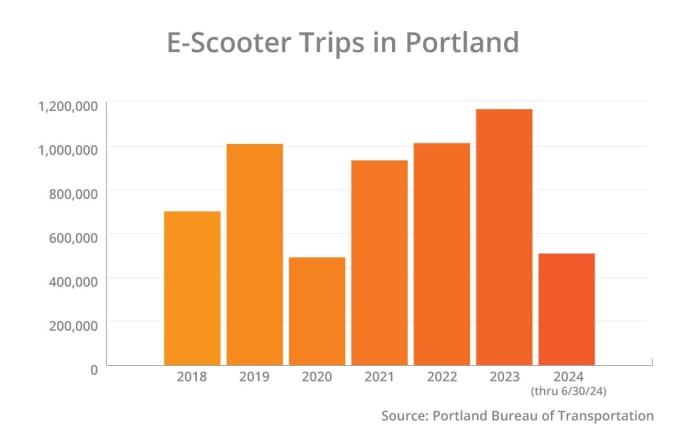
This chart shows the annual totral e-scooter trips growing since 2018, except during the pandemic in 2020 when all transportation use declined. Annual e-scooter trips in Portland rose to a record 1.1 million in 2023.
Photo: PBOT
Path to New Partnership
PBOT first piloted shared e-scooters for four months in 2018.
During the pilot, users took around 700,000 trips on 2,000 e-scooters from multiple operators. Data on these rides showed how trips by e-scooter replaced driving and ride-hailing trips. It drew more people to active transportation as well, with scooter riders preferring to use low-speed streets and bike lanes.
PBOT piloted e-scooters again in April 2019, extending the pilot through the pandemic until summer 2024 when the new permanent program launched.
In that time, Portlanders and visitors rented e-scooters over 5.8 million times. PBOT has used this wealth of data to assess whether e-scooters can help reduce congestion and air pollution and expand access for underserved Portlanders.
The proposed agreement calls for a 50% increase in bus service in Everett, a new microtransit zone, continued paratransit service, and the transfer of Everett Transit operations to Community Transit.
CEO Magnus Friberg discusses Luminator’s shift toward becoming a digital partner, the growing importance of software and interoperability, and how AI can help agencies improve operations and passenger experience.
In METRO's latest installment, we take a look at recent news from Complete Coach Works, Beep, FlixBus, and more partnerships making headlines across the transportation sector.
In a recent episode of METROspectives, CharterUP Founder/CEO Armir Harris discussed the company’s evolution from an online charter bus marketplace into a technology platform supporting public- and private-sector mobility and much more.
Through its NAVI program, JTA is showing how autonomous vehicles, intelligent infrastructure, and coordinated operations can work together to deliver everyday public transportation.
From manufacturers and suppliers to transit agencies and motorcoach operators, these updates offer a snapshot of the projects, partnerships and business moves driving the industry forward.
Former LA Metro Chief Innovation Officer Joshua Schank discusses why good ideas aren't enough, how transit agencies can overcome resistance to change, and why today's challenges demand more innovation.
From manufacturers and suppliers to transit agencies and motorcoach operators, these updates offer a snapshot of the projects, partnerships and business moves driving the industry forward.