



Record 10.8 billion trips taken on public transit in 2014
Annual public transit ridership, the highest number in 58 years, increased even when gas prices declined by 42.9 cents in the fourth quarter.

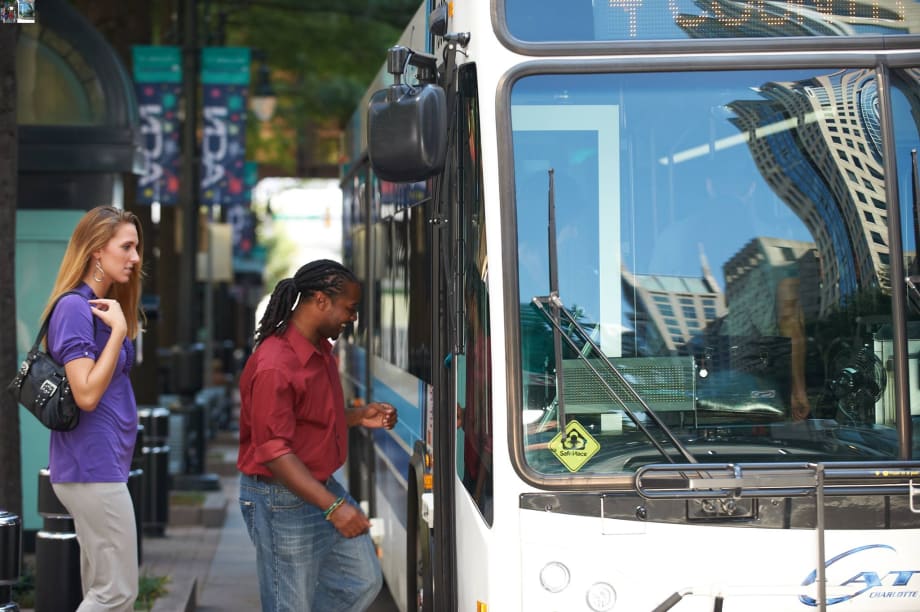
CATS Charlotte Area Transit System
CATS Charlotte Area Transit System
Americans took 10.8 billion trips on public transportation in 2014, which is the highest annual public transit ridership number in 58 years, according to a report released Sunday by the American Public Transportation Association (APTA).
"In 2014, people took a record 10.8 billion trips on public transportation — the highest annual ridership number in 58 years," said Phillip Washington, APTA chair and CEO/GM of the Regional Transportation District in Denver. "Some public transit systems experienced all-time record high ridership last year. This record ridership didn't just happen in large cities. It also happened in small and medium size communities."
Some of the public transit agencies reporting record ridership system-wide were located in the following cities: Albany, N.Y.; Boston; Canton, Ohio; Columbus, Ohio; Denver; Indianapolis; Madison, Wis.; Minneapolis; Olympia, Wash.; Orlando, Fla.; St. Petersburg, Fla.; Riverside, Calif.; Salt Lake City; San Francisco; Seattle; Spokane, Wash.; Tampa, Fla.; and Wenatchee, Wash.
RELATED:Super Bowl contributes to record Valley Metro ridership
Noting that public transit ridership increased even when gas prices declined by 42.9 cents in the fourth quarter, APTA President/CEO Michael Melaniphy said, "Despite the steep decline in gas prices at the end of last year, public transit ridership increased. This shows that once people start riding public transit, they discover that there are additional benefits besides saving money."
"People are changing their travel behavior and want more travel options," said Melaniphy. "In the past people had a binary choice. You either took public transit, most likely a bus, or you drove a car. Now there are multiple options with subways, light rail, streetcars, commuter trains, buses, ferries, cars and shared use vehicles."
Another reason behind the ridership increases is the economic recovery in certain areas. For example, Atlanta, San Francisco, Minneapolis, Seattle, and Champaign-Urbana (Ill.) were some cities that saw increased ridership in part because of an improved job market.
RELATED:Public transportation users save $9,238 annually
"Since nearly 60 percent of the trips taken on public transportation are for work commutes, public transportation ridership increases are seen in areas where the local economy is growing," said Melaniphy.
"Expanded and improved public transit services also played a role in attracting more riders," said Melaniphy. "For example, the transit agencies in Albany (N.Y.), Denver, Indianapolis, Riverside (Calif.), and Salt Lake City saw increased ridership due to greater service."
From 1995 to 2014 public transit ridership increased by 39%, almost double the population growth, which was up 21%. The estimated growth of vehicle miles traveled (VMT) was 25%. (It is estimated because the December VMT has not yet been posted by the Federal Highway Administration.)
Pointing out that the current federal surface transportation bill expires on May 31, Melaniphy said, "The record ridership in 2014 is a clear message to Congress that the citizens of this country want expanded public transit services. Congress needs to work together now to pass a long-term, well-funded surface transportation bill that invests in our country's public transit infrastructure. This is critical not only to the millions of Americans who use public transportation, but is also crucial for our country's economic competitiveness."
2014 Ridership Breakdown
Light rail (modern light rail, streetcars, trolleys, and heritage trolleys) ridership increased 3.6% in 2014 with 16 out of 28 public transit systems reporting increases. Light rail in Minneapolis showed a significant increases of 57.4% due to the opening of the METRO Green Line in Minneapolis. Light rail ridership in Oceanside, Calif. increased by 36% due to the system being shut down for several months in 2013. Four light rail systems saw double digit increases in 2014 in the following cities: Houston (17.9%); San Diego (15.3%); Denver (12.0%); and Seattle -Sound Transit (11.7%). Light rail ridership in the following cities also saw increases in 2014: San Francisco (7.2%); Salt Lake City (6.0%); Hampton, Va. (5.4%); New Orleans (5.3%); San Jose, Calif. (4.4%); Newark, N.J. (3.4%); Dallas (3.2%); and Charlotte, N.C. (3.1%).
Heavy rail (subways and elevated trains) ridership increased by 3.3% across the country as 8 out of 15 public transit systems reported increases. Heavy rail systems with increases in ridership for 2014 were in the following cities: San Francisco (6.1%); Boston (4.9%); Chicago (4.1%); New York -MTA NYC Transit (4.0%); New York -MTA Staten Island Railway (3.5%); Atlanta (2.3%); and Miami (2.1%).
Nationally, commuter rail ridership increased by 2.9 percent in 2014 as 22 out of 28 public transit systems reported increases. Four commuter rail systems saw double digit increases in 2014 in the following cities: Salt Lake City (16.2%); Stockton, Calif. (15.7%); Seattle -Sound Transit (10.4%); and San Carlos, Calif. (10.1%). Ridership in the following cities also saw increases in 2014: Lewisville, Texas (9.3%); Dallas-Ft. Worth (6.9%); Newark, N.J. (5.4%); Anchorage, Alaska (5.4%); Portland, Ore. (4.7%); Nashville, Tenn. (4.4%); Boston (3.5%); Oceanside, Calif. (3.5%); Oakland, Calif. (2.5%); and Baltimore, Md. (2.2%).
Bus ridership decreased nationally by 1.1%. However, in small and medium size population groups, bus ridership saw percentage increases of 2.0 and 0.5 respectively. The following cities showed the highest large bus ridership increases in 2014: Baltimore, Md. (6.8%); Portland, Ore. (5.3%); Oakland, Calif. (4.2%); San Francisco (3.9%); Columbus, Ohio (3.0%); Atlanta (2.8%); San Diego (2.4%); and Seattle -King County DOT (2.0%).
Demand response (paratransit) ridership increased in 2014 by 0.2%. Trolleybus ridership declined by 2.8% in 2014.
To see the complete APTA 2014 ridership report, go to: http://www.apta.com/resources/statistics/Documents/Ridership/2014-q4-ridership-APTA.pdf
More Management
People Movement: Dan Dipert Coaches Adds Third-Generation Leader, Keolis Names New Valley Metro VP/GM, and More
In this edition, we also cover recent appointments and announcements at the Wabtec, SilverRide, HNTB, and more, showcasing the individuals helping to shape the future of transportation.
Read More →
METRO Opens Submissions for 2026 Motorcoach Awards
Nominations are now being accepted for METRO Magazine’s Operator of the Year and Innovative Operator of the Year awards.
Read More →
New York MTA Advances Final Contract for Second Avenue Subway Expansion
Contract Four is the largest in the Second Avenue Subway Phase 2 project and includes construction of station infrastructure, tracks, and signals for the subway expansion, MTA officials said. Work on Contract Four will begin in 2027.
Read More →

Transit Agencies Highlight Safety Gains at National Summit
Leaders from 15 major transit systems shared crime-reduction results and safety initiatives while discussing the role of continued federal support.
Read More →
NITA Names New Leadership, Expands Reduced-Fare Program at First Board Meeting
The new regional transit authority appointed its first board chair and interim executive director while extending reduced fares across CTA, Metra, and Pace for eligible riders.
Read More →
Beyond the Checklist: A Structured Approach to Transit Maintenance
Reliability-Centered Maintenance helps transit agencies move beyond routine checklists to focus limited resources on the assets and failures that have the greatest impact on safety, reliability, and service.
Read More →
APTA 2026 Nominating Committee Selects Leadership Slate, Names Chair and Vice Chair Nominees
Leadership changes will help shape the association’s priorities and its representation of the transportation industry during the 2026–2027 term.
Read More →
DART Launches Major Security, Fare Enforcement Initiative
The 90-day demonstration will deploy coordinated security teams at five light rail stations while testing controlled access and gathering data to guide future investments.
Read More →
Advancing Fare Collection Through Technology and Innovation
Learn about delivering 1300 gates at 91 stations while managing fare evasion. Explore the large scale deployment, solution customization and real-world results that affect the region. Prepare for deployment in your region now.
Read More →
Game Day in Motion: Moving Millions During the 2026 World Cup
Between packed transit stations and team motorcoaches, see how agencies and operators across North America tackled the transportation demands of the 2026 FIFA World Cup.
Read More →