




RELATED: Law enforcement keeps crime levels down on LA Metro
The car remains king in L.A. despite growing public transit options
Survey finds a perceived lack of safety and convenience are dissuading people from using public transportation.
February 20, 2020
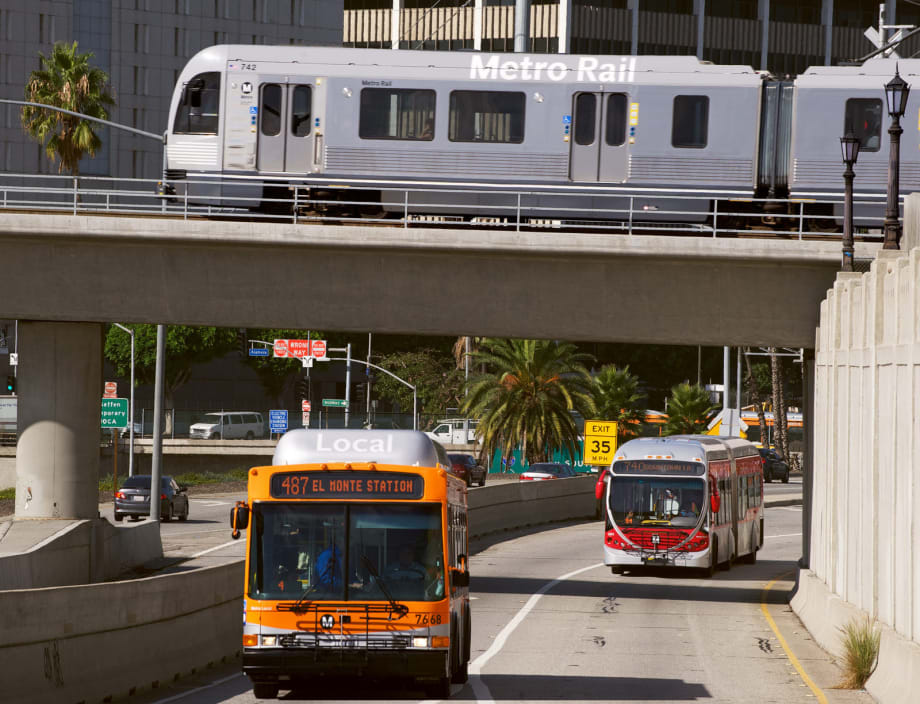
A new survey finds a perceived lack of safety and convenience are dissuading people from using public transportation in Los Angeles County. LA Metro
5 min to read
A new survey finds a perceived lack of safety and convenience are dissuading people from using public transportation in Los Angeles County. LA Metro
Despite Los Angeles County’s legendary traffic jams, residents remain wedded to their cars and reluctant to use public transportation due to concerns over safety and convenience, according to the new USC Dornsife/Union Bank LABarometer mobility survey. But in identifying specific concerns, the survey, also pointed to potential solutions for increasing use of public transportation.
Private vehicles are used at more than twice the rate of the second-most popular transportation mode, ride-hailing (e.g. Lyft and Uber). Respondents considered personal vehicles the safest, most convenient and enjoyable way to get around.
“This survey underscores how important the full customer service experience is, in transit and other modes,” said Marlon Boarnet, chair of the Department of Urban Planning and Spatial Analysis at the USC Sol Price School of Public Policy. “Safety and convenience are key factors that are limiting the alternatives to the car, but Los Angeles can become a city where everyone has viable alternatives to driving. The data in this study help highlight the challenges and opportunities, and help point the way forward.”
LABarometer respondents love their cars in part because they feel safer from crime. However, car users are more vulnerable to accidents: 15% of residents were involved in an accident/collision last year, most commonly while driving, according to LABarometer.
“It’s fascinating that people believe they are safer in cars than in public transit. That’s simply false. There are 40,000 deaths per year on the highways, but only a fraction of that number of deaths on mass transit. We all feel safe and comfortable with what we know—in this case, driving,” said Wendy Wood, Provost Professor of Psychology and Business at the USC Dornsife College of Letters, Arts and Sciences. Wood is also a member of the Board of Directors of the Los Angeles Metro’s Office of Extraordinary Innovation.
The mobility survey, conducted from December 11, 2019, to February 7, 2020, asked 1,400 L.A. County residents a series of questions about their transportation behaviors, experiences, and attitudes to better understand how Angelenos travel around L.A. County and why they make the transportation decisions they do. During the initial phases of survey design, the survey team consulted with transportation agencies, mobility companies and non-profit organizations to better understand key data gaps. No financial consideration was provided to the consulting entities.
Safety and Convenience Concerns
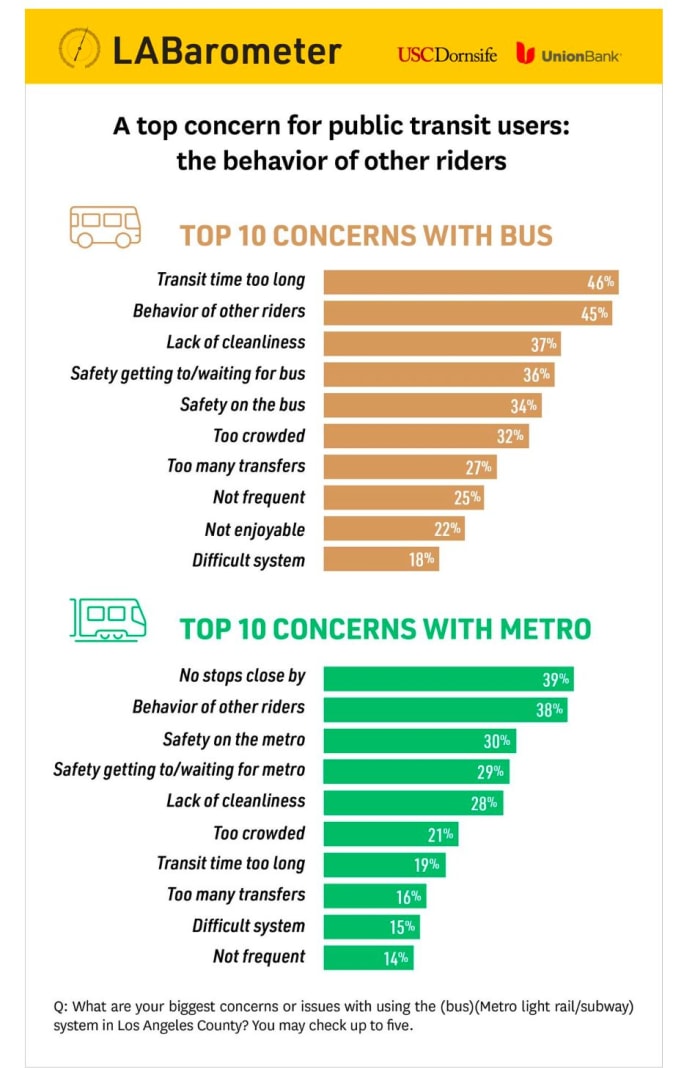
LABarometer respondents cited a variety of concerns about public transportation.
In general, residents felt slightly more secure on buses than on the Metro. The behavior of other riders was the second-biggest concern for those who use Metro and the bus. The top concern for bus riders? Long transit times. The top concern for Metro riders was a lack of nearby stops.
Cleanliness, convenience-related issues, and safety getting to or waiting at stops were top-10 concerns for each system.
In L.A., transit times are a problem for drivers and public transit users alike. Between 30-40% of residents missed an activity last year because transit times were too long or they couldn’t afford transportation. Nearly half said they missed social or leisure activities, at least occasionally, and 29% were forced to skip personal or family medical care visits because transit times were too long.
Finding Solutions
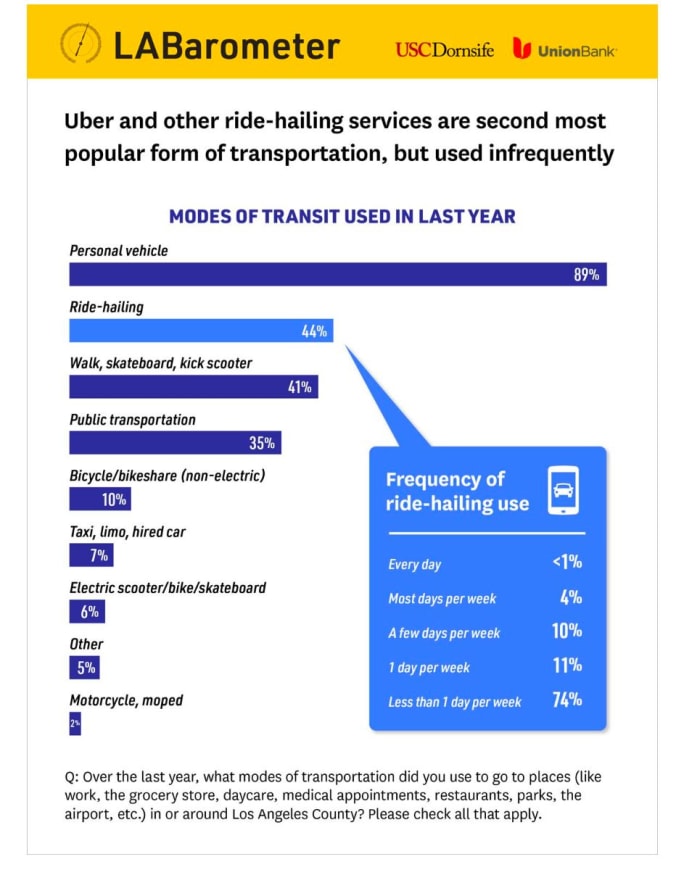
Competition from ride-hailing does not appear to be the problem for public transit, as respondents who ride-hail are more likely to use public transit than those who do not. The most frequent users of public transit – lower-income residents – are also the most frequent users of ride-hailing services.
To dig deeper and identify potential solutions, LABarometer researchers analyzed the individual circumstances and attitudes associated with increased public transit among residents.
“Our findings suggest that safety improvements could get more people on the Metro,” said Kyla Thomas, director of the LABarometer and a sociologist with the USC Dornsife Center for Economic and Social Research. “But improving convenience for daily activities is likely to get people to use the Metro more frequently, as a real substitute for the car.”
Conversely, there may be tipping points that finally persuade drivers to make greater use of public transportation.
“The habit of driving persists even when traffic becomes the nightmare that it is in L.A. today,” Wood said. “But motorists will change their habits and use more public transportation if you add some friction to driving, such as making parking more expensive or simply unavailable.”
For those who use public transit, walking is by far the most popular way to get to a bus or Metro station. Yet, the LABarometer shows that more travel-related incidents of harassment and assault are happening on our sidewalks than anywhere else, and to women more so than men. Sixteen percent of women and 5% of men said they experienced some form of sexual harassment last year while traveling. Seventy-four percent of those who experienced sexual harassment or assault reported that they were walking at the time of the incident.
Who's on scooters and e-bikes?
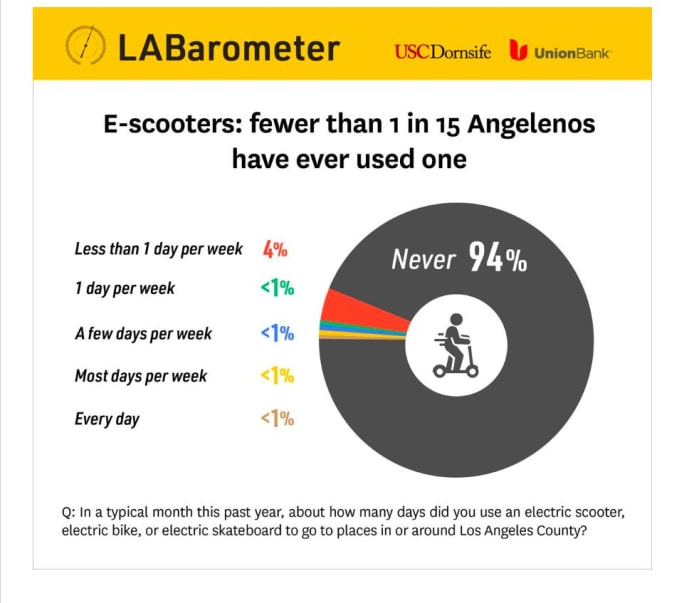
Perhaps not surprisingly, residents who use e-scooters or e-bikes are more likely to use the Metro. But despite the amount of media attention devoted to these newly arrived modes of transportation, 94% of residents said they’d never used them. Fewer than 2% of people said they used them at least once a week.
About USC Dornsife/Union Bank LABarometer
LABarometer is a quarterly, internet-based survey of Los Angeles County residents, designed and administered by the USC Dornsife Center for Economic and Social Research. The survey monitors social conditions and attitudes in Los Angeles, with a focus on four key issues: livability; mobility; sustainability and resilience; and affordability and prosperity.
More Management

METRO Opens Submissions for 2026 Motorcoach Awards
Nominations are now being accepted for METRO Magazine’s Operator of the Year and Innovative Operator of the Year awards.
Read More →
New York MTA Advances Final Contract for Second Avenue Subway Expansion
Contract Four is the largest in the Second Avenue Subway Phase 2 project and includes construction of station infrastructure, tracks, and signals for the subway expansion, MTA officials said. Work on Contract Four will begin in 2027.
Read More →
Transit Agencies Highlight Safety Gains at National Summit
Leaders from 15 major transit systems shared crime-reduction results and safety initiatives while discussing the role of continued federal support.
Read More →

NITA Names New Leadership, Expands Reduced-Fare Program at First Board Meeting
The new regional transit authority appointed its first board chair and interim executive director while extending reduced fares across CTA, Metra, and Pace for eligible riders.
Read More →
Beyond the Checklist: A Structured Approach to Transit Maintenance
Reliability-Centered Maintenance helps transit agencies move beyond routine checklists to focus limited resources on the assets and failures that have the greatest impact on safety, reliability, and service.
Read More →
APTA 2026 Nominating Committee Selects Leadership Slate, Names Chair and Vice Chair Nominees
Leadership changes will help shape the association’s priorities and its representation of the transportation industry during the 2026–2027 term.
Read More →
DART Launches Major Security, Fare Enforcement Initiative
The 90-day demonstration will deploy coordinated security teams at five light rail stations while testing controlled access and gathering data to guide future investments.
Read More →
Sponsored•September 9, 2026
Advancing Fare Collection Through Technology and Innovation
Learn about delivering 1300 gates at 91 stations while managing fare evasion. Explore the large scale deployment, solution customization and real-world results that affect the region. Prepare for deployment in your region now.
Read More →
Game Day in Motion: Moving Millions During the 2026 World Cup
Between packed transit stations and team motorcoaches, see how agencies and operators across North America tackled the transportation demands of the 2026 FIFA World Cup.
Read More →
Surface Transportation Extension Averts Shutdown, Leaves Transit Funding Gap
The stopgap keeps federal transportation programs moving, but missing advance funding could complicate the transit and rail projects agencies are planning next.
Read More →