



TheRide laying off 44 positions to maintain financial stability amidst COVID-19
he staff reductions include union and non-union employees. In addition, executive staff have voluntarily reduced their salaries.

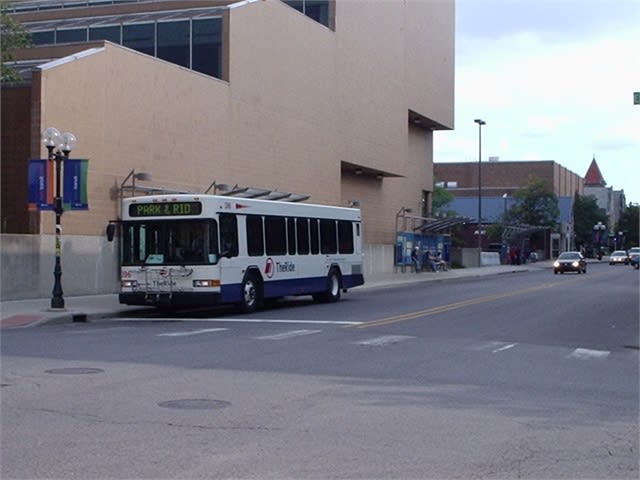
The layoffs are designed to avoid further service reductions and will enhance the ability to restore service once businesses and schools begin to reopen.
TheRide
The layoffs are designed to avoid further service reductions and will enhance the ability to restore service once businesses and schools begin to reopen.
TheRide
Mich.’s Ann Arbor Area Transportation Authority (TheRide) announced that — as part of a plan to preserve financial sustainability while ensuring public health and helping to mitigate the spread of the coronavirus — it will permanently layoff 44 positions, or 15% of its workforce. The staff reductions include union and non-union employees. In addition, executive staff have voluntarily reduced their salaries.
Due to the pandemic, TheRide has temporarily reduced fixed-route services by 70%, ridership has dropped, and the agency is not collecting fares from passengers to aid social distancing. The loss of all fare revenue is a major financial hit, representing about 15% of TheRide’s budget and $600,000 per month.
Like most transit agencies, TheRide’s largest expense is staffing costs. Since Gov. Gretchen Whitmer declared Michigan to be in a state of emergency on March 11, TheRide has kept all staff employed — office staff worked from home, frontline staff who were on the job were paid time and a half, and many staff received full pay even as they stayed at home simply because there was no work that could be done.
“This is a tremendously difficult decision, but the impacts of COVID-19 have forced us to quickly update our priorities in order to ensure we can continue to provide services in the future. There are no easy solutions — TheRide faces great uncertainty in its finances, and the economic impacts of the pandemic pose a threat to the agency’s mission in the community,” TheRide's CEO Matthew Carpenter said.
In addition to layoffs, Carpenter and the two deputy CEOs will each voluntarily reduce their salary by 10% for at least the next six months, all travel and offsite training has been canceled, and hiring is restricted. These steps and layoffs will save TheRide about $4.9 million during a full year.
The layoffs are designed to avoid further service reductions and will enhance the ability to restore service once businesses and schools begin to reopen.
The cost savings announced today, combined with TheRide’s remaining reserve funds and federal CARES Act relief funds approved by Congress “leaves the agency in a momentarily strong financial position,” Carpenter said. “However, the future remains very uncertain as we simply do not know how long these funds will need to last, whether the state government will cut its funding, what unforeseeable expenses will occur, and how much it will cost to restore services,” he said. “For all those reasons, we believe that preserving our resources now is the best strategy to ensure we can continue to meet the community’s needs in the future.”
“Going forward, we will rebuild our team along new lines and chart a sustainable course in our new circumstances,” Carpenter added. “The organization that emerges will look different from how it was before, but we will still be here to support our communities, residents, and passengers.”
More Management

METRO Opens Submissions for 2026 Motorcoach Awards
Nominations are now being accepted for METRO Magazine’s Operator of the Year and Innovative Operator of the Year awards.
Read More →
New York MTA Advances Final Contract for Second Avenue Subway Expansion
Contract Four is the largest in the Second Avenue Subway Phase 2 project and includes construction of station infrastructure, tracks, and signals for the subway expansion, MTA officials said. Work on Contract Four will begin in 2027.
Read More →
Transit Agencies Highlight Safety Gains at National Summit
Leaders from 15 major transit systems shared crime-reduction results and safety initiatives while discussing the role of continued federal support.
Read More →

NITA Names New Leadership, Expands Reduced-Fare Program at First Board Meeting
The new regional transit authority appointed its first board chair and interim executive director while extending reduced fares across CTA, Metra, and Pace for eligible riders.
Read More →
Beyond the Checklist: A Structured Approach to Transit Maintenance
Reliability-Centered Maintenance helps transit agencies move beyond routine checklists to focus limited resources on the assets and failures that have the greatest impact on safety, reliability, and service.
Read More →
APTA 2026 Nominating Committee Selects Leadership Slate, Names Chair and Vice Chair Nominees
Leadership changes will help shape the association’s priorities and its representation of the transportation industry during the 2026–2027 term.
Read More →
DART Launches Major Security, Fare Enforcement Initiative
The 90-day demonstration will deploy coordinated security teams at five light rail stations while testing controlled access and gathering data to guide future investments.
Read More →
Advancing Fare Collection Through Technology and Innovation
Learn about delivering 1300 gates at 91 stations while managing fare evasion. Explore the large scale deployment, solution customization and real-world results that affect the region. Prepare for deployment in your region now.
Read More →
Game Day in Motion: Moving Millions During the 2026 World Cup
Between packed transit stations and team motorcoaches, see how agencies and operators across North America tackled the transportation demands of the 2026 FIFA World Cup.
Read More →
Surface Transportation Extension Averts Shutdown, Leaves Transit Funding Gap
The stopgap keeps federal transportation programs moving, but missing advance funding could complicate the transit and rail projects agencies are planning next.
Read More →