



Transit Authority of River City Executive Director Barker retires
"I’m now looking forward to staying engaged in volunteer organizations, traveling and enjoying family and friends more.”


Transit Authority of River City Executive Director J. Barry Barker is retiring after nearly 25 years leading the Louisville, Kentucky-based public transportation agency.

Transit Authority of River City Executive Director J. Barry Barker is retiring after nearly 25 years leading the Louisville, Kentucky-based public transportation agency.
Transit Authority of River City Executive Director J. Barry Barker is retiring after nearly 25 years leading the Louisville, Kentucky-based public transportation agency. His last day is Nov. 30, 2018.
TARC Assistant Executive Director Ferdinand L. Risco Jr., who joined TARC in February 2017, will serve as interim executive director.
“It’s been a great ride, and I know the TARC team, along with an outstanding Board of Directors, will do great things. I’m forever grateful for the opportunity to have served TARC and our city,” Barker said. “After nearly 25 years with this great organization, I’m now looking forward to staying engaged in volunteer organizations, traveling and enjoying family and friends more.”
Risco, a U.S. Army veteran with more than 20 years of experience relating to transportation with private, public and non-profit organizations, said, “This is an exciting time at TARC with improvements underway. I’m honored to serve as Interim Executive Director and to work with Barry Barker and everyone on the TARC team.”
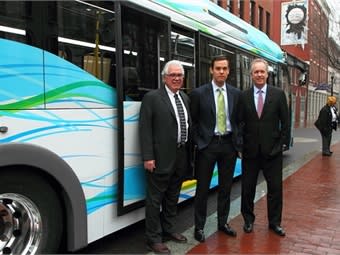
TARC Executive Director J. Barry Barker, Proterra President/CEO Ryan Popple and Mayor Greg Fischer (left to right) in a 2015 photo launching the agency's zero-emission bus fleet. Courtesy Transit Authority of River City
Before joining TARC, Risco was Executive Director of the Office of Diversity and Inclusion at Metropolitan Atlanta Rapid Transit Association.
Early next year, TARC will launch a “tap and go” electronic fare payment system on all buses and a new mobility website with start-to-finish trip planning options linking TARC, ride sharing and biking. The region’s first bus rapid transit route will begin operating in late 2019 along Dixie Highway for faster service linking downtown and southwest Jefferson County.
And in May, TARC will host the American Public Transportation Association’s 2019 Bus and Paratransit Conference, which will bring 5,000 transit industry representatives to Louisville.
Under Barker, TARC was designated in 2006 as the nation’s Urban System of the Year by the Community Transportation Association of America. The following year, Barker was recognized as the Outstanding Public Transportation Manager of the Year by the American Public Transportation Association. In 2012, the Transportation Research Board of the National Academies honored Barker with the Sharon D. Banks Award for Humanitarian Leadership in Transportation.
Locally, Barker has served on more than a dozen non-profit agency boards, including in leadership positions, and in 2010 headed Metro United Way’s annual fundraising campaign.
TARC provides 12 million passenger trips a year, with 63% of riders traveling to and from work, and another 20% on school trips.
“TARC moves the workforce of today and tomorrow, and we’re critical for people to access opportunity and all life has to offer,” Barker said. “I have always been motivated by the belief that the quality of life in our communities is only as good as it is for the least advantaged members of our communities. Access to life’s opportunities is a must if communities and individuals are to thrive. I’ve been fortunate to champion these beliefs at TARC and in the community.”
The Mayor will work with the TARC board on next steps.
More Management

METRO Opens Submissions for 2026 Motorcoach Awards
Nominations are now being accepted for METRO Magazine’s Operator of the Year and Innovative Operator of the Year awards.
Read More →
New York MTA Advances Final Contract for Second Avenue Subway Expansion
Contract Four is the largest in the Second Avenue Subway Phase 2 project and includes construction of station infrastructure, tracks, and signals for the subway expansion, MTA officials said. Work on Contract Four will begin in 2027.
Read More →
Transit Agencies Highlight Safety Gains at National Summit
Leaders from 15 major transit systems shared crime-reduction results and safety initiatives while discussing the role of continued federal support.
Read More →

NITA Names New Leadership, Expands Reduced-Fare Program at First Board Meeting
The new regional transit authority appointed its first board chair and interim executive director while extending reduced fares across CTA, Metra, and Pace for eligible riders.
Read More →
Beyond the Checklist: A Structured Approach to Transit Maintenance
Reliability-Centered Maintenance helps transit agencies move beyond routine checklists to focus limited resources on the assets and failures that have the greatest impact on safety, reliability, and service.
Read More →
APTA 2026 Nominating Committee Selects Leadership Slate, Names Chair and Vice Chair Nominees
Leadership changes will help shape the association’s priorities and its representation of the transportation industry during the 2026–2027 term.
Read More →
DART Launches Major Security, Fare Enforcement Initiative
The 90-day demonstration will deploy coordinated security teams at five light rail stations while testing controlled access and gathering data to guide future investments.
Read More →
Advancing Fare Collection Through Technology and Innovation
Learn about delivering 1300 gates at 91 stations while managing fare evasion. Explore the large scale deployment, solution customization and real-world results that affect the region. Prepare for deployment in your region now.
Read More →
Game Day in Motion: Moving Millions During the 2026 World Cup
Between packed transit stations and team motorcoaches, see how agencies and operators across North America tackled the transportation demands of the 2026 FIFA World Cup.
Read More →
Surface Transportation Extension Averts Shutdown, Leaves Transit Funding Gap
The stopgap keeps federal transportation programs moving, but missing advance funding could complicate the transit and rail projects agencies are planning next.
Read More →