




Helping Out: USDOT Awards $21M in New Thriving Communities Program Grants
USDOT Names Headquarters in Honor of Former Secretaries
The LEED-certified USDOT headquarters building is located in the Navy Yard neighborhood of Washington, D.C.
May 11, 2023
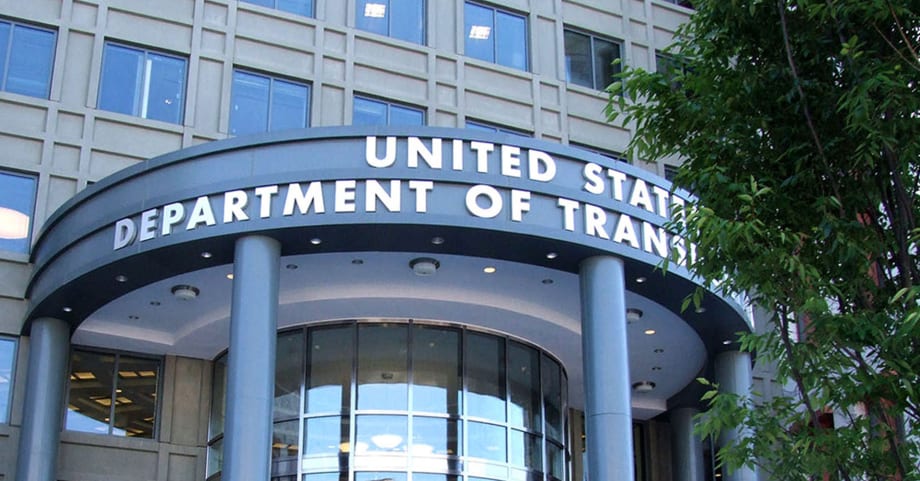
Completed in 2007, the campus includes twin buildings connected by an underground walkway.
Photo: Federal Highway Administration
3 min to read
U.S. Transportation Secretary Pete Buttigieg and U.S. General Services Administrator Robin Carnahan announced the naming of the U.S. Department of Transportation headquarters building to the William T. Coleman, Jr. and Norman Y. Mineta Federal Building.
Meaning Behind the Name
The name is dedicated to two former Secretaries of Transportation. At the event on May 10, Buttigieg and Carnahan were joined by members of the Coleman and Mineta families, as well as DOT and GSA employees, lawmakers, senior government officials, and other transportation leaders.
“Secretaries Bill Coleman and Norm Mineta were not only exemplary stewards of our nation’s transportation system, but boundary-breaking leaders who devoted their lives to the service of our country,” said Buttigieg. “It is a fitting tribute to Secretaries Coleman and Mineta that we are naming the USDOT headquarters in their honor so that their legacies continue to inspire future generations of public servants.”
Honoring Secretary Coleman, Secretary Mineta
Secretary Coleman, the first African American Secretary of Transportation and the second African American to serve in a presidential cabinet, served as the Department’s fourth secretary from 1975-1977 under President Gerald Ford.
A military veteran and a lawyer by trade, Coleman worked on civil rights cases alongside Supreme Court Justice Thurgood Marshall prior to his service as Transportation Secretary.
As Transportation Secretary, Coleman oversaw the creation of the Materials Transportation Bureau, known today as the Pipeline and Hazardous Materials Safety Administration.
Following his tenure at USDOT, Coleman returned to his legal career.
President Clinton presented Coleman with the Presidential Medal of Freedom in 1995.
Secretary Mineta, the first Asian American Transportation Secretary and the Department’s longest-serving secretary, served as the Department’s 14th secretary from 2001-2006 under President George W. Bush.
Mineta oversaw the department’s response to the Sept. 11 attacks, including making the decision to ground all flights in the National Airspace System and quickly establishing the Transportation Security Administration (TSA).
During Mineta’s long career in public service, he also served in the U.S. Army and as a U.S. Congressman from California, where he helped spearhead the fight for marriage equality and championed legislation that led to the Americans with Disabilities Act, the Voting Rights Act, and the Civil Liberties Act.
Before his service as Transportation Secretary, Mineta also served as Commerce Secretary under President Clinton, making him the first Asian American to hold a cabinet post.
Where is the HQ?
The LEED-certified USDOT headquarters building is located in the Navy Yard neighborhood of Washington, D.C. Completed in 2007, the campus includes twin buildings connected by an underground walkway.
U.S. Senators Roger Wicker, Maria Cantwell, Tom Carper, Shelley Moore Capito, Tim Scott, Corey Booker, Raphael Warnock, Jim Inhofe, Tammy Duckworth, and other senators along with U.S. Representatives Peter DeFazio and André Carson led the passage of the William T. Coleman, Jr. and Norman Y. Mineta Federal Building Act.
President Biden signed the bill into law in May 2022, formally authorizing the name change.
More Management

METRO Opens Submissions for 2026 Motorcoach Awards
Nominations are now being accepted for METRO Magazine’s Operator of the Year and Innovative Operator of the Year awards.
Read More →
New York MTA Advances Final Contract for Second Avenue Subway Expansion
Contract Four is the largest in the Second Avenue Subway Phase 2 project and includes construction of station infrastructure, tracks, and signals for the subway expansion, MTA officials said. Work on Contract Four will begin in 2027.
Read More →
Transit Agencies Highlight Safety Gains at National Summit
Leaders from 15 major transit systems shared crime-reduction results and safety initiatives while discussing the role of continued federal support.
Read More →

NITA Names New Leadership, Expands Reduced-Fare Program at First Board Meeting
The new regional transit authority appointed its first board chair and interim executive director while extending reduced fares across CTA, Metra, and Pace for eligible riders.
Read More →
Beyond the Checklist: A Structured Approach to Transit Maintenance
Reliability-Centered Maintenance helps transit agencies move beyond routine checklists to focus limited resources on the assets and failures that have the greatest impact on safety, reliability, and service.
Read More →
APTA 2026 Nominating Committee Selects Leadership Slate, Names Chair and Vice Chair Nominees
Leadership changes will help shape the association’s priorities and its representation of the transportation industry during the 2026–2027 term.
Read More →
DART Launches Major Security, Fare Enforcement Initiative
The 90-day demonstration will deploy coordinated security teams at five light rail stations while testing controlled access and gathering data to guide future investments.
Read More →
Sponsored•September 9, 2026
Advancing Fare Collection Through Technology and Innovation
Learn about delivering 1300 gates at 91 stations while managing fare evasion. Explore the large scale deployment, solution customization and real-world results that affect the region. Prepare for deployment in your region now.
Read More →
Game Day in Motion: Moving Millions During the 2026 World Cup
Between packed transit stations and team motorcoaches, see how agencies and operators across North America tackled the transportation demands of the 2026 FIFA World Cup.
Read More →
Surface Transportation Extension Averts Shutdown, Leaves Transit Funding Gap
The stopgap keeps federal transportation programs moving, but missing advance funding could complicate the transit and rail projects agencies are planning next.
Read More →