



Washington to Depart L.A. Metro Later This Year
He recently informed the Metro Board that he does not plan to seek a new contract or extend his current contract, which expires in May of this year.
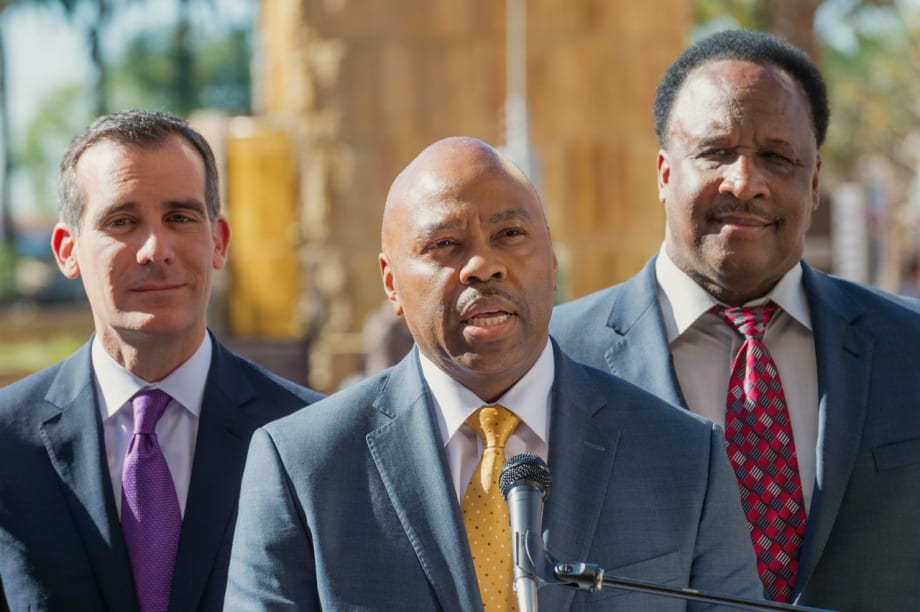
Washington, who has been with Metro since May 2015, spearheaded several notable successes including the passage of Measure M
LA Metro/Steve Hymon
Los Angeles Mayor and Los Angeles County Metropolitan Transportation Authority Board Chair Eric Garcetti announced that Metro CEO Phillip A. Washington is stepping down later this year.
Washington recently informed the Metro Board that he does not plan to seek a new contract or extend his current contract, which expires in May of this year.
“It has been my distinct pleasure and absolute honor to serve and lead Metro’s nearly 11,000 employees for the last six years,” said Washington. “I leave with great satisfaction knowing that working together we have improved mobility and increased access to opportunity for all residents of L.A. County, and weathered the most devastating health crisis of the past century. We have quickened the sense and pace of public service and left L.A. County’s mobility space better than it was.”
As Metro’s CEO, Washington manages a balanced annual budget of $7 billion, is responsible for overseeing $18 billion to $20 billion in capital construction projects, and provides oversight of the nation’s third busiest transit agency that transports 1.2 million passengers (pre-COVID) daily on a fleet of 2,200 clean-air buses and six rail lines. Washington is also engaged in all facets of transportation and infrastructure in L.A. County including aviation, goods movement, freight/railroads, water, public works, housing, and transit-oriented communities.
Washington, who has been with Metro since May 2015, spearheaded several notable successes including the passage of Measure M, the largest transportation investment ballot measure in North America. L.A. County voters overwhelmingly approved Measure M by more than 71%, launching the nation’s largest public works program that will create an estimated 700,000 jobs in the region.
He was also instrumental in securing $9 billion in grant funding over the past five years by working with Metro’s federal and state partners and building their trust in Metro’s leadership and undeniable track record of success.
Workforce development and advancing equity have been the hallmarks of Washington’s tenure at Metro. Under his leadership, Metro aggressively created real opportunities for small, women-owned, minority-owned, and veteran-owned businesses, including the first Prime contract for a minority business.
Washington also elevated and encouraged Metro’s greatest asset, its workforce (present and future), by advancing and institutionalizing real and effective employee professional development programs, including the SEED Transportation School of Los Angeles County, Workforce Initiative Now, the Metro Leadership Academy, the ENO Multi-Agency Exchange Program, and the creation of the Women and Girls Governing Council, which released a groundbreaking study that is changing the way the transportation industry addresses and responds to the needs of how women and girls travel.
Under Washington’s leadership, innovation flourished at Metro. He placed emphasis on not just talking about innovation but implementing it in concrete ways that help real people improve their lives. The Office of Extraordinary Innovation, Metro Micro, Mobility on Demand, the NextGen Bus Study, Metro’s TAP apps for Apple and Android phones, a partnership with the Transit app, and the very real possibility of a Fareless Transit System in L.A. County are a few examples.
More Management

METRO Opens Submissions for 2026 Motorcoach Awards
Nominations are now being accepted for METRO Magazine’s Operator of the Year and Innovative Operator of the Year awards.
Read More →
New York MTA Advances Final Contract for Second Avenue Subway Expansion
Contract Four is the largest in the Second Avenue Subway Phase 2 project and includes construction of station infrastructure, tracks, and signals for the subway expansion, MTA officials said. Work on Contract Four will begin in 2027.
Read More →
Transit Agencies Highlight Safety Gains at National Summit
Leaders from 15 major transit systems shared crime-reduction results and safety initiatives while discussing the role of continued federal support.
Read More →

NITA Names New Leadership, Expands Reduced-Fare Program at First Board Meeting
The new regional transit authority appointed its first board chair and interim executive director while extending reduced fares across CTA, Metra, and Pace for eligible riders.
Read More →
Beyond the Checklist: A Structured Approach to Transit Maintenance
Reliability-Centered Maintenance helps transit agencies move beyond routine checklists to focus limited resources on the assets and failures that have the greatest impact on safety, reliability, and service.
Read More →
APTA 2026 Nominating Committee Selects Leadership Slate, Names Chair and Vice Chair Nominees
Leadership changes will help shape the association’s priorities and its representation of the transportation industry during the 2026–2027 term.
Read More →
DART Launches Major Security, Fare Enforcement Initiative
The 90-day demonstration will deploy coordinated security teams at five light rail stations while testing controlled access and gathering data to guide future investments.
Read More →
Advancing Fare Collection Through Technology and Innovation
Learn about delivering 1300 gates at 91 stations while managing fare evasion. Explore the large scale deployment, solution customization and real-world results that affect the region. Prepare for deployment in your region now.
Read More →
Game Day in Motion: Moving Millions During the 2026 World Cup
Between packed transit stations and team motorcoaches, see how agencies and operators across North America tackled the transportation demands of the 2026 FIFA World Cup.
Read More →
Surface Transportation Extension Averts Shutdown, Leaves Transit Funding Gap
The stopgap keeps federal transportation programs moving, but missing advance funding could complicate the transit and rail projects agencies are planning next.
Read More →