



Transit, Motorcoach Associations Respond to Latest COVID Relief Bill
The proposed budget reconciliation title from the House Transportation & Infrastructure Committee would provide the transit industry with $30 billion in emergency funding.
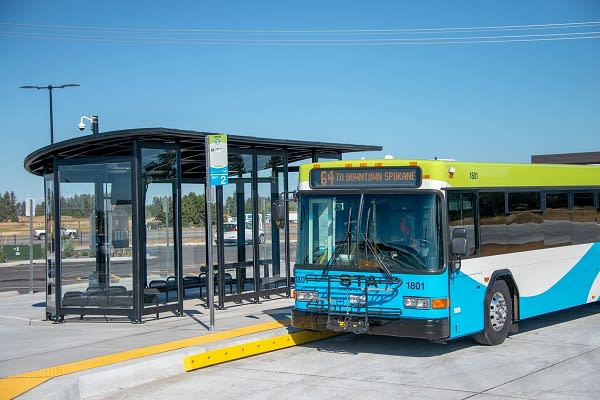
The proposed budget reconciliation title from the House Transportation & Infrastructure Committee would provide the transit industry with $30 billion in emergency funding.
Spokane Transit
A proposed budget reconciliation title from the House Transportation & Infrastructure Committee would provide the transit industry with $30 billion in COVID-19 emergency relief funding, in addition to $1.5 billion of funding for Amtrak.
This would be the third round of emergency funding provided to the transit industry following the $25 billion provided through the Coronavirus Aid, Relief and Economic Security (CARES) Act, which was signed into law in late March 2020, and the $14 billion provided through the Coronavirus Response and Relief Supplemental Appropriations (CRRSA) Act of 2021, which was signed into law in late December 2020.
APTA President/CEO Paul P. Skoutelas released the following statement in support of the bill.
“The American Public Transportation Association (APTA), on behalf of the entire public transportation industry, applauds the House Committee on Transportation and Infrastructure’s Budget Reconciliation Title providing $30 billion of COVID-19 emergency funding relief for public transit. The proposed funding is vital to the industry’s survival and will help prevent massive labor cuts and drastic service reductions. APTA also strongly supports the $1.5 billion of emergency funding provided for Amtrak.
A recent independent, economic analysis conducted by EBP US Inc. for APTA found that public transit agencies face a projected shortfall of $39.3 billion. While initial rounds of emergency funding provided transit agencies across the nation with relief, public transit funding needs continue to grow due to ongoing losses of ridership, fare revenue, and state and local tax revenue.
The $30 billion of emergency funding included in the Budget Reconciliation Title is essential to providing the public transportation industry with long-term certainty critical to the nation’s economic recovery. The time is now to invest more in our nation’s public transportation infrastructure to support jobs, reconnect Americans, and build the necessary infrastructure network to provide critical public transit services and economic opportunities for all.
APTA commends the incredible work of the Administration and Congressional leaders, including President Joseph R. Biden, Jr., Secretary of Transportation Peter Buttigieg, Speaker of the House Nancy Pelosi, Senate Majority Leader Charles E. Schumer, and the Chairs of the House and Senate Committees on Appropriations, House and Senate Committees on the Budget, House Committee on Transportation and Infrastructure, Senate Committee on Banking, Housing, and Urban Affairs, and the Senate Committee on Commerce, Science, and Transportation. We thank each of these leaders for their critical efforts to ensure that the Budget Reconciliation bill provides $30 billion in COVID-19 emergency funding to help public transit agencies continue to provide a critical lifeline to essential workers and to help our communities begin to rebuild our economy.”
Meanwhile, the American Bus Association (ABA) has expressed their concern for the motorcoach industry being once again left out of the latest Congressional COVID relief package.
ABA President/CEO Peter Pantuso released the following statement.
“Once again Congress has left out transportation sectors integral to multimodal America – and a sector clearly in need of help for survival,” Pantuso said. “This draft goes against what President Biden has said about ensuring all American have access to affordable transportation. The motorcoach industry, and our passengers, span all socio-economic and demographic groups that define America. From rural America to the intercity, buses go everywhere and serve everyone, safely, affordably, and efficiently, while remaining one of the greenest forms of transportation. Considering the importance of social equity and addressing climate change in this day and age, it’s incredible for Congress to once again overlook the motorcoach industry.”
Since the COVID pandemic hit a year ago, the private motorcoach industry has been decimated, with nearly 80% of the industry’s workforce being furloughed. The ABA reports that the industry went from generating $15 billion in 2019 to $2.6 billion in 2020.
More Management

METRO Opens Submissions for 2026 Motorcoach Awards
Nominations are now being accepted for METRO Magazine’s Operator of the Year and Innovative Operator of the Year awards.
Read More →
New York MTA Advances Final Contract for Second Avenue Subway Expansion
Contract Four is the largest in the Second Avenue Subway Phase 2 project and includes construction of station infrastructure, tracks, and signals for the subway expansion, MTA officials said. Work on Contract Four will begin in 2027.
Read More →
Transit Agencies Highlight Safety Gains at National Summit
Leaders from 15 major transit systems shared crime-reduction results and safety initiatives while discussing the role of continued federal support.
Read More →

NITA Names New Leadership, Expands Reduced-Fare Program at First Board Meeting
The new regional transit authority appointed its first board chair and interim executive director while extending reduced fares across CTA, Metra, and Pace for eligible riders.
Read More →
Beyond the Checklist: A Structured Approach to Transit Maintenance
Reliability-Centered Maintenance helps transit agencies move beyond routine checklists to focus limited resources on the assets and failures that have the greatest impact on safety, reliability, and service.
Read More →
APTA 2026 Nominating Committee Selects Leadership Slate, Names Chair and Vice Chair Nominees
Leadership changes will help shape the association’s priorities and its representation of the transportation industry during the 2026–2027 term.
Read More →
DART Launches Major Security, Fare Enforcement Initiative
The 90-day demonstration will deploy coordinated security teams at five light rail stations while testing controlled access and gathering data to guide future investments.
Read More →
Advancing Fare Collection Through Technology and Innovation
Learn about delivering 1300 gates at 91 stations while managing fare evasion. Explore the large scale deployment, solution customization and real-world results that affect the region. Prepare for deployment in your region now.
Read More →
Game Day in Motion: Moving Millions During the 2026 World Cup
Between packed transit stations and team motorcoaches, see how agencies and operators across North America tackled the transportation demands of the 2026 FIFA World Cup.
Read More →
Surface Transportation Extension Averts Shutdown, Leaves Transit Funding Gap
The stopgap keeps federal transportation programs moving, but missing advance funding could complicate the transit and rail projects agencies are planning next.
Read More →