$8B Rail Project Funding Should Stir Interest in 2024
In December, the FRA announced $8.1 billion in funding for passenger rail projects. The funding is a part of the Bipartisan Infrastructure Act that Congress passed several years ago, but the funding now is flowing aggressively.
The funding is a part of the Bipartisan Infrastructure Act that Congress passed several years ago, but the funding now is flowing aggressively.
Photo: Amtrak
4 min to read
In December, the Federal Railroad Administration (FRA) announced $8.1 billion in funding for passenger rail projects. The funding is a part of the Bipartisan Infrastructure Act that Congress passed several years ago, but the funding now is flowing aggressively.
This type of historic support is facilitating an abundance of rail projects throughout America. The opportunities for public-private sector collaboration to improve the country’s transportation infrastructure have never been greater. The examples that follow are similar to the types of large projects that will launch in 2024.
Ad Loading...
Projects in the Works
After securing a $1 billion federal grant from the FRA, the North Carolina Department of Transportation will move forward with the final engineering design, right-of-way acquisition, and construction of the S-Line spanning from Raleigh to Wake Forest.
The project — estimated to cost $1.4 billion in total — is currently in the design and engineering phase. Construction is scheduled for early 2025. This project is part of a multi-phase effort to connect North Carolina to Virginia through Washington, D.C.
The S-Line will be a high-performance passenger rail line that provides convenient and inexpensive travel options. It will include construction of new and upgraded track, 11 grade separations, and closure of multiple at-grade crossings.
A project to connect the Northern Lights Express, a higher-speed passenger rail, will launch soon. The objective will be to connect Minneapolis and Duluth with stops in the Minnesota towns of Hinckley, Cambridge, and Coon Rapids, as well as Superior, Wis.
The railway will be designed to expand in the future. The new rail line will operate with speeds up to 90 mph over approximately 150 miles of rail corridor. It will include construction of six train stations and expanding existing stations along the route.
Ad Loading...
The Pennsylvania Department of Transportation will receive $144 million to enhance rail infrastructure along the Keystone West Corridor between Pittsburgh and Harrisburg. The funding support is from the Federal-State Partnership for Intercity Passenger Rail program. This project will accommodate a second daily round-trip of the Amtrak Pennsylvanian service.
Plans are to update tracks, right-of-way acquisition, sidings, and to make signal improvements along Norfolk Southern Corporation’s main line. Norfolk Southern owns the corridor and has priority on the line, which means Amtrak trains can often be delayed. That’s why the project is a high priority, and rail officials say the upgrades will improve the reliability of trains. The total cost estimate has been tagged at $180 million. Construction will begin in 2024, but no solicitations have been issued.
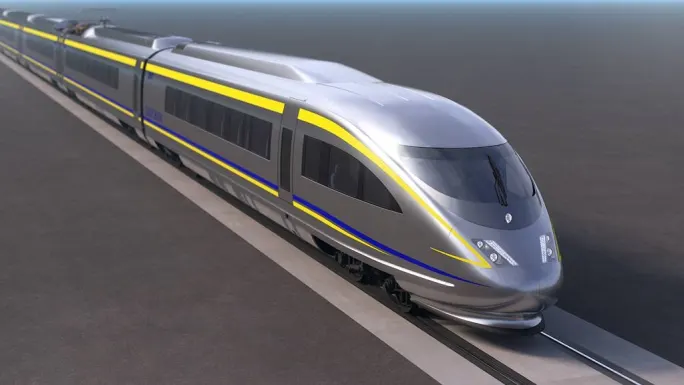
The California High-Speed Rail Authority recently unveiled plans for the construction of track and overhead contact systems for California’s high-speed rail project located between the cities of Merced and Bakersfield.
Photo: California High Speed Rail Authority
More Projects…and High-Speed Rail
In a partnership between the Virginia Passenger Rail Authority and the Virginia Railway Express, track and station improvements will be made at L’Enfant Station in Washington, D.C., at a cost of $111 million.
The project is in the engineering phase, with construction planned for 2025. The current side platform allows access to only one train at a time. Additionally, it is constrained in length, only providing space for a six-car train.
A new island platform will allow multiple trains access at the same time and will be extended to accommodate longer trains. The project also calls for the construction of approximately one mile of additional mainline track through and around the station.
Ad Loading...
L’Enfant Station is the busiest of all, and this project is a component of the larger Virginia Transforming Rail Phase 2 effort. Funding support from the Bipartisan Infrastructure bill topped out at $729 million, but the larger Phase 2 initiative is expected to cost $2.6 billion in total.
The California High-Speed Rail Authority recently unveiled plans for the construction of track and overhead contact systems for California’s high-speed rail project located between the cities of Merced and Bakersfield.
An overhead contact system is comprised of vertical structures that are placed along rail tracks to power the trains. Installation of these features is valued at $131 million. Project planners will create high-level designs for track and contact systems for the 171 miles running from Merced to Bakersfield. These systems will also be implemented along the 119-mile stretch that is currently under construction, as well as the portion that is still being planned.
Track construction will include the track system itself and all parts of the overhead contact system, fencing, drainage, and access walkways. An RFQ for design services was released in November, and construction is slated to begin in 2024.
Amtrak Continues ADA Accessibility Work
Also in December, $93 million in federal funding was awarded to Amtrak for the purpose of upgrading Chicago’s Union Station, a hub for local and regional rail transit. Improvements to the station are outlined in the city’s Hub Improvement Project.
Ad Loading...
The project will renovate and expand Union Station platforms, upgrade ventilation systems to disperse train exhaust, and convert the defunct former mail platforms to passenger use. The platform renovations will result in compliance with the Americans with Disabilities Act and improve congestion by providing an added entrance and exit that will improve the flow of crowds in the station.
A project cost estimation of $93 million has been announced, and funding support is from a federal program that supports passenger rail projects. Officials have many more improvements planned for Union Station and the surrounding rail lines.
Rail funding is abundant because of the critical infrastructure need. These types of projects will be launching throughout the U.S. in 2024.
With $610 million available through the FY 2026 Buses and Bus Facilities Competitive Program and the Low or No Emission Grant Program, agencies must build a compelling case before the September 21 deadline that balances environmental compliance with operational feasibility.
The global cycling conference highlighted how cities are integrating bicycles into multimodal transportation networks, expanding cycle tourism and reshaping urban mobility.
Mike Bismeyer — often known as “The Kindness Guy” — has spent more than 17 years in public transit and mobility, serving in industry leadership roles, speaking across North America, and advocating for stronger workplace cultures. But his message doesn’t come from theory. It comes from lived experience.
Transport leaders from around the world gathered in Leipzig, Germany, for the 2026 International Transport Forum to discuss resilience, climate impacts, supply chains and the future of sustainable mobility.
Polis comprises cities and regions, as well as corporate partners, from across Europe, promoting the development and implementation of sustainable mobility. This year’s event had over a thousand attendees across various policy forums and an exhibition.
Across North America and beyond, transit agency officials are contending with a perfect storm of operational headaches and strategic challenges that hamper daily service and long-term progress.
Simply incentivizing electrification is not enough to make a meaningful impact; we must shift our focus toward prioritizing public transportation and infrastructure.