




Check Out:WMATA Adding New Bus Stop Signs as Part of Better Bus Network
WMATA Celebrates Three Years of Joint Development Project Successes
Agency projects add homes, offices, and millions in tax revenue as WMATA fast-tracks more joint development deals.
July 3, 2025
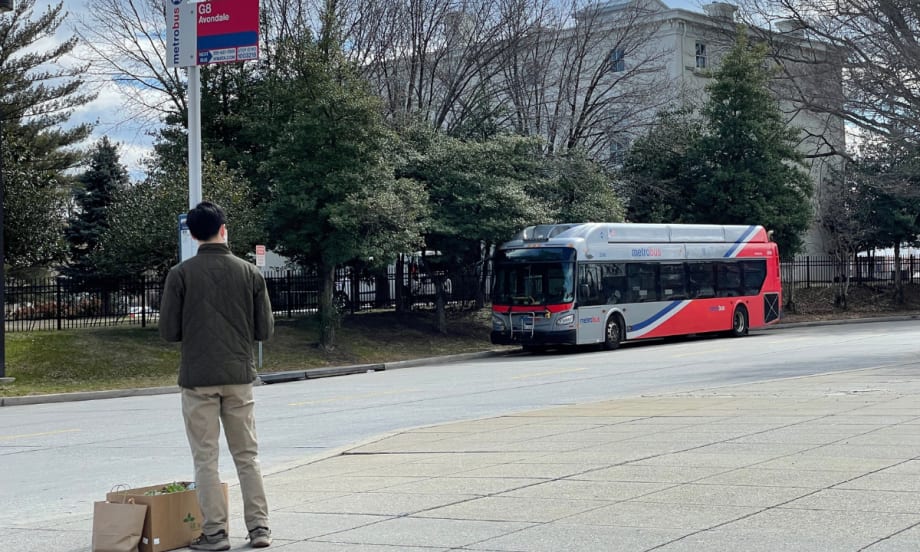
WMATA is nearly halfway towards achieving its goal of 20 additional joint development agreements by 2032.
Photo: Washington Metropolitan Area Transit Authority
3 min to read
The Washington Metropolitan Area Transit Authority (WMATA) recently announced a new progress report highlighting three years of success for the metro’s joint development real estate program.
The agency’s joint development program collaborates with developers to build housing, offices, and other amenities on WMATA's property. It is a form of transit-oriented development that generates new ridership and revenue and adds new housing, jobs, and tax revenue to the region.
So far, the program has delivered eight projects in three years totaling 1,490 residential units (813 affordable) and one million square feet of office space, resulting in $15 million in new annual tax revenue for local jurisdictions according to a new progress report on the metro’s 10-Year Strategic Plan.
Five new developments, either under construction or expected to break ground in 2025, will add another 1,270 residential units and 422,000 square feet of office, generating $22 million in new annual tax revenue.
“Metro has completed more joint development projects than any other transit system in the nation, and we’re not slowing down,” said WMATA GM/CEO Randy Clarke. “Over the last three years, the metro team has developed and implemented strategies to accelerate joint development because we know the value that it brings to the region’s economy, residents, and the metro system.”
WMATA Accelerates Joint Development Push, Unveils New Tracker
WMATA is nearly halfway towards achieving its goal of 20 additional joint development agreements by 2032. Since 2022, the agency’s board has approved five new joint development agreements, and staff are in negotiations on four additional agreements.
To achieve this milestone, WMATA has updated transaction templates, streamlined processes, and retained external real estate advisors and counsel, with a goal to complete future negotiations in six to nine months.
Plus, the agency recently executed an amended Joint Development Agreement for Takoma with EYA for a 434-unit residential building with 17,000 square ft. of retail and a 1.8-acre park, and a Joint Development Agreement for Twinbrook with Hines will be executed this month. The Twinbrook joint development includes a 437-unit residential building with 5,000 square feet of retail. Both projects are expected to break ground in 2027.
To give the WMATA’s stakeholders and the public increased visibility into the joint development program, the agency is launching a new Joint Development Tracker that shows all completed projects, their fiscal impact, and future development sites.
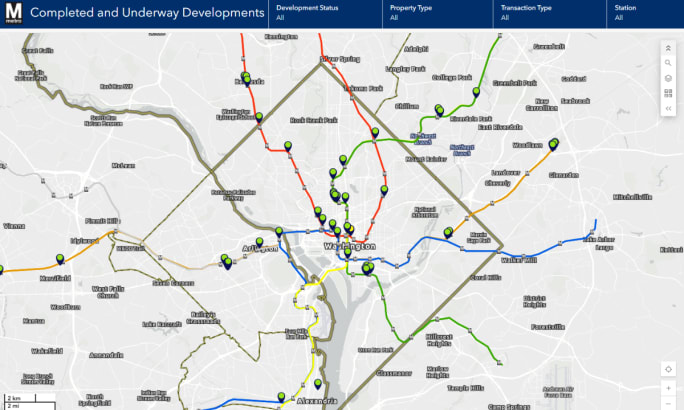
WMATA is launching a new Joint Development Tracker that shows all completed projects, their fiscal impact, and future development sites.
Source: Washington Metropolitan Area Transit Authority
Plotting the Next Wave of Transit Growth
In 2024, WMATA released four solicitations, from which they selected developers for two stations and a third is expected this fall.
According to an agency statement, the agency’s site planning and solicitation process reduces risk and increases site marketability through right-sizing transit facilities, controlling the cost of replacement assets, and utilizing updated solicitation templates.
WMATA’s 2025 Progress Report identifies 29 million square feet of remaining development potential across 41 stations, with the potential to generate an additional $300 million in new annual tax revenue. Station prioritization groupings help the metro staff manage internal resources, and local jurisdictions understand and proactively address challenges to development.
Since 1975, WMATA’s 59 projects have created 10,800 residential units, 5.7 million square feet of office development, and 1.3 million square feet of retail development across 32 stations, generating $220 million in annual tax revenue.
More Management

METRO Opens Submissions for 2026 Motorcoach Awards
Nominations are now being accepted for METRO Magazine’s Operator of the Year and Innovative Operator of the Year awards.
Read More →
New York MTA Advances Final Contract for Second Avenue Subway Expansion
Contract Four is the largest in the Second Avenue Subway Phase 2 project and includes construction of station infrastructure, tracks, and signals for the subway expansion, MTA officials said. Work on Contract Four will begin in 2027.
Read More →
Transit Agencies Highlight Safety Gains at National Summit
Leaders from 15 major transit systems shared crime-reduction results and safety initiatives while discussing the role of continued federal support.
Read More →

NITA Names New Leadership, Expands Reduced-Fare Program at First Board Meeting
The new regional transit authority appointed its first board chair and interim executive director while extending reduced fares across CTA, Metra, and Pace for eligible riders.
Read More →
Beyond the Checklist: A Structured Approach to Transit Maintenance
Reliability-Centered Maintenance helps transit agencies move beyond routine checklists to focus limited resources on the assets and failures that have the greatest impact on safety, reliability, and service.
Read More →
APTA 2026 Nominating Committee Selects Leadership Slate, Names Chair and Vice Chair Nominees
Leadership changes will help shape the association’s priorities and its representation of the transportation industry during the 2026–2027 term.
Read More →
DART Launches Major Security, Fare Enforcement Initiative
The 90-day demonstration will deploy coordinated security teams at five light rail stations while testing controlled access and gathering data to guide future investments.
Read More →
Sponsored•September 9, 2026
Advancing Fare Collection Through Technology and Innovation
Learn about delivering 1300 gates at 91 stations while managing fare evasion. Explore the large scale deployment, solution customization and real-world results that affect the region. Prepare for deployment in your region now.
Read More →
Game Day in Motion: Moving Millions During the 2026 World Cup
Between packed transit stations and team motorcoaches, see how agencies and operators across North America tackled the transportation demands of the 2026 FIFA World Cup.
Read More →
Surface Transportation Extension Averts Shutdown, Leaves Transit Funding Gap
The stopgap keeps federal transportation programs moving, but missing advance funding could complicate the transit and rail projects agencies are planning next.
Read More →