Calif. Consortium Focused on Developing, Delivering Bus Maintenance Training
Since 2004, the Southern California Regional Transit Training Consortium has provided bus maintenance training throughout the region via partnerships with local colleges, universities, and transit agencies.
by Alex Roman, Managing Editor
August 17, 2017
As maintenance professionals continue to retire in droves, the SCRTTC works to not only train maintenance personnel, but also people to deliver their courses through its train-the-trainer component.
7 min to read
The SCRTTC develops training programs based on needs assessments they conduct with their transit agency partners, which enables them to help fill the maintenance training gap.
Unique even now, the Southern California Regional Transit Training Consortium (SCRTTC) began in 2004 to provide a training resource network, comprised of community colleges, universities, transit agencies, public, and private organizations, focused on the development and delivery of training and employment of the transit industry workforce, with a particular focus on bus maintenance. Today, it has grown to not only include parts of Central and Northern California, but also recently launched a distance-learning component.
“We initially had 29 members when we began back in 2004,” explains the SCRTTC’s Executive Director David Stumpo. “Over the years, some colleges have dropped their technical programs, and therefore their membership, but now as we are 13 years down the road, we have grown overall to now include 46 members.”
Ad Loading...
Over the last 13 years, the consortium has been a vital resource in providing supplemental training, and in some cases, serving as the main source for maintenance training for smaller agencies in their network, outside of the supplier training that comes along with adding new equipment or components.
“Our program doesn’t replace any training the transit agencies provide or their trainers, we are simply an add-on; a synergy to getting their training accomplished effectively,” says Nina Babiarz, training director for the SCRTTC.
Training Development After receiving its initial funding through the Federal Highway Administration, the SCRTTC began with a needs assessment to look at what areas of training needed to be developed.
“From that day forward, we began building courses based on the needs of transit agencies and utilized colleges in our member network to do that under our Standard Operating Procedures for course building and certifying courses,” says Stumpo.
Stumpo adds that what the assessment found was that much of the training transit agency technicians were receiving from suppliers was inadequate, and that many agencies in the consortium didn’t have in-house training programs. The SCRTTC’s needs assessment process has been performed yearly ever since, adds Babiarz, because the need for specific types of training change rapidly.
With the SCRTTC doing annual assessments, one of the biggest issues they have found that transit agencies are facing in the maintenance shops is retirement.
Ad Loading...
“A lot of history and knowledge is walking right out of the door and that institutional knowledge needs to be replaced by folks that are currently climbing through the ranks,” says Babiarz.
Another issue facing shops is the growing changes in technologies, especially as electric buses usage continues to grow around the nation.
“Especially here in California, there are mandates dictating that our transits move to zero-emission electric buses, and some agencies are even considering hydrogen fuel-cell buses,” Babiarz explains. “With that growing usage, there is a need for advanced courses, but agencies are finding they can’t just leapfrog right to that type of training because they need those basic, foundational courses first.”
To develop a course, the consortium starts with a beta designed by subject matter experts, which includes the educator, a transit agency, and a trainer, as well as a manufacturer if applicable. Once the beta is delivered, the process moves forward.
However, if 25% of the content changes during the initial beta process, the course must go back through the beta process again where it is then re-delivered.
Ad Loading...
Following the beta process, the course then enters a train-the-trainer module, where the instructors are called in and taught how to teach the course. Once the process is completed and no more changes are made to the course, the course and instructors are certified. Certified teachers have to co-teach, initially, and then are fully certified after that to teach the course anywhere, anytime.
“We tend to say, if all the operations and maintenance materials exists, that the process can take six to eight weeks from start to finish,” Stumpo says. “Sometimes if we’re going to do instructor-led or build a distance-based component, the process can take about 14 weeks.”
To date, the consortium has developed more than 29 courses and delivered more than 71,404 hours to more than 4,990 students.
GRTC Turns to Apprenticeship Program to Develop Mechanics
Currently in a historic period of change and growth, Richmond, Va.’s Greater Richmond Transit Co. (GRTC) recently launched the “GRTC Apprenticeship Program” — a paid, on-the-job training program that will develop certified journey-level mechanics and ensure GRTC maintains an adequate staff of highly qualified mechanics.
“GRTC does not currently have a mechanic/maintenance shortage. We are typically staffed at about 80 people in the Maintenance Department, which is where we are right now,” says Carrie Rose Pace, director, communications, for GRTC. “With this staffing level, we think we can accommodate up to five apprentices at any one time.”
The curriculum was developed in-house by GRTC’s Maintenance and HR Departments, with the agency consulting with the Virginia Department of Labor and Industry as it developed the pilot.
After an apprentice completes the 6,000-hour/36-month training schedule in a variety of journey-level mechanic disciplines, GRTC aims to retain and hire apprentices as full-time employees. Applicants must be at least 18 years of age at the time of appointment as an apprentice mechanic and must possess a valid Virginia Driver’s License.
“The Apprenticeship Program was developed to cultivate talent for the future as GRTC’s services continue to grow,” says Pace. “We also see this as an incredible opportunity to benefit the community by providing on-the-job training for individuals entering the workforce, regardless of their previous maintenance training or experience. This program is open to internal candidates as well who want to develop their skills and potentially earn more money. It’s a win-win for the employee and for us.”
As maintenance professionals continue to retire in droves, the SCRTTC works to not only train maintenance personnel, but also people to deliver their courses through its train-the-trainer component.
Online expansion Slowly but surely the consortium’s membership has begun to grow beyond just Southern California to Central and Northern California. Stumpo says the delay in growth for the consortium toward the north was because there was never a champion to bring the colleges and transit agencies together. As time has passed, however, more colleges and agencies are beginning to come online to help expand the consortium’s reach.
“Several agencies began to see the importance of our curriculum and that they could certify some of their own folks certified to deliver our courses,” says Stumpo. “In some cases, our members from the south have gone north to deliver training, and those in the north are always welcome to come south for training as long as they don’t mind paying a bit of travel. Either way, it is essentially still cheaper than other training available.”
Ad Loading...
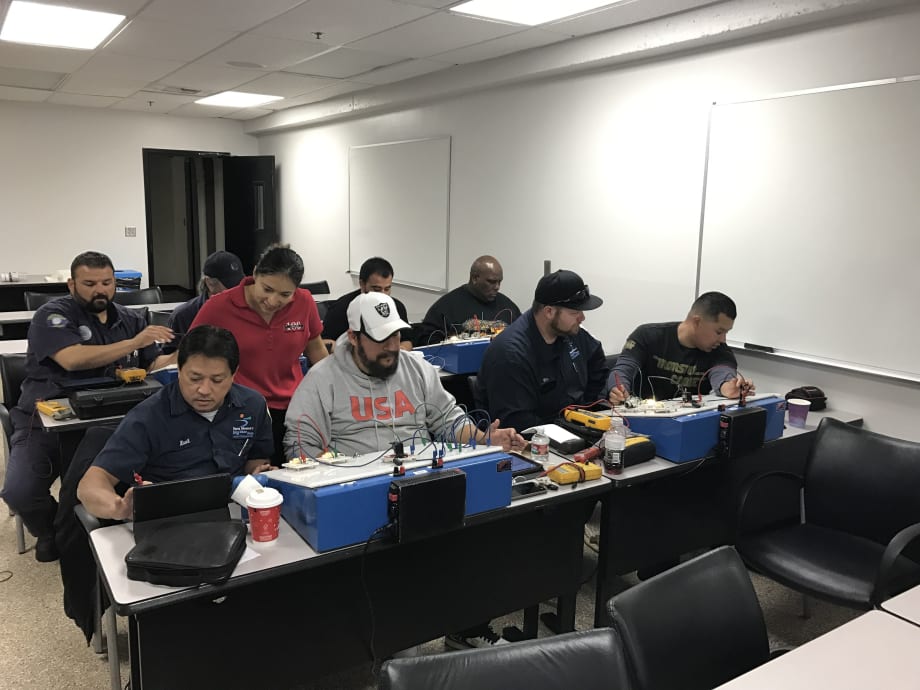
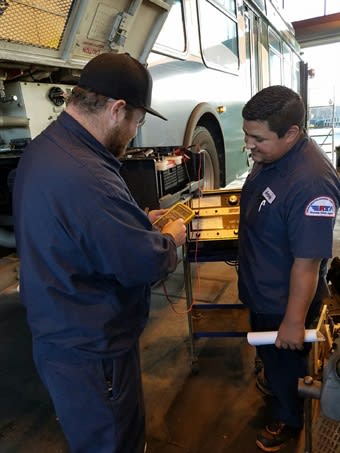
Recently, a $673,000 FTA Innovative Workforce Development Grant enabled the SCRTTC to begin building distance-based courses that consortium members and others would be able to take online. The first course developed for the new program focused on DVOM, or digital volt ohm meter, training.
“When we started developing the course, our developer was so profoundly excellent in building these tech courses,” Stumpo says. “What they were able to create was a system where, if you had your iPad in your hand, it became a live meter that enabled techs to move the leads around, see meter readings, and see switches turn on. So it really was more than just a textbook course, it became a real-live interactive learning experience.”
Since the development of the first course, the SCRTTC has created three more courses, including a foundational electrical class and a CNG vehicle safety course, as well as a course for Cummins’ INSITE engine control management system. The consortium has also created a blended class, which includes one day in the classroom and one day online, enabling techs to only have to be out of the office one day for training and essentially complete the course through the distance-based module.
“Through the development of these e-courses, we have proven that distance-based learning is a viable option for the transit agencies and their technicians, which means that we are continuing to do our needs assessments and build more ecourses,” Stumpo says.
As the ecourses proved to be successful, Stumpo adds that agencies from the north, including Solano Transit, Sacramento Regional Transit, Santa Cruz Metro, and more began to come onboard.
Ad Loading...
In addition to growing its distance-based courses, the consortium has also begun working with manufacturers, including BYD, Proterra, and Complete Coach Works, to develop training standards for working with their electric vehicles. The SCRTTC’s collaboration with CCW and Gardena, Calif.’s GTrans has already yielded a bumper-to-bumper training program for the agency’s new all-electric buses, powered by CCW’s ZEPS system.
Calif.'s GTrans Lands E-Bus Grant, Maintenance Training
Gardena, Calif.’s GTrans was recently awarded a $2.7 million grant by the California Energy Commission’s (CEC) Alternative and Renewable Fuel and Vehicle Technology Program to convert five of their existing hybrid gasoline-electric powered buses to battery-electric propulsion systems. As part of the grant, GTrans will team with SCRTTC to provide its maintenance team with much-needed training on the new buses.
“GTrans and SCRTTC, through its unique partnership with industry experts and educational institutions, will work to develop a train-the-trainer curriculum,” explains Ernie Crespo, director, transportation, for GTrans. “This class will be designed to educate GTrans mechanics on necessary safety practices, personal protective equipment, and procedures when working on a [Complete Coach Works] Zero Emission Propulsion Systems (ZEPS) high-voltage transit vehicle in a shop environment.”
The program will also identify basic preventative maintenance practices and procedures in servicing ZEPS and fundamental troubleshooting procedures. An overview of the ZEPS motor systems, auxiliary motors, batteries, and charging systems will be described and shown. The students/mechanics will also perform voltage tests/measurements, and provided a basic understanding of troubleshooting.
“Having worked with hybrids in the past, GTrans’ maintenance team has a leg up on most transit agencies that are often starting from scratch,” says the SCRTTC’s David Stumpo. “Either way, maintenance technicians need foundational training to begin working with electric buses. They need to understand meters with high voltage that they’ve never used before, as well as the batteries themselves and the charging infrastructure. The training we worked on with GTrans will really give their team familiarization with the new buses from bumper to bumper.”
Adding that the SCRTTC has already yielded 1,000 hours of training that has enhanced the skills of GTrans’ mechanics, Crespo says it was of the utmost importance to include training like the one developed with the consortium to bring his team up to speed, as well as keep them there.
“Any time GTrans has the ability to include training in a grant opportunity, we take it, especially when it comes to deploying new technology,” he says. “Our mechanics are an integral part of the team that will make this project a success over the long term. GTrans mechanics must be equipped with the skills to understand, diagnose, and maintain these buses — and providing them with the training to do so is critical.”
The SCRTTC’s Nina Babiarz adds that an important side-benefit of providing training like this, as well as ongoing training throughout a technicians’ career, helps them to continue their professional growth.
“Transit is in competition with other industries, which means attracting new talent and training those already in the field is critical,” she says. “When awarding grants, the CEC and the California Air Resources Board are starting to understand training is really critical to their own goals and objectives, because if the work force is not trained and these new technologies are not operating successfully, it’s an impediment to the industry.”
Model considerations Babiarz and Stumpo say the SCRTTC’s model is possible in other regions, but agree that the wealth of both colleges and transit agencies in Southern California was a key component to making the consortium possible. They also cite their partners’ willingness to work together as part of their success.
“The consortium was founded by the folks that were on the front trenches of making all this stuff happen and it was really their willingness to collaborate that fueled the consortium early on, and even still,” says Babiarz. “Everybody really gives what they can.”
Babiarz adds that collaborative spirit also carries over outside of the consortium’s on-site trainings and meetings.
“People make personal contacts at our trainings too, and utilize those new relationships by bouncing ideas off of one another or learning how maybe they addressed a similar issue they are having in their shop,” she explains.
Ad Loading...
Reflecting on what he would do differently, or how he would advise others considering a similar model, Stumpo says that finding a more sustainable funding source is key.
“Early on, we were operating from one grant to another, so our program really toggled up and down, in terms of what we could deliver,” he says. “If we had more sustainable funding early on, we probably would have been more ramped up then we are today. Now that we’re a little more sustainable, we are really ramping up our distance-based training and our strategic intent of building a national model.”
Contract Four is the largest in the Second Avenue Subway Phase 2 project and includes construction of station infrastructure, tracks, and signals for the subway expansion, MTA officials said. Work on Contract Four will begin in 2027.
The new regional transit authority appointed its first board chair and interim executive director while extending reduced fares across CTA, Metra, and Pace for eligible riders.
Reliability-Centered Maintenance helps transit agencies move beyond routine checklists to focus limited resources on the assets and failures that have the greatest impact on safety, reliability, and service.
The 90-day demonstration will deploy coordinated security teams at five light rail stations while testing controlled access and gathering data to guide future investments.
Learn about delivering 1300 gates at 91 stations while managing fare evasion. Explore the large scale deployment, solution customization and real-world results that affect the region. Prepare for deployment in your region now.
Between packed transit stations and team motorcoaches, see how agencies and operators across North America tackled the transportation demands of the 2026 FIFA World Cup.
The stopgap keeps federal transportation programs moving, but missing advance funding could complicate the transit and rail projects agencies are planning next.