Changing A Transit Agency’s Organizational Culture By Design
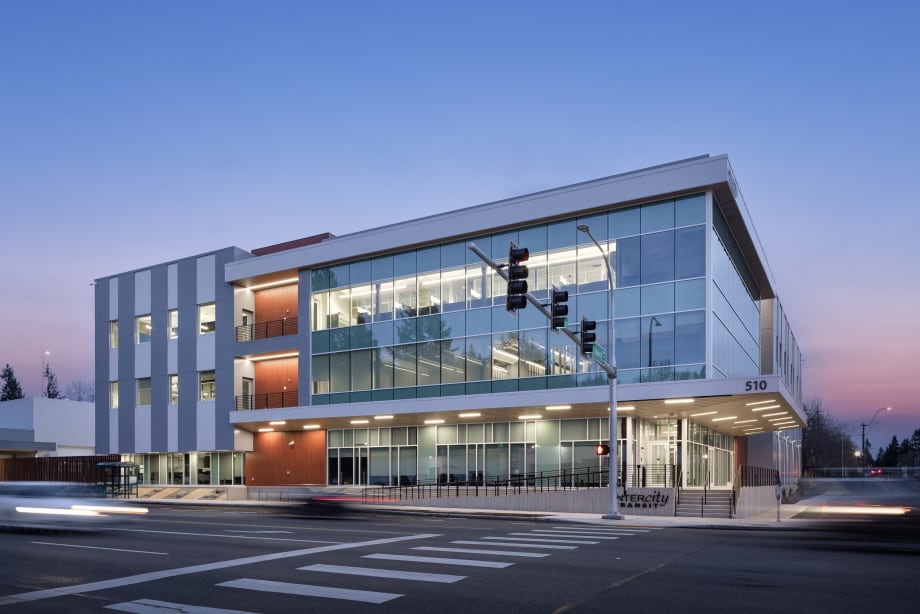
Stantec was retained by Olympia, Wash.'s Intercity Transit through a competitive RFQ selection process in 2018 to help the agency plan a new Pattison Garage Headquarters.
by Merlin Maley
October 19, 2023
Stantec was retained by IT through a competitive RFQ selection process in 2018 to help the agency plan a new Pattison Garage Headquarters.
Photo: Chang Kim
7 min to read
Intercity Transit (IT), in Olympia, Wash., serves Thurston County within the Puget Sound region. IT’s current Pattison Garage headquarters was originally constructed in 1985 and was designed for a transit fleet of 40 buses. At that time, the population of Thurston County was approximately 139,000 people.
Today, the region has grown to over 307,000 people. During this period of population growth, IT substantially expanded its fixed-route bus service, while also adding additional transportation options including Dial-A-Lift and Vanpool service.
Ad Loading...
Stantec was retained by IT through a competitive RFQ selection process in 2018 to help the agency plan a new Pattison Garage Headquarters.
Prior to Stantec’s contract award, IT had completed several capital improvement projects including expanded bus storage, sub-grade stormwater detention facilities, and an unleaded fueling facility utilized by their vanpool customers and non-revenue fleet. These improvements certainly helped alleviate the impacts from IT’s growing fleet, however the existing administrative, operations, facilities maintenance, and bus maintenance facilities were bursting at the seams and expanded facilities were identified through a space needs programming process.
Transit Vehicles
1985
2018 (Existing
2045
40-Foot Buses
40
71
110
Dial-A-Lift
0
44
88
Vanpool/Village Vans
0
38
132
Subtotal
40
179
362
Employees
Unknown
312
387
Square Footage
58,511 sf
58,511 sf
84,390 sf
Employee Parking
21,400
21,400
59,400
Embarking on the Process
Before re-envisioning IT’s need for a new facility, the overarching project and agency goals had to be established to help guide the design and decision-making process. Utilizing a Stantec framework called “Design2Thrive,” IT’s stakeholders identified the following priorities and goals:
Goal #1: Provide a facility that promotes employee happiness and inclusivity.
Goal #2: Make employee health and safety a priority.
Ad Loading...
Goal #3: Embrace resiliency as a defining characteristic of Intercity’s culture.
Goal #4: Provide visionary leadership for the future.
Additionally, the City of Olympia had lofty planning goals, especially for one of its primary north-south transportation corridors, Martin Way.
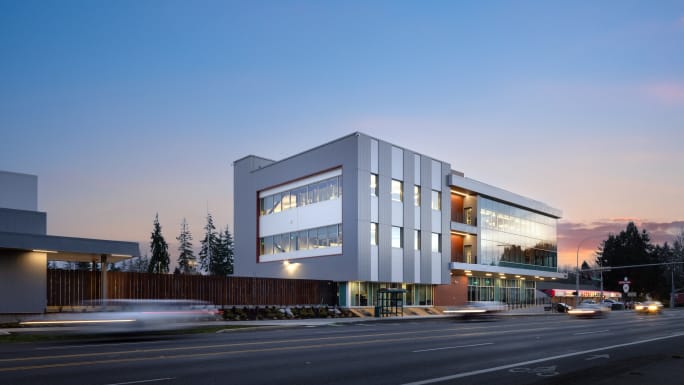
Martin Way is a primary frontage along the northern property line of the Pattison Garage facility. Previous master planning efforts required a long city approval process resulting in an Interlocal Development Agreement between the City and IT.
The development agreement pushed all new buildings up to the Martin Way setback as part of the planning strategy to recapture the public right-of-way with buildings and structures versus a decades long suburban development history along the corridor. This included buildings set back significantly from the street and large expansive parking lots adjacent to the right-of-way.
Ad Loading...
Additional planned improvements for the Martin Way corridor included protected bike lanes, traffic calming, and landscape enhancements. All new projects along the corridor must embrace these goals or face a lengthy planning waiver application process with no guarantees of approval.
For IT, time was of the essence. Under their previous approvals, their Conditional Use Permit (CUP) was approved by the City if their submitted capital improvement plans met all the conditions of the CUP. Therefore, the master planning process had to align the new space needs program to the approved CUP. The long-term growth needs for the agency were much greater than the originally anticipated needs from the 2015 executed agreement.
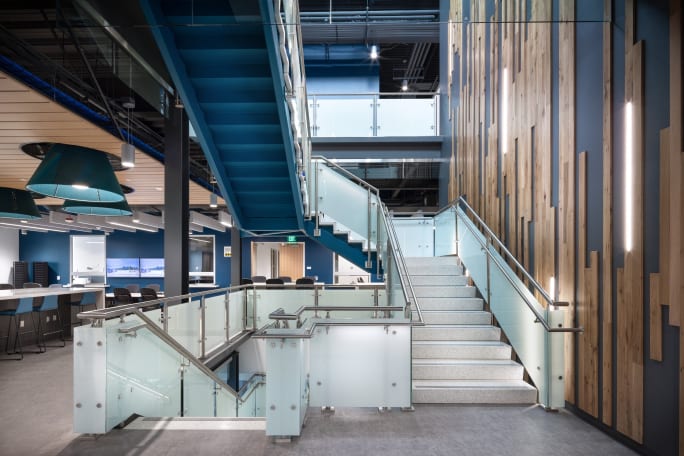
Creating social equity included providing daylight and views to the exterior for all employees, providing useable outdoor spaces, and an exercise loop within the campus.
Photo: Chang Kim
Healthy and Sustainable Design Solutions
IT’s goals for the project became the road map for the entire design and engineering efforts. People were the number one priority for their new facility.
Of course, the project needed to accommodate the growth of the transit fleet, but without great people and facilities that empower the employees on a daily basis, reaching the planned service expansion goals would never become a reality.
Goal #1 embraces the idea of “creating spaces that are accessible to everyone and exclusive to no one. Intercity Transit is a family, and the spaces should reflect that feeling.”
Ad Loading...
Creating social equity included providing daylight and views to the exterior for all employees, providing useable outdoor spaces and an exercise loop within the campus, including gender neutral restrooms, making meeting spaces flexible and multi-purpose, and embracing a “café” concept versus the usual “breakroom.” The café is centrally located on the second floor, directly connected to the three-story open and light filled staircase and is a place for all employees to enjoy their daily meals, informal meetings, and larger agency gatherings.
The Pandemic and Moving Ahead
Throughout 2018 and 2019, the design process was moving ahead and the project was progressing as expected.
Fast forward to Mid-March 2020, and suddenly the world fell out from underneath everyone. Our OAC (Ownership, Architect, Contractor) met regularly (sometimes more than once per day) to discuss the onset of the pandemic and the project. I asked IT’s leadership team if they wanted the A|E team to stop work to give them space and time to assess, and was told, “No, Merlin. We do not want to stop your team because we need these facilities improvements.” This was a monumental decision that will be addressed in more detail within the next section.
The Design Development (60% design) documents were submitted in late January 2022 and the reviews by IT’s staff, owner’s representative (State of Washington Department of Enterprise Services), and the GCCM Contractor (Forma Construction) were positive, however budget challenges did exist.
The entire team continually worked to manage the desired scope and budget, while keeping IT's goals for the project as the driving force.
Ad Loading...
As for completing 100% design during the pandemic, everyone had to learn to pivot and do so quickly. Typically, this is the most critical time for A|E teams to coordinate the final details in person, meet with our owners and construction partners in person to ensure all decisions have been documented, while also diving into the final details and planning for the permitting review and final bidding processes.
IT's leadership became the driving force and they fully committed to additional virtual meetings throughout the day and evening to cover the final details.
Forma Construction continued to deliver updated project pricing information as previously awarded subcontracting partners knew the project was not going on hold, and everyone worked collectively to stay on schedule and submitted permit documents in June.
Before re-envisioning IT’s need for a new facility, the overarching project and agency goals had to be established to help guide the design and decision-making process.
Photo: Chang Kim
Construction During a Pandemic
As many projects across the world went on hold, this project continued to move forward despite the uncertainty of the times and delays to the procurement of building products and materials.
Travel to job site by the A|E was for site observations only, and was limited initially, but technology played a big role in making up for observing the project while much of the team was remote.
Ad Loading...
The contractor provided a dedicated web camera of the project site with 24/7 access. Videos and photos were distributed to the team to aid in seeing the built conditions for evaluation against the permit documents. As we got into the Q2 of 2021, the A|E team was allowed to travel to the jobsite again, but in limited numbers while following all on-site protocols established to help prevent the spread of COVID-19.
The real benefit of staying the course and not delaying the project came in the form of bid savings. As mentioned, the project (like most) had some cost challenges, but by bidding the job in the second half of 2020, the entire team realized that cost savings were a certain because of the downward slide in economic conditions around Thurston County and the Seattle region.
In the end, this equated to over meaningful savings in buy out savings while allowing IT to add some removed scope items back into the project. One of the biggest changes was an overall upgrade in the HVAC and ventilation systems of the building.
IT was committed to protecting its employees long after the pandemic ended and the team decided to add a Reme Halo in line air duct purifier into the air handling system along with other active filtration systems to ensure the air being circulated throughout the building would be cleaner than the outside air coming into the building, and air from within the building would be cleaned of any impurities.
Stantec is currently working on Phase 2 improvements to the South Parcel, which includes completely gutting and remodeling the existing maintenance building, demolition of the original administration and operations building to expand employee parking, and more.
Photo: Chang Kim
The Finish Line
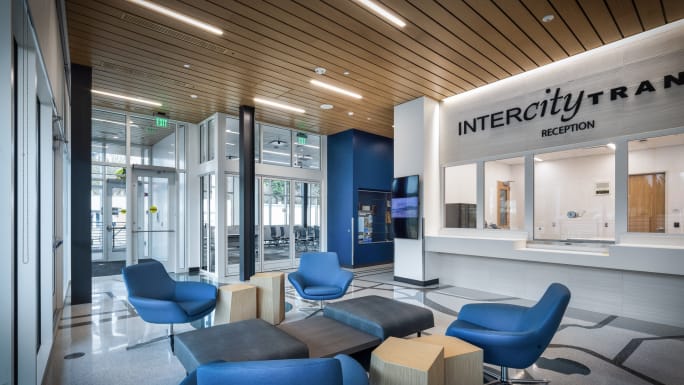
The north parcel (phase 1) completed construction in late 2022. The Administration, Operations, Facilities Maintenance, Fueling, and Wash Bays became fully operational in early 2023. Staff has been elated with these new facilities, individual department spaces and functional layouts, and the overall quality of the selected finish materials and furniture.
Ad Loading...
Stantec is currently working on Phase 2 improvements to the South Parcel, which includes completely gutting and remodeling the existing maintenance building, demolition of the original administration and operations building to expand employee parking, new paving for transit vehicle circulation with associated new sub-grade stormwater detention facilities, and perimeter security fencing to keep employees safe.
Once Phase 2 is completed, every employee within Intercity Transit will be positively impacted by their leadership team’s commitment to shaping IT’s culture to be one of the best places to work in Thurston County for decades to come.
The new facility will allow IT’s fleet to grow over the coming decades with new and expanded transportation services being delivered to the community, and thus, increasing the importance of utilizing mass transit to combat climate change.
About the Author: Merlin Maley is sr. principal, western region transit director, buildings, at Stantec.
Contract Four is the largest in the Second Avenue Subway Phase 2 project and includes construction of station infrastructure, tracks, and signals for the subway expansion, MTA officials said. Work on Contract Four will begin in 2027.
The new regional transit authority appointed its first board chair and interim executive director while extending reduced fares across CTA, Metra, and Pace for eligible riders.
Reliability-Centered Maintenance helps transit agencies move beyond routine checklists to focus limited resources on the assets and failures that have the greatest impact on safety, reliability, and service.
The 90-day demonstration will deploy coordinated security teams at five light rail stations while testing controlled access and gathering data to guide future investments.
Learn about delivering 1300 gates at 91 stations while managing fare evasion. Explore the large scale deployment, solution customization and real-world results that affect the region. Prepare for deployment in your region now.
Between packed transit stations and team motorcoaches, see how agencies and operators across North America tackled the transportation demands of the 2026 FIFA World Cup.
The stopgap keeps federal transportation programs moving, but missing advance funding could complicate the transit and rail projects agencies are planning next.