



How can public transport be more resilient to pandemics?
Depending on the status of coronavirus in your city, you will be working to minimize complex risks so that everyone working in and using public transport is safe.

COVID cells_viaCDC

Photo of coronavirus cells via CDC
Regardless of the crisis management plans you had in place, it’s fair to say that nothing could have prepared us for the recent coronavirus (COVID-19) pandemic. While it sweeps the globe, the impact is being universally felt regardless of the level of threat currently faced in your country.
Public transport systems are highly vulnerable to disease outbreaks, but they are also essential for daily mobility. Depending on the status of coronavirus in your city, you will be working to minimize complex risks so that everyone working in and using public transport is safe.
Here, we talk about how modern transit technology can help agencies to provide a safer service during these challenging times.
Public transport in the wake of coronavirus (COVID-19)
It’s unlikely that coronavirus will be completely eradicated soon. This means that extra precautions against the spread will remain a high priority, even when "business as usual" gradually resumes. Looking ahead, when social distancing is behind us, attention will be given to lessen the impact of any future novel contagions. It’s possible that some countries will introduce legislation, requiring proactive disease prevention measures to implemented.
There is no doubt that this will change life as we know it.
The pandemic has happened so quickly and the authorities have had to act rapidly to protect our society. Likewise useful resources have already been produced to help public transport operators manage the impact, including the UITP Factsheet and The Shenzhen Bus Group Report. They offer valuable recommendations on preparedness for public transport networks.
While there is great emphasis on personal hygiene and sanitizing fleets, reducing contact and social distancing is also imperative to minimizing the risks. Some of these recommendations can be quickly and easily implemented if you have the right technology systems in place.
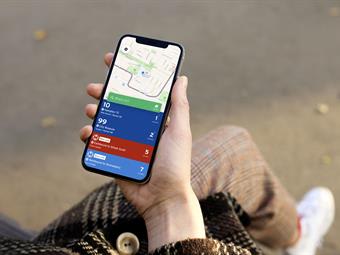
Rreal-time monitoring and management of your public transport fleet operations is crucial now more than ever.
St. Louis Metro
How the right technology can protect public transport from disease outbreaks
If you are operating in crisis management mode, it is quite likely that you will have set up an emergency operation team. Tasked with managing your response to the situation, the team will need to make the right decisions, quickly. This could be around controlling passenger flow, adapting services accordingly, customer communication, and revenue protection.
1.Managing operations and controlling demand
Fleet operations undoubtedly need to change. Bus operations should match passenger flow or be used to discourage unnecessary travel in accordance with government directives. This could involve controlling departures and reducing bus dispatch frequencies, as well as adjusting branch, peak and night routes, and suspending intercity bus services. You may also face the challenge of providing services with limited workforce due to absence.
This is where real-time monitoring and management of your public transport fleet operations become crucial. Automatic vehicle location (AVL) with a transit management system gives you city-wide visibility and control over every aspect of your operations. You can simulate resource, fleet, route, and schedule adjustments, then quickly implement any changes.
With an integrated transit management and passenger information system, any service adjustments can be automatically updated in your journey planning apps and passenger information displays.
These systems also increase performance and operational efficiency, enabling transport providers to deliver better services with less resources.
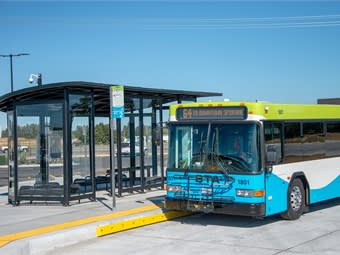
When providing to-the-minute service times, it’s important that real-time GTFS feeds use an ETA prediction engine with corrective algorithms for truly accurate arrivals.
Spokane Transit
2. Managing passenger flow and decreasing waiting times
Operators can support social distancing measuring by avoiding crowds gathering at bus stations, terminals, and stops. Accurate real-time passenger information enables travelers to plan their trip in advance and time their arrival so that they do not take any unnecessary risks.
When providing to-the-minute service times, it’s important that real-time GTFS feeds use an ETA prediction engine with corrective algorithms for truly accurate arrivals. This data can be instantly delivered to your passengers on-the-go via your mobile journey planning app, along with a wide range of other service information.
Mobile apps can also be used to control passenger flow, providing notifications, or introducing measures to stagger ridership. Passenger counting devices and cameras can be installed in vehicles can be integrated with the transit management system, so you can keep track of 50% passenger load restrictions that have been implemented in some cities.
3. Regular and informative passenger communication
Communication with passengers during these times is vital for maintaining public confidence in transport services and dealing with the situation with complete transparency.
Authorities have a duty of care to share all potentially valuable information and news, as well as standards of conduct to reduce any risk associated with travel. There will also be service changes and restrictions. This should all be communicated in advance where possible or in real-time as it happens.
Operators can keep their passengers fully informed, simultaneously and consistently across a wide range of channels with a passenger information system. Before travel via the website and mobile apps, at the start of the journey with screens at stations and solar powered digital bus stops, and during the journey on displays in the buses.
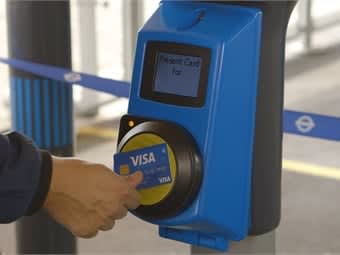
Aside from the wider benefits of contactless ticketing and automatic fare payment systems, it immediately removes the need for cash to change hands.
Visa
4.Avoid cash handling with contactless payments
A quick Google on cash handling and the coronavirus paints the picture as to why transport workers have voiced their concerns around cash handling, and why many operators have enforced contactless payment only, where possible.
Aside from the wider benefits of contactless ticketing and automatic fare payment systems, it immediately removes the need for cash to change hands. It also eliminates any contact between passengers and ticket kiosks, drivers or ticket inspectors. Contactless ticketing comes in the form of:
Contactless card payment cEMV (contactless Europay, Mastercard and Visa)
cEMV mobile payment using NFC tags (Near Field Communication)
Mobile device QR codes (Quick Response)
Account based ticketing using pre-charged smart cards
Ticketing apps could also be used to control passenger flow, by introducing measures to stagger ridership.
5.Enhance operation resilience with modern cloud-based systems
Advances in technology has enabled the public transport sector to operate in a dynamic digital world. This is largely a result of cloud-based transit platforms offering ready-made solutions that can accelerate time to market.
These platforms also offer greater resilience by enabling workplace mobility. This means your operations to continue in the event of a crisis like we are experiencing right now. They are accessible from any internet connected device, which means controllers and dispatchers can still run the transport system without being physically present in the company premises.
The software is offered as a service (SaaS) giving operators the flexibility to introduce new tools and scale with pay-as-you-grow subscription packages that fit any budget. No longer does it take a year to implement a new tool... but weeks or at most months. They also offer leading-edge capabilities as well as analytics, enabling operators to learn and adjust their models almost in real time.
These "transit systems as a service" offer the fastest, most flexible path to implementing advanced transit management capabilities.
Urša Hribernik is Head of Mobility at LIT Transit
More Management

METRO Opens Submissions for 2026 Motorcoach Awards
Nominations are now being accepted for METRO Magazine’s Operator of the Year and Innovative Operator of the Year awards.
Read More →
New York MTA Advances Final Contract for Second Avenue Subway Expansion
Contract Four is the largest in the Second Avenue Subway Phase 2 project and includes construction of station infrastructure, tracks, and signals for the subway expansion, MTA officials said. Work on Contract Four will begin in 2027.
Read More →
Transit Agencies Highlight Safety Gains at National Summit
Leaders from 15 major transit systems shared crime-reduction results and safety initiatives while discussing the role of continued federal support.
Read More →

NITA Names New Leadership, Expands Reduced-Fare Program at First Board Meeting
The new regional transit authority appointed its first board chair and interim executive director while extending reduced fares across CTA, Metra, and Pace for eligible riders.
Read More →
Beyond the Checklist: A Structured Approach to Transit Maintenance
Reliability-Centered Maintenance helps transit agencies move beyond routine checklists to focus limited resources on the assets and failures that have the greatest impact on safety, reliability, and service.
Read More →
APTA 2026 Nominating Committee Selects Leadership Slate, Names Chair and Vice Chair Nominees
Leadership changes will help shape the association’s priorities and its representation of the transportation industry during the 2026–2027 term.
Read More →
DART Launches Major Security, Fare Enforcement Initiative
The 90-day demonstration will deploy coordinated security teams at five light rail stations while testing controlled access and gathering data to guide future investments.
Read More →
Advancing Fare Collection Through Technology and Innovation
Learn about delivering 1300 gates at 91 stations while managing fare evasion. Explore the large scale deployment, solution customization and real-world results that affect the region. Prepare for deployment in your region now.
Read More →
Game Day in Motion: Moving Millions During the 2026 World Cup
Between packed transit stations and team motorcoaches, see how agencies and operators across North America tackled the transportation demands of the 2026 FIFA World Cup.
Read More →
Surface Transportation Extension Averts Shutdown, Leaves Transit Funding Gap
The stopgap keeps federal transportation programs moving, but missing advance funding could complicate the transit and rail projects agencies are planning next.
Read More →