



LAVTA Expands Core Projects to Boost Ridership, New Mobility
The agency was named APTA’s Outstanding Public Transportation System for the first time in its 35-year history.

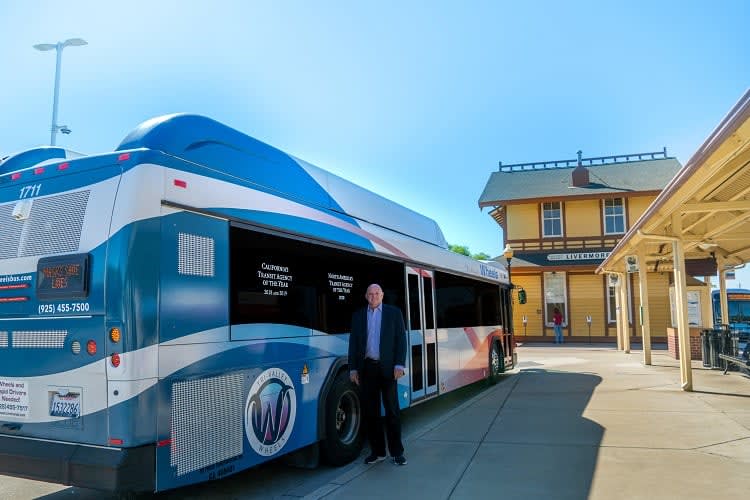
Starting with the redesign of its fixed-route bus services in 2016, LAVTA prioritized its ridership efforts in four key areas.
LAVTA
Calif.’s Livermore Amador Valley Transit Authority (LAVTA), reached a milestone as it was named APTA’s Outstanding Public Transportation System (4 million or fewer annual trips) for 2020. This is the first time the agency has received the honor in its 35-year history.
“The award came as a complete surprise and I didn’t believe it when I first heard the news,” says Michael Tree, LAVTA’s executive director. “We’ve been working really hard as a team the last few years on a variety of projects, including improvements to our fixed-route service, the Valley Link rail project, our shared autonomous vehicle project, and our partnerships with Uber and Lyft.”
The agency’s staff, which is comprised of a 14-person team and a seven-member board of directors, has worked to boost LAVTA’s ridership (up to 12% over a two-year period from 2017 to 2019) and increase the agency’s commitment to meeting community needs, even during the challenging times of the COVID-19 pandemic.
“We’ve really focused on getting the right people in the right positions that have a lot of capacity to be flexible, and do the work wherever they’re needed,” Tree adds, “Mostly thinking outside of the box.”
Tapping into new ridership
Starting with the redesign of its fixed-route bus services in 2016 — covering 40 square miles including the cities of Dublin, Livermore, and Pleasanton in Alameda County — LAVTA prioritized its ridership efforts in four key areas.
The highest priority was increasing the number of rapid routes with all day 15-minute service to connect with every BART train departure and arrival.
“That’s when the convenience factor of the routes really kicks in, and you can see some amazing ridership results,” Tree explains.
At the same time, increasing individualized marketing along those rapid routes, through LAVTA’s SmartTrips Tri-Valley Program — where a team of trained travel advisors went door-to-door to each resident in a targeted area of 3,500 homes and delivered personalized information and support to ride transit — generated an 11% increase in ridership within the project area.
Additionally, the growing partnership with the Alameda County Transportation Commission and the Livermore School District helped bring more than 1,000 students into the agency’s ridership network as they expanded a pilot transit pass program at nine of the community’s middle and high schools in 2019.
“They kind of were an untapped well of ridership potential,” Tree says. “That’s when things really just started to take off and the momentum was there.”
Prior to that, in 2016, Tree said the Las Positas College (LPC) universal access pilot program was another boost to getting the community on board, as LPC students were allowed to ride any LAVTA service. Student ridership for the fall 2019 semester totaled to 65,989, which was 36% higher than fall 2017’s ridership.
Fast forward to February of this year, LAVTA had just experienced six consecutive months of double-digit ridership growth. While ridership is currently rebounding slowly at about 15% of pre-COVID ridership levels (at press time), Tree said LAVTA’s work with other Bay Area transit agencies is ultimately setting the standard for safety — ensuring riders are safe no matter what transit agency they’re riding with.
More on-demand, real-time mobility
When it comes to adding new mobility options, LAVTA has its share in several lanes.
A sprouting partnership with Uber and Lyft in 2016 has grown into the agency’s GoDublin program, which split the cost of shared Uber and Lyft rides anywhere in the city of Dublin up to $5.
“The program was well received, and the average subsidy provided by LAVTA was about $2.70 a ride,” Tree says. “We were anxious to see what impact the GoDublin program would have on the rapid route running through Dublin. To our surprise the ridership actually increased.”
In 2019, approximately 1,500 rides were being provided monthly through the program.
Tree cited several reasons for the boost in ridership, but the most prominent was the agency’s individualized marketing program along the rapid route in the area.
During the COVID-19 pandemic, LAVTA expanded its GoDublin program throughout its entire service area with the GoTri-Valley Project.
“When the pandemic hit with physical distancing protocols, we basically could only get 10 people on a fixed-route bus. We had capacity issues,” Tree says. “We were trying to expand the number of mobility options, not just in Dublin, but throughout the entire service area.”
The agency hopes to have similar expansion prospects with its Shared Autonomous Vehicle (SAV) program. The program kicked off with a testing phase in Dublin in June 2018 and is funded by a grant from the Bay Area Air Quality Management District.
Despite it still being in the beginning stages, Tree says the agency expects to start rolling out SAV rides adjacent to the Dublin/Pleasanton BART station, with an eye toward providing revenue service to connect a nearby, high-density business park with the station.
“It’s about a mile away [from the BART station] and we are planning to construct a mobility hub on the business park campus that would include the SAV when the technology matures a bit,” Tree says. “The hub would also include bike sharing and scooters to increase mobility options for that first/last mile challenge.”
The timeline of completion for the SAV project is expected within the next year or two, when the mobility hub is built.
When asked about how LAVTA keeps the innovation wheel going for new mobility projects, Tree said it is all about patience.
“My advice on creating innovative programs is to take your time and find the right partners,” Tree notes. “Your partners and their expertise and willingness to invest in your project, as well as the right oversight within your agency, are really important to a successful project.”
More Bus

New York MTA Plans Largest Bus Fleet Upgrade in More Than a Decade
The agency is seeking manufacturers for 650 new CNG buses to replace aging vehicles, improve reliability, and advance its broader fleet modernization strategy.
Read More →
Building a Flexible Path to Transit Electrification
John Hroncich discusses BAE Systems’ modular and scalable approach, lessons learned from decades of real-world operations, and how agencies can identify electrification strategies that fit their fleets.
Read More →
Bus Tech Talk: Keeping Transit Technicians Ahead of the Technology Curve
LA Metro’s Obed Mejia discusses technician training, evolving maintenance technology, fleet replacement, and strategies for getting the most out of today’s transit fleets.
Read More →
Biz Briefs: RIPTA Unveils New Frontrunners, Clevland RTA Adds New Siemens, and More
In METRO's latest installment, we take a look at recent news from Siemens, Prevost, Dodge, and more partnerships making headlines across the transportation sector.
Read More →
People Movement: Holly Arnold Joins Transdev and More
In this edition, we also cover recent appointments and announcements at Pace, CamTran, MCI, and more, showcasing the individuals helping to shape the future of transportation.
Read More →
The High Cost of Transit Buses: Industry Leaders Look to Procurement Reform
Transit leaders and policymakers examine how standardized bus designs, streamlined procurement, and predictable funding could help agencies stretch budgets and deliver better service.
Read More →
The Business Voice Behind Public Transportation
As chair of APTA’s Business Members Board of Governors, Ray Melleady explains how more than 850 business members are partnering with transit agencies to advance funding, innovation, and industry-wide collaboration.
Read More →
From Surviving to Thriving: Building Stronger Transportation Organizations
Bus Business Consultants founder Brian Dickson shares lessons on leadership, organizational health, and creating options for long-term success in a changing transportation industry.
Read More →
Finding the ‘Happy Medium’: Optimizing Maintenance Without Sacrificing Reliability
The key to maintenance optimization isn’t doing less work—it’s doing the right work at the right time on the right assets.
Read More →
LA Metro, City of West Hollywood, and Partners Advance Smarter Bus Lane Enforcement
The award-winning partnership combines AI-powered detection with human oversight to improve bus reliability, accessibility, and enforcement efficiency.
Read More →