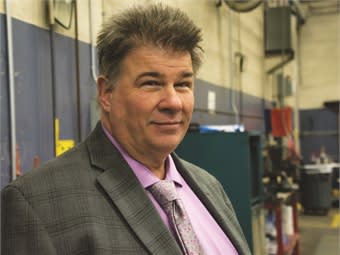
Winning in the 501-vehicles-and-over category, Ed Bennett, director of bus maintenance, oversees three bus maintenance facilities and a fleet of about 719 buses.
TriMet
7 min to read
At BusCon 2019, which was held in Indianapolis in September, METRO Magazine presented its annual Maintenance Director of the Year Awards to two industry stalwarts who have gone above and beyond to run a great maintenance operation.
Criteria for the award includes:
Ad Loading...
Innovative best practices resulting in cost savings; increased vehicle uptime; shop efficiencies; the recruiting/hiring/retaining of staff; and/or an impact on safety.
Improvements made through the better management of people, processes/assets, and/or financing/funding.
Triennial Reviews.
Ed Bennett TriMet
Winning in the 501-vehicles-and-over category, Ed Bennett, director of bus maintenance, oversees three bus maintenance facilities and a fleet of about 719 buses, which is comprised of battery-electric, diesel-hybrid, and diesel vehicles.
With A 35-year career, which includes experience in both the public and private sector, Bennett joined TriMet a few years ago and implemented a preventive maintenance inspection (PMI) program that enabled the bus maintenance department to react proactively by addressing repairs prior to the bus breaking down.
“I developed a high-level PMI program that monitors the overall health of the fleet from cradle to grave,” explains Bennett. “Each item listed on our newly revised inspection forms requires the technician to identify the levels of severity for each component or subcomponent.”
For example, severity level 1 indicates normal signs of aging. The component should be checked during the next regularly scheduled PMI to ensure acceleration of component age has not occurred. Severity level 2 indicates progressed aging and requires scheduled repair prior to the next regularly scheduled PMI. Severity level 3 indicates a defect found that is safety, road call/road trade, or ADA-related, where the bus must be placed out of service until the repair is completed.
Ad Loading...
While at TriMet, Bennett has helped the agency experience significant savings in finances, parts, fleet, and labor.
TriMet
The new system has eliminated deferred work and decreased the number of overall identified defects on future PMIs.
“If you stay true to this practice, in theory, every time your PMI interval goes around, there are less and less write-ups because everything is being fixed before the next PMI,” Bennett says.
Upon first arriving at TriMet, the mean distance between failures was a little over 4,000 miles. One year after implementation of the program, TriMet saw its combined all mean distance between failure rate (major/minor/other) increase to about 14,600 miles. With lost service for major road calls (all mechanical) totaling a mean distance between failures of 280,593 miles.
Bennett says the new process took some time to produce results, as well as for the maintenance technicians to adjust and fine-tune the new practice.
“I told my team it’s going to get a lot worse before it gets better,” Bennett says. “At first, there was so much work piling up that you could tell everybody’s stress level was up, but right around month eight we started to see positive change happening.”
Ad Loading...
In July 2017, TriMet collaborated with Cummins and Valvoline for a pilot program to address high oxidation rates and wear metals observed in oil samples. TriMet tested Valvoline Premium Blue over a year duration, working with Cummins Engineering, which resulted in 65% better valve train wear protection, 33% piston deposit reduction, oxidation resistance that exceeded limits by 80%, and viscosity control that exceeded limits by 80%.
By the end of the pilot program, Cummins granted TriMet an extended oil range from 6,000 miles to 12,000 miles, resulting in an annual savings of $150,234 in labor and $131,250 in oil. TriMet also experienced a reduction of 12,500 gallons of engine oil used annually.
“Everything we do here is not a knee-jerk reaction, it’s all data driven, but it takes time until you experience a return on that initial investment,” says Bennett. “The oil project is now paying off for us and helped TriMet reduce its carbon footprint while still operating diesel engines.”
Working in conjunction with labor union ATU 757, the agency recently standardized PMI time expectations, which has resulted in further savings in finances and labor hours.
In 2018, TriMet completed 5,511 safety critical inspections, which equates to about 60,856 labor hours, or $4.4 million worth of labor. By implementing standardized PMI time expectations, the agency is now completing the same amount of safety critical inspections, but taking about 30,425 total annual hours to complete, saving about $2.2 million worth of labor, annually.
Ad Loading...
Bennett says a key to his success in the shop is due to the lessons learned in both the public and private sector.
“I owe my success to all the people that I’ve worked with in the past but working in the private sector taught me to be efficient when making decisions,” he says. “What I try to do is a find a way to blend that with my public sector experience, because we have a responsibility to the public to be respectful of the asset, which in this case is our vehicles. And, I believe that we’re doing that.”
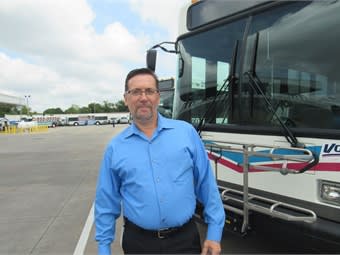
With more than 35 years of experience at Votran, Kazawitch has seen the agency grow its fleet from 28 to 175 vehicles.
Votran
Rick Kazawitch
Volusia County Public Transit System (Votran)
For more than 38 years, Rick Kazawitch has been at Votran, beginning on the service island before being added in an apprentice position and eventually climbing the ladder all the way to director of maintenance, which he has been for the last 20-plus years.
“At 19, I came to inquire about a mechanic position,” Kazawitch explains. “At the time, Votran had 48 buses and five mechanics, so they had no openings. I almost walked away, but then I asked, ‘Where can I start until an opening becomes available?’”
Kazawitch adds his love for the transit world drove him to soak up every bit of training and opportunity he could, before he eventually got to where he is now. During his time at Votran, he has seen the agency grow its fleet from 28 to 175 vehicles and its maintenance staff from five to 40 employees, while also testing multiple new technologies and alternative fuels along the way.
Ad Loading...
Kazawitch says one key to his success, and the success of his maintenance team, over the years is staying ahead of the curve with training.
“The equipment is ever-changing, and it’s a challenge to keep myself and my team ahead of the curve as our technology and equipment changes almost yearly,” he says. “We have technicians ranging in experience from 40 years with the company to just one year. Not everybody embraces change as well as others do.”
To help technicians statewide stay on top of the latest in training, as well as attract new talent to the industry, Kazawitch is on the Transit Maintenance Analysis Resource Center committee, which was created in conjunction with the Florida Department of Transportation and the Center for Urban Transportation Research.
“Back in the day, we all went to some type of training that wasn’t specific to transit,” he says. “We now have an accredited training program with a curriculum that consists of 15 modules that we adapt to stay up-to-date with all the latest challenges and technologies technicians are facing in the garage today.”
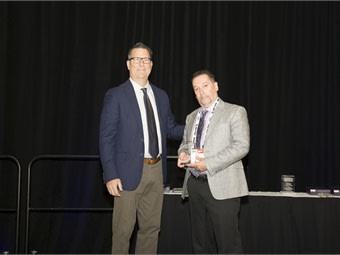
In addition to winning the Transit Maintenance Director of the Year Award, Rick Kazawitch (right) and Votran were also honored for their usage of propane autogas on their propane fleet.
METRO Magazine
Kazawitch says the agency has now adapted its own in-house training program, which mirrors the statewide curriculum he helped create. The program begins with the basics and progressively works its way up to advanced level training for technicians. Like the statewide program, Votran’s training adapts to address technicians’ latest needs in the shop.
Ad Loading...
Training and staying ahead of the curve has helped the Votran maintenance team reduce the number of road calls reported year-to-year from 212 in 2017 to 168 in 2018. Those numbers decreased despite the fact the agency has added two new fixed-routes and increased frequencies on several routes in its service area.
Kazawitch says the agency’s preventive maintenance program, which like its training program is not static, has been key in keeping up with the increased engine hours and overall mileage on the fleet.
“By examining our data for all of our major components, we forecast their service life and create a replacement schedule to get the best life out of the component and replace that component before a catastrophic failure occurs,” he says. “Then of course by looking at that data and trends we are seeing with our fleet and those components, if we start to see we are not meeting the target criteria, we’ll make those adjustments within our replacement schedule.”
Kazawitch adds Votran is currently “far above” hitting 90% of its target mileage without a catastrophic failure.
While picking up his Transit Maintenance Director of the Year Award for the 500-and-under category at BusCon 2019, Kazawitch and Votran were also honored by the Propane Education & Research Council for its usage of propane autogas on its paratransit fleet.
Ad Loading...
“We started testing and operating propane on our paratransit fleet in 2010 and have cautiously tracked the data on dependability and return on investment,” Kazawitch says. “Our intent now is to increase our usage of propane, as well as the number of fueling stations we have at our facility.”
Elizabeth Suchsland, assistant GM, operations and maintenance, for Votran says Kazawitch’s historical knowledge, intellectual curiosity, and passion for the industry is just the beginning of the impact he has made at the agency.
“It’s also things that can’t always be measured, like his willingness to listen and obtain input from others, along with putting in the hours to work at the state and local levels to support and grow the industry,” she says. “It is a true honor to work with him.”
Austin Transit Partnership CEO Greg Canally discusses the city's nearly 10-mile light rail project, its collaborative approach to project delivery, the importance of community engagement, and the milestones ahead as construction approaches in 2027.
ETA founder and CEO John Maglio explores the evolution of transit technology, the importance of reliable systems, and how stronger partnerships can help agencies improve operations and the passenger experience.
The Systemwide Network Plan identifies infrastructure needs and potential investments to expand all-day, bidirectional rail service across the Chicago region.
In this edition, we also spotlight recent personnel moves at HDR, PATH, STV, and more, highlighting the people taking on new roles across the transportation industry.
Transit agencies are using fare-free service, trip-planning tools, and targeted rides to improve voting access. See what other agencies can learn from these efforts.
The railroad’s shift to electric service has brought more frequent trains, stronger customer satisfaction, and increased ridership, earning it APTA’s Outstanding Public Transportation System award.
CTA launched crisis intervention teams as CATS prepares to deploy fare ambassadors, expanding customer assistance and security efforts across both systems.
Bus Business Consultants Founder Brian Dickson discusses the leadership principles, operational discipline, and strategic planning that separate transportation companies positioned for long-term success from those stuck in survival mode.
The 12.4-mile corridor is projected to serve 66,200 daily riders, reduce travel times by up to 24%, and create the nation's busiest bus rapid transit corridor.