



The Future of Passenger Transit Cleaning
Public transportation brings unique cleaning and disinfecting challenges because more than 34 million people utilize these services each weekday in the U.S.
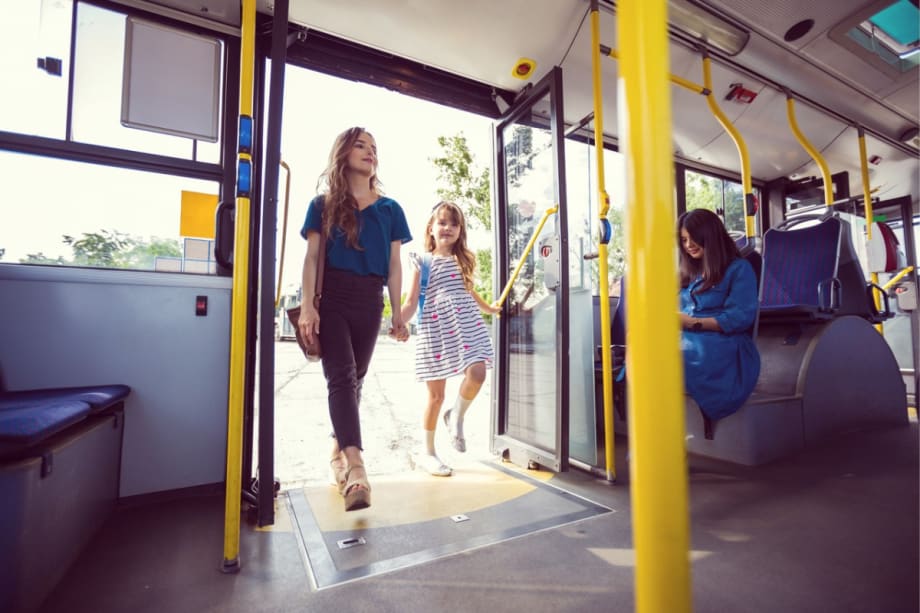
Passengers and employees of public transportation are often in enclosed, crowded spaces with poor ventilation.
Photo: izusek
Effective cleaning on public transportation is essential to protect passengers and employees alike, especially as viruses and other pathogens, including SARS-CoV-2, influenza, MRSA, E. coli, salmonella, superbugs and more, make their way onto passenger transit systems.
Public transportation brings unique cleaning and disinfecting challenges because more than 34 million people utilize these services each weekday in the U.S. (more than 448,000 people work in the U.S. public transportation industry) and sometimes vehicles are in service for 24 hours making it difficult to implement overnight or downtime deep cleanings.
Unique Cleaning and Disinfecting Challenges
Passengers and employees of public transportation are often in enclosed, crowded spaces with poor ventilation. This can lead to a concentration of dangerous airborne and surface pathogens.
With this much close-proximity human interaction throughout each day on buses, coaches, and passenger trains, it is essential to have both the air and the many high-touch surfaces, including handles, railings, seatbacks, tops of seats, armrests, and pullcords and shared equipment such as steering wheels, GPS systems, and fare readers, that collect pathogens cleaned effectively, efficiently and frequently. This will ensure a safe, healthy environment for public transportation passengers and employees.
Most pathogens stay in the air for minutes to several hours and spread from person to person during that time. Getting sufficient fresh air into public transportation vehicles to foster ventilation – through open windows or fans – is not always feasible.
Air filtration systems are good at removing larger matter such as pollen, dust mites, bacteria, and mold from the air, but viruses are too small and cannot be trapped in filters. Often bacteria/mold that is trapped can be re-released into the circulating air or re-grow in the filters.
Additionally, air filtration systems do not inactivate pathogens on surfaces that can stay for hours, days, or even months – increasing the likelihood of transference to people.
Current Chemical Cleaning Methods are Insufficient
Manual chemical cleaning methods such as disinfecting sprays and wipes are insufficient for inactivating pathogens on surfaces in public transportation as many of these chemicals are not being used frequently enough or effectively.
Chemicals are only effective when users adhere to product instructions and dwell times, or the length of time they need to remain “wet” on the surface (often as long as four-to-10 minutes) before the surface is wiped and/or available for re-use. The fumes from chemical cleaners can be harmful to humans and some chemicals are not suitable for all surfaces. They may be corrosive to technology, touchscreens, and manual and digital transit card readers, or ineffective on certain materials and fabrics.
The cleaning and disinfecting process takes time and often happens only one to two times per day, so as soon as a person touches a surface, it is re-contaminated until the next time chemicals are utilized.
An example of this was in New York City when the pandemic was raging through the city in the spring of 2020. In May of that year, Governor Andrew Cuomo announced that the MTA would disinfect the entire New York City subway system.
To do this, the transit system, including buses, trains, and all 472 stations, closed between 1 a.m. and 5 a.m. each day so crews could clean. It was an unprecedented move in a 24-hour city. It also was a monumental and labor-intensive undertaking that required crews to wear protective suits and move through each train car and bus spraying chemical disinfectant.
These cleaning measures had the right intention, but as soon as passengers – potentially coughing and sneezing into the air and touching surfaces – re-entered MTA buses, trains, and stations, the environment was re-contaminated.
Surely, there must be a better way.

With this much close-proximity human interaction throughout each day on buses, coaches, and passenger trains, it is essential to have both the air and the many high-touch surfaces.
Photo: Aphiwatthana Yasan
The Future of Passenger Transit Cleaning
There is a new tool that is available to be added to public transportation cleaning and disinfecting protocols to address the ongoing and concerning pathogen issues within the industry. It is a germicidal light called Filtered Far UV-C, and it is ready now to be deployed in high volumes in buses and trains to meet the scale of public transportation needs. And it doesn’t require closing down any mode of transport.
Filtered Far UV-C disinfects pathogens with the same efficacy as conventional UV-C light (long used in hospitals and healthcare settings for disinfection), but it has a patented filter that, when used within the current limits set by the American Conference of Governmental Industrial Hygienists (ACGIH), makes it safe for human use and exposure without requiring the use of protective gear.
It is a 24/7, always-on, potentially lifesaving light technology that can be installed in overhead fixtures on buses and trains to inactivate aerosolized pathogens and used in a handheld format for rapid surface disinfection at close distances. When used at close distances, Filtered Far UV-C can inactivate pathogens in seconds, including SARS-CoV-2 in less than one second.
Far UV-C vs. Filtered Far UV-C: An Important Distinction
Conventional UV-C devices and lamps emit UV-C light having a peak irradiance of around 254nm light. It’s tough on pathogens, but too dangerous for use when people are directly exposed to it.
Far UV-C refers to the narrow band of UV-C light from 200nm to 230nm. Sometimes, it is referred to as 222nm because light at this specific peak irradiance of 222nm wavelength has been scientifically proven to have the same efficacy as 254nm UV-C but is human-safe.
However, not all Far UV-C is the same and unfortunately, Far UV-C light is often being misrepresented in the media and incorrectly touted by companies as safe for human exposure without mention of the needed patented filter, which makes current Filtered Far UV-C lights safe for human exposure.
Filtered Far UV-C has a peak irradiance of 222nm and uses a special optical band pass filter to block the “tail” of UV-C wavelengths above 230nm that are harmful to humans.
Opportunists have disregarded the need for filtration and have used partial scientific evidence to play on the fears of people who are desperate for solutions. These inferior products emit wavelengths that are unsafe for human exposure and have the potential to cause long-term health effects.
Continued commercialization of safe and effective Filtered Far UV-C will make disinfection easy and chemical-free for passenger transportation – reducing pathogens in both air and on surfaces.
This new technology is a new tool to help us all fight existing and forthcoming pathogens to keep public transportation passengers and employees safe.
Latest and Greatest: NFI Parts, Bitimec Highlight Products You Need to Know
About the Authors: Jennifer Rosen and Ben Feeney are co-founders of Freestyle Partners LLC., an IP accelerator that has a portfolio of U.S. and global patents and patents pending that utilize UV-C and Filtered Far UV-C within a variety of commercial applications.
More Management

METRO Opens Submissions for 2026 Motorcoach Awards
Nominations are now being accepted for METRO Magazine’s Operator of the Year and Innovative Operator of the Year awards.
Read More →
New York MTA Advances Final Contract for Second Avenue Subway Expansion
Contract Four is the largest in the Second Avenue Subway Phase 2 project and includes construction of station infrastructure, tracks, and signals for the subway expansion, MTA officials said. Work on Contract Four will begin in 2027.
Read More →
Transit Agencies Highlight Safety Gains at National Summit
Leaders from 15 major transit systems shared crime-reduction results and safety initiatives while discussing the role of continued federal support.
Read More →

NITA Names New Leadership, Expands Reduced-Fare Program at First Board Meeting
The new regional transit authority appointed its first board chair and interim executive director while extending reduced fares across CTA, Metra, and Pace for eligible riders.
Read More →
Beyond the Checklist: A Structured Approach to Transit Maintenance
Reliability-Centered Maintenance helps transit agencies move beyond routine checklists to focus limited resources on the assets and failures that have the greatest impact on safety, reliability, and service.
Read More →
APTA 2026 Nominating Committee Selects Leadership Slate, Names Chair and Vice Chair Nominees
Leadership changes will help shape the association’s priorities and its representation of the transportation industry during the 2026–2027 term.
Read More →
DART Launches Major Security, Fare Enforcement Initiative
The 90-day demonstration will deploy coordinated security teams at five light rail stations while testing controlled access and gathering data to guide future investments.
Read More →
Advancing Fare Collection Through Technology and Innovation
Learn about delivering 1300 gates at 91 stations while managing fare evasion. Explore the large scale deployment, solution customization and real-world results that affect the region. Prepare for deployment in your region now.
Read More →
Game Day in Motion: Moving Millions During the 2026 World Cup
Between packed transit stations and team motorcoaches, see how agencies and operators across North America tackled the transportation demands of the 2026 FIFA World Cup.
Read More →
Surface Transportation Extension Averts Shutdown, Leaves Transit Funding Gap
The stopgap keeps federal transportation programs moving, but missing advance funding could complicate the transit and rail projects agencies are planning next.
Read More →