




RELATED: Massport mitigates airport congestion with TNC plan
Are airports in for a traffic jam this holiday? Not necessarily
If airports want to regulate rideshare, they need to offer alternative service that’s capable of competing with the likes of Uber and Lyft.
December 23, 2019

5 min to read

J.Starcic/METRO Magazine
Airports across the country are gearing up for a hectic holiday travel season. AAA is predicting record travel this year, with an estimated 115.6 million Americans expected to travel 50 miles or more between December 21 and January 1. If accurate, this will be the largest travel volume since AAA began tracking the numbers in 2000.
Record-high travelers will surely present significant traffic and congestion issues at airports across the country. Couple this with a rapid rise in rideshare congestion, and it’s a total traffic mess. Many hubs from LAX to Boston’s Logan International Airport are creating new regulations to combat the traffic problem in advance of the busiest travel season, but they’ve certainly not avoided criticism.
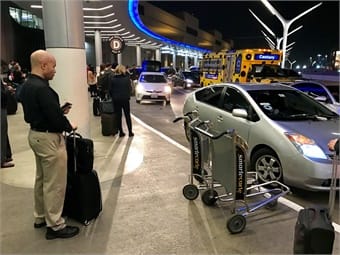
If airports want to regulate rideshare, they need to offer alternative service that’s capable of competing with the likes of Uber and Lyft.
J. Starcic/METRO Magazine
As airports prepare to service millions of travelers this season, they need to understand how to approach the issue without completely losing sight of consumer preferences along the way.
Enter, the airport shuttle (that you can finally track)
It comes as no surprise that airports across the country are implementing big changes to regulate rideshare. At San Francisco International, companies like Uber and Lyft accounted for 75% of commercial ground transportation in 2018. That’s about 880,000 trips a month, which obviously makes for a traffic nightmare. While it’s necessary that airports set restrictions to combat the traffic problem, they can’t overlook the reasons why consumers tend to lean more toward rideshare in the first place.
Uber and Lyft offer unprecedented benefits to consumers, especially travelers. Being able to schedule a pick-up and track that ride before you’ve even made it to the gate is a luxury that obviously keeps riders coming back. But what if airports could offer comparable levels of trip ownership and customization?
If airports want to regulate rideshare, they need to offer alternative service that’s capable of competing with the personalized service Uber and Lyft provide. The airport shuttle has been the most popular replacement for rideshare service at the airport, and while it’s certainly more efficient from a traffic perspective, it doesn’t have the best reputation. Airport shuttles have long been known for their tendency to be delayed, outdated, and impossible to track down. However, airports like LAX are starting to recognize this stigma, which is why they’re modernizing the shuttles themselves, as well as the backend operations that inform the service all together.
Companies like Journey Holding are powering airports with technology solutions to finally update airport shuttles with features like GPS tracking, where travelers can request a pick-up on demand and then watch a van icon move along its route and get an estimated arrival time at a given stop — just like waiting for an Uber, but without the added congestion. While these features may seem like a longtime coming to consumers today, airports are legacy operations with often limited resources. This typically leaves them playing catch-up with tech innovation that’s happening at a rapid pace around them. In leveraging external resources like Journey Holding, airports are able to keep pace with those changes, as well as customer-expectations.
By collecting insights on the backend around things like peak travel times, or how full a given shuttle is, shuttle service can be adjusted based on real-time data. I’m sure you’ve seen plenty of airport shuttles running empty along routes throughout the day. This isn’t just a waste of resources, it also creates unnecessary congestion. As airports continue to modernize and become just as data-driven as companies like Uber and Lyft, they will be able to avoid these scenarios. Of course, this helps them optimize routes and resources, but it also allows airport operators to identify areas that aren’t being served enough, or evaluate and respond to instances where travelers are experiencing a lack of reliable service. Ultimately, altering shuttle service so that it’s informed by data and made available on-demand on the platforms consumers use most — their phones — is making this sustainable and efficient transit alternative a competitive option.
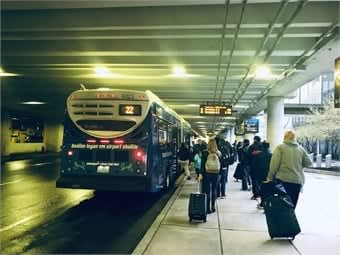
Many hubs from LAX to Boston’s Logan International Airport (shown) are creating new regulations to combat the traffic problem in advance of the busiest travel season.
J. Starcic/METRO Magazine
Thinking beyond the airport
Air travel demand is expected to rise far beyond this holiday season. As traveler numbers increase, airports have to recognize the opportunity to leverage transportation technology as a means to combat the congestion issues that will inevitably follow. Beyond that, the benefit of making these changes extends outside of the airport itself.
When we think about addressing traffic and congestion, and reforming transportation to do so, it’s important to take an in-depth look at airports. Of course, these hubs are known for being busy traffic centers, but they’re also full of useful data around how people interact with important transit features that are also present in the cities they reside in — think curbs, sidewalks, parking lots, etc. This makes airports the ideal “testing ground” for transit innovation. Operating data-driven transit solutions on airport grounds is a great way to understand how those same solutions could ultimately function in major metros. This is a huge driver for companies like Journey Holding that are powering airports with the resources to gather and analyze transit data. Of course, these efforts streamline travel at the airport itself, but they also pave the way for future innovation to happen on city streets and highways beyond the airport.
The bottom line is, airport infrastructure is growing increasingly strained as traveler numbers rise. As we prepare for record-travel this holiday, it’s critical that airports react with an understanding of consumer preferences. We know the rideshare wave can’t be sustained at airport curbs, but breaking this culture isn’t as simple as placing bans and restrictions on the service. Airports and transit innovators alike need to take advantage of the opportunity to develop smart, sustainable, data-driven alternatives that can compete both on airport grounds and in the cities they reside in.
Justin Rees is CEO of Ford Mobility’s TransLoc, DoubleMap, and Ride Systems.
Subscribe to Our Newsletter
More Blog Posts
Building a Winning FTA Grant Proposal: Why Propane Autogas is the Pragmatic Choice for Fleet Resilience
With $610 million available through the FY 2026 Buses and Bus Facilities Competitive Program and the Low or No Emission Grant Program, agencies must build a compelling case before the September 21 deadline that balances environmental compliance with operational feasibility.
Read More →
Velo-city Conference 2026: Latest Trends in Cycling as Part of Urban Mobility
The global cycling conference highlighted how cities are integrating bicycles into multimodal transportation networks, expanding cycle tourism and reshaping urban mobility.
Read More →
Kindness Isn’t Soft...It’s Strategic.
Mike Bismeyer — often known as “The Kindness Guy” — has spent more than 17 years in public transit and mobility, serving in industry leadership roles, speaking across North America, and advocating for stronger workplace cultures. But his message doesn’t come from theory. It comes from lived experience.
Read More →
Inside ITF 2026: Transport Reacts to A Challenging World
Transport leaders from around the world gathered in Leipzig, Germany, for the 2026 International Transport Forum to discuss resilience, climate impacts, supply chains and the future of sustainable mobility.
Read More →
Every Ride Tells a Story — But You’re Not Just Selling the Ride
You’re selling the moment, the meaning, and the emotion behind it.
Read More →
How Digital Signage is Reshaping the Traveler Experience at Transportation Hubs
What was once a landscape of static signs has evolved into a responsive, immersive environment powered by real-time visual communication.
Read More →
Latest Trends in Urban Mobility from Polis Conference 2025
Polis comprises cities and regions, as well as corporate partners, from across Europe, promoting the development and implementation of sustainable mobility. This year’s event had over a thousand attendees across various policy forums and an exhibition.
Read More →
Why Transit Leaders Require Better Tools for Operational Clarity In Today’s Tech-Fragmented Environment
Across North America and beyond, transit agency officials are contending with a perfect storm of operational headaches and strategic challenges that hamper daily service and long-term progress.
Read More →
The Powerless Brokers: Why California Can’t Build Transit
It is no secret that transit in the U.S. is slow and expensive to build.
Read More →
Why Transport Sustainability Should Focus on People Instead of Cars
Simply incentivizing electrification is not enough to make a meaningful impact; we must shift our focus toward prioritizing public transportation and infrastructure.
Read More →