




RELATED: Montreal transit app rewards riders with personalized offers
Public Transit Has 'Perks' With Loyalty Programs
The benefits of using public transit are many — environmentally friendly, less stressful than driving and no time wasted sitting in traffic, to name a few. For commuters in cities like Philadelphia, Los Angeles and Montreal, there are even more advantages for using transit — discounts at local businesses for using bus/train/trolley passes.
May 4, 2016
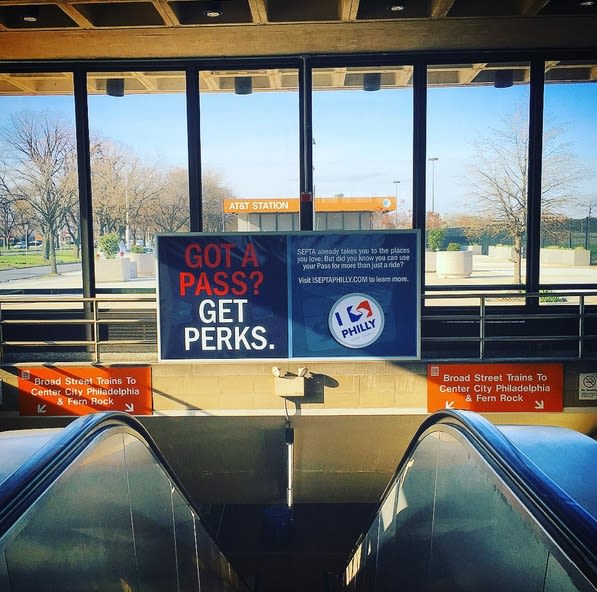
SEPTA has advertised its "Pass Perks" loyalty program around the system, on vehicles, at stations, in online ads and on its website.
3 min to read

The benefits of using public transit are many — environmentally friendly, less stressful than driving and no time wasted sitting in traffic, to name a few. For commuters in cities like Philadelphia, Los Angeles and Montreal, there are even more advantages for using transit — discounts at local businesses for using bus/train/trolley passes.
The Southeastern Pennsylvania Transit Authority’s (SEPTA) “Pass Perks” loyalty program was launched by SEPTA’s marketing department in 2006. Pass Perks rewards the Authority’s daily, weekly and monthly pass holders with discounts and special offers for museums, restaurants and shops across the SEPTA service region. There are even offers for yoga studios, spas and sporting event tickets — which, like using mass transit, are ways to relax while not being stuck in traffic.

“Pass Perks is a win-win-win for our riders, the Authority and our partners,” said SEPTA Director of Marketing Liz Bradford. “The program allows us to offer something special to those who buy our passes, in many cases for locations they are already patronizing. And for the partners, there is no cost for them to join the program—they just need to be a consumer-oriented business.”
Businesses that enroll as Pass Perks partners are featured on the SEPTA Marketing Department’s popular ISEPTAPHILLY.com website, a site dedicated telling the public how to use SEPTA to get to the hottest events and locations around Philadelphia on SEPTA, as well as recent SEPTA news. Pass Perks partners are also promoted on social media.
“We have more than 27,000 likes on the Pass Perks Facebook page and almost 40,000 ISEPTAPHILLY Twitter followers,” said Bradford. “Pass Perks partners are exposed to thousands of current and potential customers with little capital investment on their part. It’s hard to find a good advertising deal like that anywhere else.”

Of course, to ensure that SEPTA pass holders use mass transit to take advantage of the discount offers, ISEPTAPHILLY.com helps customers plan their trips on the Authority’s modes.
“We re-launched ISEPTAPHILLY.com in February 2016, incorporating the Pass Perks website with our other marketing tools,” said Bradford. “Now, our riders can access Pass Perks on mobile devices, checking out the deals while on the go. This ease of use will help us grow Pass Perks, introducing it to audiences that might not have been aware of these opportunities.”
With the new website, SEPTA is able to track which offers resonate with pass holders the most. “Our riders like sports — the top three performers were the Phillies, Flyers and Sixers. The Philadelphia Union is also in the top six,” said Bradford. “Based on these data we gather, we can tailor the program to meet our customers’ interests.”
Heather Redfern is the Public Information Manager for the Southeastern Pennsylvania Transportation Authority.
Subscribe to Our Newsletter
More Blog Posts
Velo-city Conference 2026: Latest Trends in Cycling as Part of Urban Mobility
The global cycling conference highlighted how cities are integrating bicycles into multimodal transportation networks, expanding cycle tourism and reshaping urban mobility.
Read More →
Kindness Isn’t Soft...It’s Strategic.
Mike Bismeyer — often known as “The Kindness Guy” — has spent more than 17 years in public transit and mobility, serving in industry leadership roles, speaking across North America, and advocating for stronger workplace cultures. But his message doesn’t come from theory. It comes from lived experience.
Read More →
Inside ITF 2026: Transport Reacts to A Challenging World
Transport leaders from around the world gathered in Leipzig, Germany, for the 2026 International Transport Forum to discuss resilience, climate impacts, supply chains and the future of sustainable mobility.
Read More →
Every Ride Tells a Story — But You’re Not Just Selling the Ride
You’re selling the moment, the meaning, and the emotion behind it.
Read More →
How Digital Signage is Reshaping the Traveler Experience at Transportation Hubs
What was once a landscape of static signs has evolved into a responsive, immersive environment powered by real-time visual communication.
Read More →
Latest Trends in Urban Mobility from Polis Conference 2025
Polis comprises cities and regions, as well as corporate partners, from across Europe, promoting the development and implementation of sustainable mobility. This year’s event had over a thousand attendees across various policy forums and an exhibition.
Read More →
Why Transit Leaders Require Better Tools for Operational Clarity In Today’s Tech-Fragmented Environment
Across North America and beyond, transit agency officials are contending with a perfect storm of operational headaches and strategic challenges that hamper daily service and long-term progress.
Read More →
The Powerless Brokers: Why California Can’t Build Transit
It is no secret that transit in the U.S. is slow and expensive to build.
Read More →
Why Transport Sustainability Should Focus on People Instead of Cars
Simply incentivizing electrification is not enough to make a meaningful impact; we must shift our focus toward prioritizing public transportation and infrastructure.
Read More →
Transit ROI & System Efficiencies Will Drive 'Big, Beautiful' Transit Funding
For many years, the narrative surrounding public transit improvements has been heavily weighted toward environmental gains and carbon reduction. While these are undeniably crucial long-term benefits, the immediate focus of this new funding environment is firmly on demonstrable system efficiencies and a clear return on investment.
Read More →