



SEPTA steps up to fight human trafficking
Transit can play a role in helping to stop human trafficking, considering the number of people using it 24 hours a day. SEPTA Police Chief Thomas Nestel was recently joined by representatives from local social service agencies and a former human trafficking victim to discuss signs of the crime, law enforcement efforts and how the public can help.

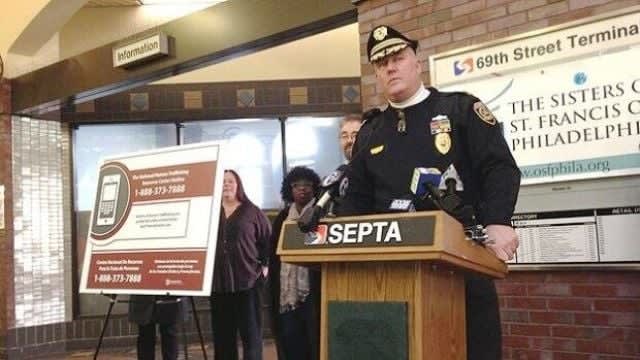
SEPTA Police Chief Thomas Nestel at the 69th Street Transportation Center discussing SEPTA's human trafficking initiatives.
SEPTA Police Chief Thomas Nestel at the 69th Street Transportation Center discussing SEPTA's human trafficking initiatives.
The 2014 Super Bowl brought more than the big game to the New York City/ North Jersey metropolitan area: the event created an increased awareness of the crime of human trafficking.
According to the U.S. Department of Homeland Security’s Blue Campaign, sex trafficking generates $32 billion a year. And, major sporting and entertainment events can mean more opportunities for these crimes.
Transit can certainly play a role in helping to stop human trafficking, considering the number of people who use buses, trains and trolleys or access depots and stations 24 hours a day.
In Philadelphia, just before Super Bowl Sunday, Southeastern Pennsylvania Transportation Authority (SEPTA) Police Chief Thomas Nestel was joined by representatives from local social service agencies and a former human trafficking victim to discuss signs of the crime, law enforcement efforts and how the public can help.
RELATED: "Human trafficking the focus of L.A. Metro program"
SEPTA's police department has altered its approach when dealing with prostitution.
"In the past, we focused on the person who was providing the service, not the person who controls the prostitute,” said Nestel. “The laws have changed over the past four to five years, allowing us to pursue those who are holding people against their will and forcing them to commit sex crimes."
SEPTA police officers have received specialized training from the Philadelphia District Attorney's Office on how to prepare a trafficking case for prosecution.
"Our officers are asking questions beyond the arrest, to try to find out if the prostitute is being forced to work the streets and who is controlling her life," Nestel added. "We also have contact with social service organizations and can provide avenues of escape for trafficking victims."
The SEPTA Police Department works closely with the Philadelphia Anti-Trafficking Coalition (PATC), a group whose 62 members represent law enforcement, social service and government agencies across the Philadelphia region. PATC provides training for people most likely to encounter or provide service to trafficking victims, including police officers and medical professionals, as well as support for victims, such as access to legal aid, advocacy and shelter.
Helping SEPTA’s — and Pennsylvania’s — crime fighting efforts is the passage of Pennsylvania Act 197. Under this law, establishments such as airports, train and bus stations, welcome centers and rest areas, massage parlors, spas, hotels and motels are required to post signage with the national trafficking hotline phone number (1-877-373-7888).
RELATED: "Minneapolis Metro campaign to help combat sex trafficking"
"We are asking the public and our employees to keep an eye out for pimps who appear to be preying on vulnerable young women at our transportation hubs or in the neighborhoods around our stations," said Nestel. “We are looking for runaways, for vulnerable young woman who might be hanging out at transit stations, seemingly out of place. Posting the hotline number, in addition to the training our officers have received should make a difference in getting victims the assistance they need and stopping these heinous crimes.”
In case you missed it...
Read our METRO blog, "Bus Wi-Fi system considerations for transit agencies."
More Blog Posts

Five Years Later: What’s Changed at Greyhound
Five years after Flix acquired it, Greyhound reflects on fleet modernization, operational improvements, employee empowerment, and a renewed focus on customer experience.
Read More →
Building a Winning FTA Grant Proposal: Why Propane Autogas is the Pragmatic Choice for Fleet Resilience
With $610 million available through the FY 2026 Buses and Bus Facilities Competitive Program and the Low or No Emission Grant Program, agencies must build a compelling case before the September 21 deadline that balances environmental compliance with operational feasibility.
Read More →
Velo-city Conference 2026: Latest Trends in Cycling as Part of Urban Mobility
The global cycling conference highlighted how cities are integrating bicycles into multimodal transportation networks, expanding cycle tourism and reshaping urban mobility.
Read More →
Kindness Isn’t Soft...It’s Strategic.
Mike Bismeyer — often known as “The Kindness Guy” — has spent more than 17 years in public transit and mobility, serving in industry leadership roles, speaking across North America, and advocating for stronger workplace cultures. But his message doesn’t come from theory. It comes from lived experience.
Read More →
Inside ITF 2026: Transport Reacts to A Challenging World
Transport leaders from around the world gathered in Leipzig, Germany, for the 2026 International Transport Forum to discuss resilience, climate impacts, supply chains and the future of sustainable mobility.
Read More →
Every Ride Tells a Story — But You’re Not Just Selling the Ride
You’re selling the moment, the meaning, and the emotion behind it.
Read More →
How Digital Signage is Reshaping the Traveler Experience at Transportation Hubs
What was once a landscape of static signs has evolved into a responsive, immersive environment powered by real-time visual communication.
Read More →
Latest Trends in Urban Mobility from Polis Conference 2025
Polis comprises cities and regions, as well as corporate partners, from across Europe, promoting the development and implementation of sustainable mobility. This year’s event had over a thousand attendees across various policy forums and an exhibition.
Read More →
Why Transit Leaders Require Better Tools for Operational Clarity In Today’s Tech-Fragmented Environment
Across North America and beyond, transit agency officials are contending with a perfect storm of operational headaches and strategic challenges that hamper daily service and long-term progress.
Read More →
The Powerless Brokers: Why California Can’t Build Transit
It is no secret that transit in the U.S. is slow and expensive to build.
Read More →