




RELATED: Palm Tran focuses on importance of its bus operators
The State of Retirement for Transportation, Material Moving Workers
The economy largely depends on the transportation industry to keep people, and things, on track. Workers in this industry employ seven percent of America’s workforce and are expected to grow six percent by 2026, according to the Bureau of Labor and Statistics.
June 6, 2018

Image: IALC
4 min to read

Image: IALC
The economy largely depends on the transportation industry to keep people, and things, on track. Workers in this industry employ seven percent of America’s workforce and are expected to grow 6% by 2026, according to the Bureau of Labor and Statistics. The transportation industry is moving America, but how are these workers, who keep America going, preparing for retirement?
Let’s first take a look at the retirement readiness of America’s workforce as a whole, as shown in Figure 1. This chart shows the retirement-readiness score from a new study, "The State of America’s Workforce: The Reality of Retirement Readiness," by the Indexed Annuity Leadership Council (IALC). The Transportation and Material Moving industry scores slightly below average at 44.2. The study dives into the “retirement-readiness scores” of 11 blue- and gray-collar industries, white-collar workers and America’s workforce overall. Let’s take a closer look at how workers in the transportation industry can better prepare for their golden years.
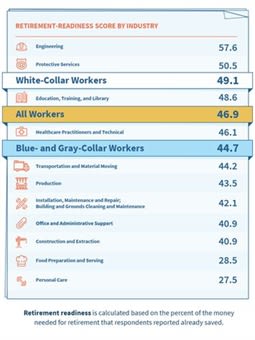
Fig. 1
This chart shows the retirement readiness of America’s workforce as a whole. Image: IALC
Access and Information are Key
While less than half of blue- and gray-collar workers have access to employer-sponsored plans, Transportation and Materials Moving workers are an exception to this statistic with many employers offering access to a 401(k). Overall, American workers are satisfied with the amount of information their employer provides about retirement options. But compared to workers who feel very ready for retirement, unprepared workers show disappointment with the retirement information provided by their employers and lower levels of access to employer-sponsored plans.
Barriers to Retirement
Debt and living expenses are two key barriers to retirement that impact transportation workers, with 23% reporting too much debt as a barrier to saving for retirement and 26% report high daily living expenses as a barrier to saving for retirement. There is also an educational component to be addressed, as we’ve seen that access to information correlates to retirement readiness. Blue- and gray-collar workers say that either they don’t know who to ask for advice and/or that retirement planning options are too difficult to understand. These deterrents to planning are frequently cited by workers in the Transportation and Material Moving industry.
Retirement Readiness
Transportation and Material Moving occupations are significantly more likely to have access to a 401(k) for retirement planning than those in other blue- and gray-collar positions and America’s workforce overall. Even with this access to retirement options from employers, many workers in the Transportation and Material Moving industry state are not prepared for retirement, with only 17% stating they are “very well prepared” as shown in Figure 2. When preparing for retirement, the study shows that only 17% of transportation and material moving workers have consulted with a financial professional.
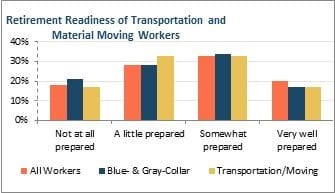
Fig. 2
This chart shows that many workers in the Transportation and Material Moving industry state are not prepared for retirement. Image: IALC
Retirement Needs: Income Planning
Income that lasts is critically important in retirement with nearly 80% of workers stating it as an essential need for retirement planning. More than three-quarters of workers plan to meet this need by relying on Social Security. Given the sustainability concerns of Social Security, it is important to consider adding savings vehicles to your financial portfolio, like fixed-indexed annuities (FIAs), that provide guaranteed lifetime income, in addition to principal protection from market declines, and tax-deferred growth. However, currently only two percent of pre-retirees are taking advantage of this option.
Preparing for Retirement
Despite gaps in retirement readiness, today’s retirement landscape offers a variety of savings options and planning resources for workers to create their own retirement freedom. Like never before, Transportation and Moving Material workers have the power to take control of their financial planning, which is not only saving for retirement, but also securing retirement income to last the long haul. Financial resources such as online calculators and budgeting tools can help ensure an accurate, customized plan is in place with funds to last a lifetime. A trusted financial professional is a good first step if you don’t know where to start when it comes to preparing for retirement.
Take a closer look at The State of America’s Workforce study and learn more about how your industry compares by downloading the corresponding white paper, which provides ideas for getting the American workforce ready for retirement.
About the Study
The State of America’s Workforce study set out to determine how America’s workforce is approaching retirement planning and preparedness, including their level of retirement readiness, associated emotions, challenges, barriers, and opportunities. All data is based on a large-scale, quantitative survey of working Americans conducted during March 2018 by Research Now, a global market research company with more than 11 million panelists. The survey included a total of 2,103 U.S. respondents aged 40 to 70 years old who were employed on a full-time basis. White-, blue- and gray-collar workers in a wide cross-section of industries were included in the survey population. The blue- and gray-collar industries surveyed were based on the classification and ranking by the Bureau of Labor Statistics (BLS). The study’s retirement-readiness scores are calculated based on the percent of the money needed for retirement that respondents reported already saved.
Jim Poolman serves as the Executive Director of the Indexed Annuity Leadership Council (IALC), a coalition of life insurance companies that have come together to increase the dialogue surrounding fixed indexed annuities (FIAs).
Subscribe to Our Newsletter
More Blog Posts
Building a Winning FTA Grant Proposal: Why Propane Autogas is the Pragmatic Choice for Fleet Resilience
With $610 million available through the FY 2026 Buses and Bus Facilities Competitive Program and the Low or No Emission Grant Program, agencies must build a compelling case before the September 21 deadline that balances environmental compliance with operational feasibility.
Read More →
Velo-city Conference 2026: Latest Trends in Cycling as Part of Urban Mobility
The global cycling conference highlighted how cities are integrating bicycles into multimodal transportation networks, expanding cycle tourism and reshaping urban mobility.
Read More →
Kindness Isn’t Soft...It’s Strategic.
Mike Bismeyer — often known as “The Kindness Guy” — has spent more than 17 years in public transit and mobility, serving in industry leadership roles, speaking across North America, and advocating for stronger workplace cultures. But his message doesn’t come from theory. It comes from lived experience.
Read More →
Inside ITF 2026: Transport Reacts to A Challenging World
Transport leaders from around the world gathered in Leipzig, Germany, for the 2026 International Transport Forum to discuss resilience, climate impacts, supply chains and the future of sustainable mobility.
Read More →
Every Ride Tells a Story — But You’re Not Just Selling the Ride
You’re selling the moment, the meaning, and the emotion behind it.
Read More →
How Digital Signage is Reshaping the Traveler Experience at Transportation Hubs
What was once a landscape of static signs has evolved into a responsive, immersive environment powered by real-time visual communication.
Read More →
Latest Trends in Urban Mobility from Polis Conference 2025
Polis comprises cities and regions, as well as corporate partners, from across Europe, promoting the development and implementation of sustainable mobility. This year’s event had over a thousand attendees across various policy forums and an exhibition.
Read More →
Why Transit Leaders Require Better Tools for Operational Clarity In Today’s Tech-Fragmented Environment
Across North America and beyond, transit agency officials are contending with a perfect storm of operational headaches and strategic challenges that hamper daily service and long-term progress.
Read More →
The Powerless Brokers: Why California Can’t Build Transit
It is no secret that transit in the U.S. is slow and expensive to build.
Read More →
Why Transport Sustainability Should Focus on People Instead of Cars
Simply incentivizing electrification is not enough to make a meaningful impact; we must shift our focus toward prioritizing public transportation and infrastructure.
Read More →