



N.Y. 'bus rapid transit' route enhancements boost ridership by 37%
The routes, which are augmented by new transit priority lanes, have attracted new ridership and improved service and reliability.

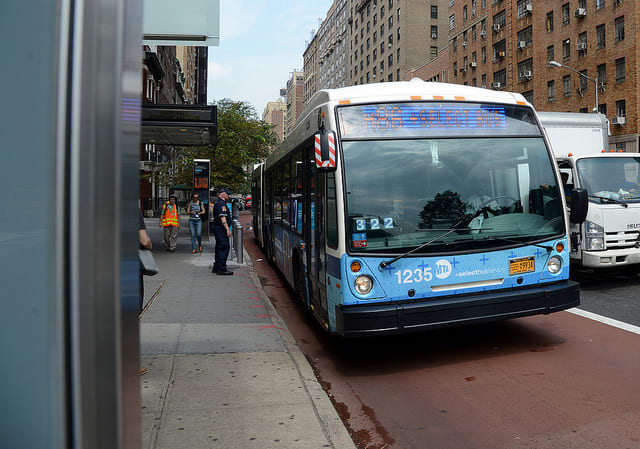
New York MTA's SBS weekend ridership has soared up to 37%.
Marc A. Hermann
New York MTA's SBS weekend ridership has soared up to 37%.
Marc A. Hermann
New York’s Metropolitan Transportation Authority (MTA) reported Select Bus Service improvements on the M14A and D routes, which are augmented by New York City Department of Transportation’s new 14th Street Transit & Truck Priority lanes, have attracted new ridership and improved service and reliability.
SBS weekend ridership has soared up to 37%, and with the October implementation of the 14th Street busway, weekday ridership has increased by 17% to 31,000 daily riders.
Comparing September 2018 to September 2019, ridership on the M14 route has increased by 37% and 29% on Sundays. Weekday ridership jumped 15% during the same period, from approximately 26,350 to 30,195. Since the 14th Street Transit & Truck Priority lanes were implemented on Oct. 2, 2019, ridership increased again to approximately 31,000. M14 ridership was also affected by the L Subway Project, during which many L Subway customers are using the M14 bus route as an alternative for Manhattan crosstown service.
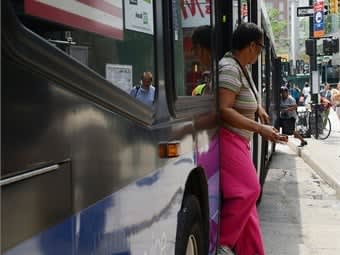
SBS is New York City’s version of Bus Rapid Transit, with features including customer-friendly amenities such as all-door boarding.
Marc A. Hermann
Additionally, since SBS was implemented on the M14 in July 2019 and the TTP lanes were implemented in early October, M14 travel times have decreased significantly. In September 2018, an M14 bus took an average of 15.1 minutes to travel between Third and Eighth avenues in either direction between 6 a.m. and 7 p.m. Preliminary data for the period after the busway was implemented shows that the same trip took just 10.6 minutes, a 30% decrease in travel time. Other performance data also improved, including wait assessment — a measure of how evenly buses are spaced — which improved from approximately 71% in September 2018 to 86% in October 2019. On-time performance jumped from 45.6% in September 2018 to approximately 68% after the busway was implemented.
SBS is New York City’s version of Bus Rapid Transit, with features including customer-friendly amenities such as all-door boarding, off-board fare payment, and bus-priority treatments such as bus lanes, traffic signal priority, and street redesigns like bus bulbs or bus stop islands.
More Bus

New York MTA Plans Largest Bus Fleet Upgrade in More Than a Decade
The agency is seeking manufacturers for 650 new CNG buses to replace aging vehicles, improve reliability, and advance its broader fleet modernization strategy.
Read More →
Building a Flexible Path to Transit Electrification
John Hroncich discusses BAE Systems’ modular and scalable approach, lessons learned from decades of real-world operations, and how agencies can identify electrification strategies that fit their fleets.
Read More →
Bus Tech Talk: Keeping Transit Technicians Ahead of the Technology Curve
LA Metro’s Obed Mejia discusses technician training, evolving maintenance technology, fleet replacement, and strategies for getting the most out of today’s transit fleets.
Read More →
Biz Briefs: RIPTA Unveils New Frontrunners, Clevland RTA Adds New Siemens, and More
In METRO's latest installment, we take a look at recent news from Siemens, Prevost, Dodge, and more partnerships making headlines across the transportation sector.
Read More →
People Movement: Holly Arnold Joins Transdev and More
In this edition, we also cover recent appointments and announcements at Pace, CamTran, MCI, and more, showcasing the individuals helping to shape the future of transportation.
Read More →
The High Cost of Transit Buses: Industry Leaders Look to Procurement Reform
Transit leaders and policymakers examine how standardized bus designs, streamlined procurement, and predictable funding could help agencies stretch budgets and deliver better service.
Read More →
The Business Voice Behind Public Transportation
As chair of APTA’s Business Members Board of Governors, Ray Melleady explains how more than 850 business members are partnering with transit agencies to advance funding, innovation, and industry-wide collaboration.
Read More →
From Surviving to Thriving: Building Stronger Transportation Organizations
Bus Business Consultants founder Brian Dickson shares lessons on leadership, organizational health, and creating options for long-term success in a changing transportation industry.
Read More →
Finding the ‘Happy Medium’: Optimizing Maintenance Without Sacrificing Reliability
The key to maintenance optimization isn’t doing less work—it’s doing the right work at the right time on the right assets.
Read More →
LA Metro, City of West Hollywood, and Partners Advance Smarter Bus Lane Enforcement
The award-winning partnership combines AI-powered detection with human oversight to improve bus reliability, accessibility, and enforcement efficiency.
Read More →