



RELATED: Nearly 90% of Americans support infrastructure spending
Q&A with APTA's Paul P. Skoutelas
METRO spoke with Skoutelas to get his thoughts on the government shutdown, his agenda, and his most memorable ride on public transit.
by Janna Starcic, Executive Editor
February 18, 2019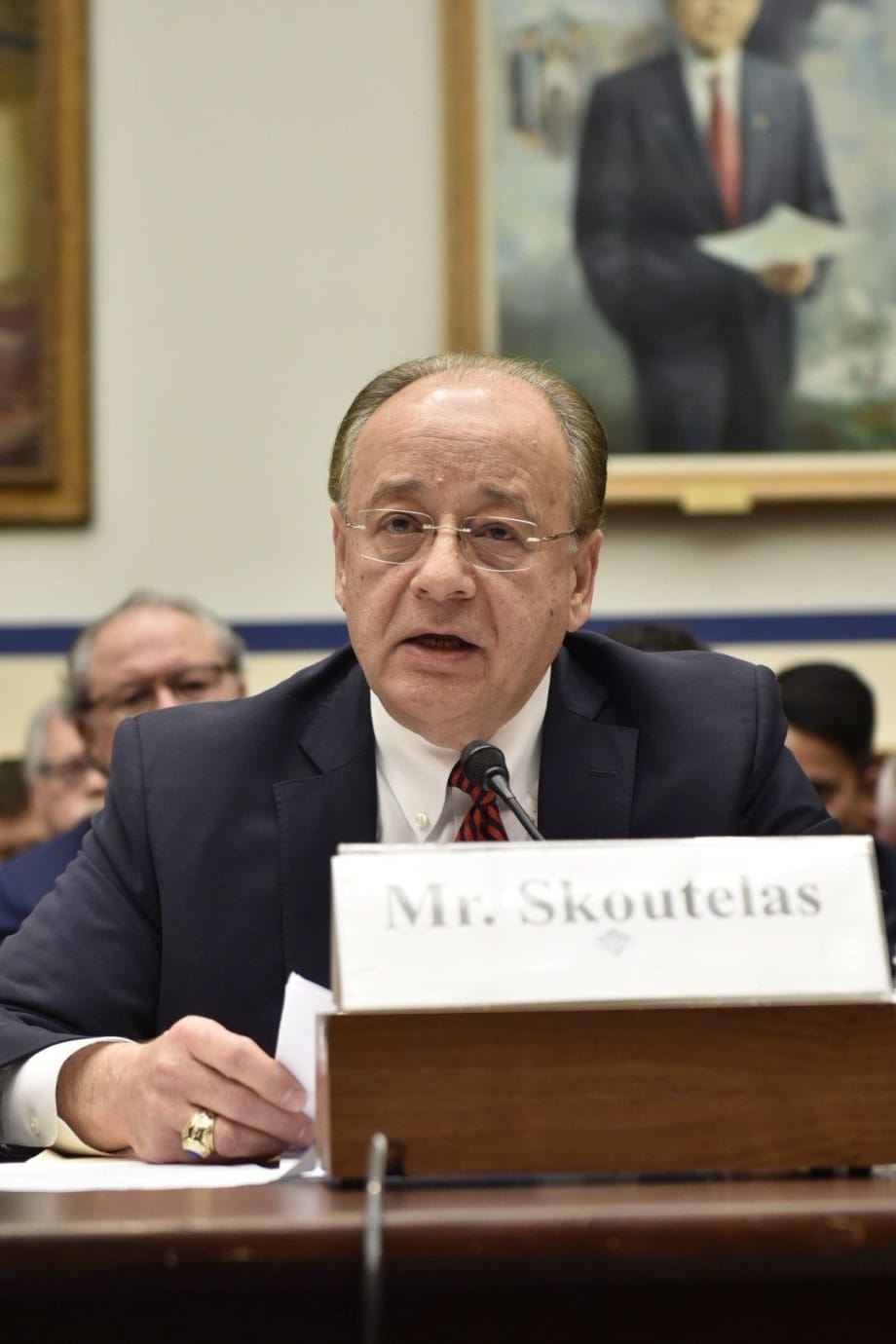
Skoutelas testifying before Congress on the oversight of positive train control implementation in the U.S.
APTA
9 min to read
Skoutelas testifying before Congress on the oversight of positive train control implementation in the U.S.
APTA
Paul P. Skoutelas' entire career has been in public transportation, with more than 40 years spent in both the public and private sectors. He served as CEO of public transit systems in Pittsburgh and Orlando, Florida, and as senior VP for WSP USA. He has also served in leadership positions on numerous boards and committees for transportation organizations.
METRO Executive Editor Janna Starcic spoke with Skoutelas to get his thoughts on the government shutdown, his agenda, and his most memorable ride on public transit.
How did the government shutdown impact public transit systems?
The impacts that were beginning to take effect included everything from having to look to other cash reserves to bridge the gap when they were expecting the flow of federal dollars, to not being able to draw down any grants to pay bills due on capital projects and some of their operating expenses.
Some of the very small systems had to curtail services, which was the most dramatic [outcome]. Others had to transfer capital funds to operations and use reserve funds. There were a couple of instances where agencies were awaiting delivery of buses and were worried whether they would have the federal dollars in hand to be able to pay the companies for those deliveries.
I don’t see long-term implications or long-term effects from the shutdown. But, if the shutdown picks up again, I’m very concerned for the health of the industry and the individual agencies, because as time goes on, those implications will become more severe. As one example of a large system, Chicago Transit Authority draws down in an average month, between $15 to $30 million dollars in federal reimbursement for its various capital programs. Through this period, they’ve just had to juggle their resources and cash reserves, but the longer-term implications could be something more severe, they would have to perhaps go into a line of credit. Same thing in Albany, New York, whereas Albany had to tap a line of credit of some four million dollars in order to come up with the cash that they needed.
What are your thoughts on the infrastructure initiative?
We are optimistic. I would describe it as a great opportunity ahead of us. We now have new leadership in the House, obviously. And, the Democratic-controlled House with Chairman Peter DeFazio, who has taken over the Transportation and Infrastructure Committee and is a huge advocate for transportation, particularly public transit. He has indicated that he wants to move a bill forward by as early as May. So, that to me signals a very positive note.
With the prospect of advancing an infrastructure bill this spring, this could be an opportunity to fix the Highway Trust Fund and possibly extend the FAST Act. APTA’s objective is to obtain significantly increased investments in our public transportation systems to foster long-term planning and growth.
We are not naïve to think that somehow because people are talking about it, that it’s automatically going to get done. There are lots of hurdles there — it’s really, how do we pay for the new investment? I think that is going to be the key issue for the leadership and others to be debating over these next months.
The U.S. Chamber of Commerce has come out with a proposal to raise the gasoline tax by a nickel a year for five years and it’s got many sign-ons to that including, certainly, ourselves and many of the other associations, like AASHTO, ARTBA, the national association of manufacturers, and a whole host of others with varied business interests and public service interests. Bottom line is, there’s a great recognition that the nation’s transportation network really is deteriorating and we need to make some significant investments.
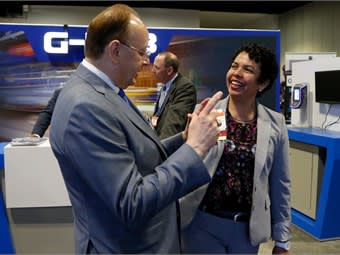
Paul P. Skoutelas talks with past APTA Chair Flora M. Castillo at a recent conference.
APTA
What have you accomplished so far in terms of your agenda?
First and foremost, I’d like to mention the advocacy effort we achieved this past Fiscal Year, the largest single-year appropriation for public transportation, over 16 billion dollars — that covers public transit programs as well as railroad programs.
Mobility has been a key area of focus for us this past year as well. We need to find ways that we can make public transit more attractive and how we can incorporate other service and delivery options within our offerings to the public. So with that in mind, we created a mobility action plan, which grew out of our Mobility Summit held last July. It’s a plan that is detailing what we will be doing in terms of our activities or strategy to elevate the importance of thinking about mobility in a much broader context than what we have as an industry historically. Along the lines of that, we have established something called the Mobility Innovation Hub. This is one of the ways that we will share information with our membership, share info about best practices, what we like to call “next practices,” things that are on the horizon, and share these examples, not only domestically but internationally, because there’s so much going on internationally in this area of mobility as well.
The other area that APTA has been engaged in, well over 20 years, in a very aggressive way, is workforce development. We’ve reviewed our offerings and identified ways to improve and strengthen those. One of the things we are looking to do is expand our professional development programs. We are doing more online training. We have a robust set of webinars that we’ve established and we've begun an analysis of credentialing to see how we can credential certain kinds of positions that will help the industry.
Another area that is really noteworthy for us in terms of accomplishments has been the support of our member commuter rail agencies. They have been under the requirements to meet positive train control (PTC) installation. The Dec. 31, 2018 deadline was to provide and meet certain milestones, which are set by Congress, and by meeting those milestones, each of those agencies could get up to two more years for full operational implementation of PTC. And, it appears as though from the work that’s been done and how we closed out the year, that every single agency has met that threshold, which is really remarkable given where we were just a year ago. Now we still have work to do because we have to meet the full implementation and operational deadline by 2020. That’s the next target here that we will be working on.
Speaking of our members, the strength that we as APTA represent really are in addition to looking at day to day for our members is the strength of the relationships that we build. We recognize here in Washington that there’s many competing voices and interests in federal investment and federal dollars. So, we have reengaged and strengthened our relationships with what we refer to as our key stakeholders, which include the Chamber, the American Association of State Highway and Transportation Officials, and the American Road & Transportation Builders Association. Those are all groups we work with on a daily basis, we have common interests to see more investment in our nation’s transportation network, and we have been working hard over the last 12 months to reengage with them and establish strong working relationships.
The others are a little closer to home, in the sense that as any organization today, you’re always looking to build more organizational capacity, and over the past 12 months it’s been one of my priorities to help expand that capacity amongst our staff and we’ve done that in virtually every department. From government affairs to tech support to our meetings area, that’s an ongoing area and I’m very pleased with our effort. I was very pleased and fortunate to inherit a top-notch organization, but we continue to find ways to make it even stronger.
How has technology changed the transportation landscape over the last five years?
There’s no doubt it has been and will continue to be a game-changer. Every single day, it’s remarkable to me to see scooters and bicycles in numbers that we’ve never seen them before, bike-sharing, car-sharing, and the Ubers and Lyfts out in cities across the country. I think in the totality, they really are transforming the way we view transportation, and by extension, how our industry is viewing what it does and its potential for the future for public transportation.
We feel very confidentally that public transportation, buses, trains, paratransit, and the like will continue to be the backbone of a truly multimodal network of services. At the same time, we recognize that it will be a wider set of mobility options that people will have available to them. One of my key themes, and I think it’s a theme that’s embraced by our membership as well in our industry, is that we need to embrace these opportunities and not see them as threats necessarily. We need to view them as opportunities that can make us more efficient where we can and to think more creatively how we can transform our own business models, so that we’re as responsive as we can be to the communities that we serve. A lot of that is going on right now. That’s one of the reasons we established the Mobility Innovation Hub. We want to share these examples, these best practices as broadly as we can. There are many cities now that are doing experiments — working with the TNCs, new partnership agreements, developing mobile apps, looking at mobile ticketing, and developing pilot projects for automated and connected vehicles — more and more.
Technology certainly is benefiting many industries. I believe it will and has benefited public transportation, so if we’re smart, and I believe we are, we’re going to leverage these technologies to improve the product and service offerings that we provide to the public. We recently released a report here at APTA, "The Transformation of the American Commuter," which found 77% of commuters see public transit as the backbone of a lifestyle of a broader array of mobility options — Ubers, Lyfts, scooters, and car-sharing. We think that bodes well, because people understand that while they have more options, they view public transit as the core. And, we do hold into account as a high priority, the equity of where we deliver service and how we deliver service to a community. And, agencies are moving in this direction. More and more, you are finding them establishing positions within their own organizations that are more mobility managers and recognizing that the smartphone and the app are something that are indispensable. They are finding ways they can utilize those tools to make their services more attractive. Our surveys show that 74% of millennials said they would use MaaS, mobility as a service, which does look at a variety of technologies and service delivery options, coordinating those for trip-planning, payments, and such. I believe and we sense, that we are right in step with what’s happening. The public transit industry is really reinventing itself going forward.

On a lighter note, what was your most memorable ride on public transportation?
I grew up in the Philadelphia area and I remember as a grade-schooler, the 1964 World’s Fair was in New York. For my class trip, we got on the train in downtown Philadelphia and took it to New York City. I believe that was my first train ride and it was just an eye-opening experience. I was in awe getting on this train, riding it the big city of New York, stepping off and going to the world’s fair. That was just remarkable. And, at the fair, getting to ride the monorail, which was even more remarkable to a young kid. I didn’t recognize it perhaps at the time, but I think it set a seed in terms of my interest in public transportation.
Subscribe to Our Newsletter
More Management
People Movement: Dan Dipert Coaches Adds Third-Generation Leader, Keolis Names New Valley Metro VP/GM, and More
In this edition, we also cover recent appointments and announcements at the Wabtec, SilverRide, HNTB, and more, showcasing the individuals helping to shape the future of transportation.
Read More →
METRO Opens Submissions for 2026 Motorcoach Awards
Nominations are now being accepted for METRO Magazine’s Operator of the Year and Innovative Operator of the Year awards.
Read More →
New York MTA Advances Final Contract for Second Avenue Subway Expansion
Contract Four is the largest in the Second Avenue Subway Phase 2 project and includes construction of station infrastructure, tracks, and signals for the subway expansion, MTA officials said. Work on Contract Four will begin in 2027.
Read More →

Transit Agencies Highlight Safety Gains at National Summit
Leaders from 15 major transit systems shared crime-reduction results and safety initiatives while discussing the role of continued federal support.
Read More →
NITA Names New Leadership, Expands Reduced-Fare Program at First Board Meeting
The new regional transit authority appointed its first board chair and interim executive director while extending reduced fares across CTA, Metra, and Pace for eligible riders.
Read More →
Beyond the Checklist: A Structured Approach to Transit Maintenance
Reliability-Centered Maintenance helps transit agencies move beyond routine checklists to focus limited resources on the assets and failures that have the greatest impact on safety, reliability, and service.
Read More →
APTA 2026 Nominating Committee Selects Leadership Slate, Names Chair and Vice Chair Nominees
Leadership changes will help shape the association’s priorities and its representation of the transportation industry during the 2026–2027 term.
Read More →
DART Launches Major Security, Fare Enforcement Initiative
The 90-day demonstration will deploy coordinated security teams at five light rail stations while testing controlled access and gathering data to guide future investments.
Read More →
Sponsored•September 9, 2026
Advancing Fare Collection Through Technology and Innovation
Learn about delivering 1300 gates at 91 stations while managing fare evasion. Explore the large scale deployment, solution customization and real-world results that affect the region. Prepare for deployment in your region now.
Read More →
Game Day in Motion: Moving Millions During the 2026 World Cup
Between packed transit stations and team motorcoaches, see how agencies and operators across North America tackled the transportation demands of the 2026 FIFA World Cup.
Read More →