



BLOGS: Bus bunching, diffusing conflict, congestion charging, etc.
2019's Cities with the Best (and Worst) Public Transportation
Ranks 100 U.S. cities across three key dimensions: Accessibility; Convenience; Safety; Reliability; and Public Transit Resources.
by Adam McCann
January 2, 2020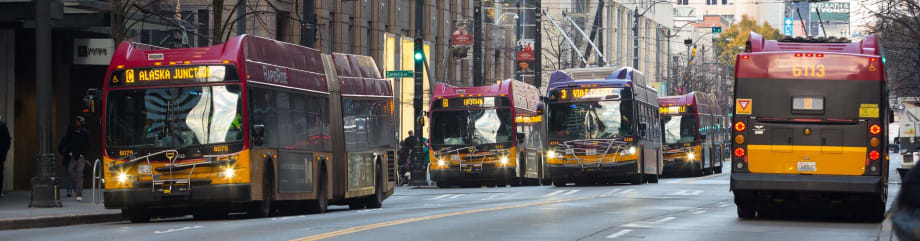
Seattle ranked as the "best" city for public transportation in the U.S. in a new report from WalletHub.
Photo: King County Metro
7 min to read
Public transportation may be a simple convenience or an absolute daily necessity, depending on the city and the size of its population. The scope of public transportation in giant metropolises like New York City can be massive.
According to the MTA, the New York City subway has over 665 mainland track miles and transports over 1.75 billion passengers per year. That’s not to mention the city’s 5,700 buses that carry over 760 million passengers per year.
There are many benefits to using public transportation over personal vehicles. The first is economic growth. According to the American Public Transportation Association, “every $1 invested in public transportation generates $4 in economic returns.” In addition, the APTA states that taking public transportation is cheaper in the long run than buying a vehicle and paying for its upkeep and gas costs. Public transportation also has drastically lower odds of an accident than driving a personal vehicle and helps to cut down pollution from emissions.
But not all cities have the same quality of public transportation. To find out where passengers will fare best during their daily commute, WalletHub compared 100 cities across 17 key metrics. Our data set ranges from share of commuters who use public transit and average age of the fleet to number of injuries and peak hours spent in congestion.
Main Findings
Cities with the Best Public Transportation
Overall Rank (1=Best) | City | Total Score | ‘Accessibility & Convenience’ Rank | ‘Safety & Reliability’ Rank | ‘Public Transit Resources’ Rank |
|---|---|---|---|---|---|
1 | Seattle, WA | 77.97 | 7 | 6 | 3 |
2 | Boston, MA | 77.84 | 2 | 34 | 10 |
3 | San Francisco, CA | 75.21 | 1 | 27 | 80 |
4 | Washington, DC | 71.23 | 3 | 48 | 52 |
5 | Madison, WI | 71.06 | 46 | 1 | 4 |
6 | Jersey City, NJ | 69.05 | 4 | 22 | 97 |
7 | New York, NY | 68.87 | 5 | 22 | 97 |
8 | Reno, NV | 68.13 | 76 | 8 | 1 |
9 | Honolulu, HI | 67.85 | 30 | 13 | 12 |
10 | Portland, OR | 66.82 | 13 | 31 | 29 |
11 | Minneapolis, MN | 66.72 | 8 | 51 | 31 |
12 | Denver, CO | 65.98 | 14 | 25 | 27 |
13 | Oakland, CA | 65.68 | 10 | 27 | 80 |
14 | Los Angeles, CA | 64.79 | 15 | 15 | 60 |
15 | San Jose, CA | 64.47 | 21 | 21 | 35 |
16 | Boise, ID | 64.45 | 82 | 3 | 37 |
17 | Lubbock, TX | 64.33 | 92 | 14 | 5 |
18 | Milwaukee, WI | 64.18 | 42 | 4 | 18 |
19 | San Diego, CA | 64.13 | 32 | 11 | 15 |
20 | Austin, TX | 63.66 | 19 | 68 | 2 |
21 | Baltimore, MD | 63.50 | 12 | 35 | 79 |
22 | Chicago, IL | 63.33 | 6 | 71 | 59 |
23 | Lincoln, NE | 63.10 | 24 | 20 | 46 |
24 | Chula Vista, CA | 62.46 | 89 | 11 | 15 |
25 | Laredo, TX | 61.52 | 99 | 5 | 43 |
26 | Santa Ana, CA | 61.48 | 35 | 15 | 60 |
27 | Long Beach, CA | 61.25 | 38 | 15 | 60 |
28 | Omaha, NE | 60.93 | 69 | 1 | 93 |
29 | Wichita, KS | 60.76 | 66 | 7 | 30 |
30 | Newark, NJ | 60.17 | 16 | 22 | 97 |
31 | Memphis, TN | 60.14 | 58 | 10 | 87 |
32 | St. Paul, MN | 59.00 | 27 | 51 | 31 |
33 | Pittsburgh, PA | 58.96 | 39 | 53 | 33 |
34 | El Paso, TX | 58.51 | 61 | 40 | 45 |
35 | Fremont, CA | 58.29 | 43 | 27 | 80 |
36 | Greensboro, NC | 58.21 | 57 | 43 | 36 |
37 | Cincinnati, OH | 58.17 | 37 | 42 | 40 |
38 | Irvine, CA | 57.88 | 70 | 15 | 60 |
39 | Toledo, OH | 57.77 | 77 | 58 | 7 |
40 | Albuquerque, NM | 57.67 | 11 | 88 | 19 |
41 | San Antonio, TX | 57.63 | 49 | 55 | 6 |
42 | Aurora, CO | 57.60 | 81 | 25 | 27 |
43 | Corpus Christi, TX | 57.43 | 54 | 67 | 8 |
44 | Anaheim, CA | 57.16 | 74 | 15 | 60 |
45 | San Bernardino, CA | 56.94 | 60 | 32 | 49 |
46 | Cleveland, OH | 56.65 | 18 | 73 | 53 |
47 | Atlanta, GA | 56.47 | 22 | 41 | 96 |
48 | Riverside, CA | 56.37 | 65 | 32 | 49 |
49 | Birmingham, AL | 56.15 | 97 | 30 | 44 |
50 | Durham, NC | 56.06 | 36 | 49 | 66 |
51 | Las Vegas, NV | 56.06 | 44 | 37 | 76 |
52 | Miami, FL | 55.86 | 20 | 45 | 94 |
53 | Tucson, AZ | 55.85 | 33 | 57 | 41 |
54 | Detroit, MI | 55.47 | 52 | 47 | 73 |
55 | Phoenix, AZ | 55.39 | 26 | 61 | 67 |
56 | Orlando, FL | 55.07 | 25 | 78 | 38 |
57 | Lexington-Fayette, KY | 54.96 | 63 | 77 | 11 |
58 | Anchorage, AK | 54.88 | 50 | 54 | 42 |
59 | Fort Wayne, IN | 54.85 | 88 | 50 | 55 |
60 | Colorado Springs, CO | 54.66 | 79 | 72 | 9 |
61 | Jacksonville, FL | 54.16 | 62 | 36 | 83 |
62 | Columbus, OH | 54.13 | 45 | 59 | 54 |
63 | Buffalo, NY | 53.91 | 40 | 56 | 75 |
64 | Stockton, CA | 53.82 | 90 | 9 | 84 |
65 | Dallas, TX | 53.78 | 29 | 79 | 20 |
66 | Nashville, TN | 53.73 | 31 | 60 | 85 |
67 | Scottsdale, AZ | 53.32 | 68 | 61 | 67 |
68 | Houston, TX | 53.32 | 34 | 70 | 65 |
69 | North Las Vegas, NV | 52.72 | 94 | 37 | 76 |
70 | Sacramento, CA | 52.09 | 51 | 44 | 90 |
71 | Virginia Beach, VA | 51.99 | 47 | 74 | 56 |
72 | Winston-Salem, NC | 51.63 | 85 | 69 | 14 |
73 | Raleigh, NC | 51.42 | 41 | 89 | 13 |
74 | Norfolk, VA | 51.18 | 48 | 74 | 56 |
75 | Irving, TX | 51.12 | 56 | 79 | 20 |
76 | Glendale, AZ | 50.84 | 98 | 61 | 67 |
77 | Garland, TX | 50.38 | 84 | 79 | 20 |
78 | Hialeah, FL | 50.28 | 83 | 45 | 94 |
79 | Fresno, CA | 50.22 | 71 | 87 | 26 |
80 | Henderson, NV | 50.09 | 95 | 37 | 76 |
81 | Louisville, KY | 49.83 | 64 | 85 | 47 |
82 | Chandler, AZ | 49.55 | 80 | 61 | 67 |
83 | Chesapeake, VA | 49.38 | 93 | 74 | 56 |
84 | Fort Worth, TX | 49.26 | 75 | 79 | 20 |
85 | Plano, TX | 49.13 | 78 | 79 | 20 |
86 | Mesa, AZ | 49.00 | 86 | 61 | 67 |
87 | Bakersfield, CA | 48.98 | 59 | 86 | 74 |
88 | Kansas City, MO | 48.76 | 23 | 93 | 34 |
89 | Philadelphia, PA | 48.73 | 9 | 97 | 86 |
90 | Gilbert, AZ | 48.52 | 100 | 61 | 67 |
91 | St. Louis, MO | 46.51 | 17 | 96 | 51 |
92 | Baton Rouge, LA | 46.26 | 91 | 91 | 17 |
93 | Arlington, TX | 45.70 | 96 | 79 | 20 |
94 | Oklahoma City, OK | 45.64 | 55 | 90 | 89 |
95 | Tulsa, OK | 43.02 | 72 | 94 | 48 |
96 | New Orleans, LA | 42.43 | 28 | 92 | 100 |
97 | Charlotte, NC | 40.67 | 53 | 95 | 88 |
98 | Tampa, FL | 24.69 | 67 | 98 | 91 |
99 | St. Petersburg, FL | 24.03 | 73 | 98 | 91 |
100 | Indianapolis, IN | 21.13 | 87 | 100 | 39 |
Survey Methodology
To determine the cities with the best and worst public transportation systems, WalletHub compared a sample of 100 U.S. cities across three key dimensions: 1) Accessibility & Convenience, 2) Safety & Reliability and 3) Public Transit Resources.
We evaluated those dimensions using 17 relevant metrics, which are listed below with their corresponding weights. Each metric was graded on a 100-point scale, with a score of 100 representing the most favorable living conditions.
Finally, we determined each city’s weighted average across all metrics to calculate its overall score and used the resulting scores to rank-order the cities in our sample. Our sample considers only the city proper in each case and excludes cities in the surrounding metro area.
Accessibility & Convenience – Total Points: 40
Share of Commuters Who Use Public Transit: Double Weight (~6.15 Points)
Average Commute Time for Transit Users: Full Weight (~3.08 Points)
Average Car Commute Time as Share of Average Public Transport Commute Time: Double Weight (~6.15 Points)
Transit Connectivity Index: Full Weight (~3.08 Points) Note: The TCI is a measure of how connected the average household member is to the availability of a transit ride.
Jobs Accessible Within a 30 Minute Transit Commute per 100 Civilian Employed Residents: Full Weight (~3.08 Points)
Peak Hours Spent in Congestion: Full Weight (~3.08 Points) Note: The total number of hours lost in congestion during peak commute periods compared to free-flow periods on a per capita basis. Peak corresponds to the absolute worst portion of the morning and afternoon commute, while free-flow is the best performance experienced over 24 hours.
Annual Public Transport Cost as Share of Median Annual Household Income: Double Weight (~6.15 Points)
Share of Commuters Who Prefer Public Transport: Full Weight (~3.08 Points) Note: This refers to commuters that choose public transportation even if they have one or more vehicles available.
Presence of Dedicated Rapid Bus & Rail Transport: Full Weight (~3.08 Points) Note: This binary metric measures the presence or absence of dedicated rapid bus and rail systems in a city.
Airport Accessibility by Public Transit: Full Weight (~3.08 Points) Note: This binary metric measures the presence or absence of a direct fixed-guideway access to an airport terminal or free bus shuttle access from rail station to an airport terminal.
Safety & Reliability – Total Points: 40
Public Transit Safety and Security Events per Passenger Miles Traveled: Full Weight (~10.00 Points) Note: Events include the following: collision, derailment, fire, security and not otherwise classified events.
Public Transit Injuries per Passenger Miles Traveled: Full Weight (~10.00 Points)
Public Transit Fatalities per Passenger Miles Traveled: Double Weight (~20.00 Points)
Public Transit Resources – Total Points: 20
Public Transport System Total Fixed Guideway Directional Route Miles per Urbanized Area Population: Full Weight (~4.00 Points) Note: The mileage in each direction over which public transportation vehicles travel while in revenue service.
Total Public Transit Vehicles Operated in Annual Maximum Service per Service Area Population: Double Weight (~8.00 Points) Note: The number of revenue vehicles operated to meet the annual maximum service requirement.
Average Age of Public Transit Fleet: Full Weight (~4.00 Points)
Average Lifetime Miles per Active Vehicles: Full Weight (~4.00 Points) Note: The total miles accumulated on all active vehicles since date of manufacture divided by the number of active vehicles.
Article, originally posted Sept.10, 2019, reprinted with permission from WalletHub.com
More Management

METRO Opens Submissions for 2026 Motorcoach Awards
Nominations are now being accepted for METRO Magazine’s Operator of the Year and Innovative Operator of the Year awards.
Read More →
New York MTA Advances Final Contract for Second Avenue Subway Expansion
Contract Four is the largest in the Second Avenue Subway Phase 2 project and includes construction of station infrastructure, tracks, and signals for the subway expansion, MTA officials said. Work on Contract Four will begin in 2027.
Read More →
Transit Agencies Highlight Safety Gains at National Summit
Leaders from 15 major transit systems shared crime-reduction results and safety initiatives while discussing the role of continued federal support.
Read More →

NITA Names New Leadership, Expands Reduced-Fare Program at First Board Meeting
The new regional transit authority appointed its first board chair and interim executive director while extending reduced fares across CTA, Metra, and Pace for eligible riders.
Read More →
Beyond the Checklist: A Structured Approach to Transit Maintenance
Reliability-Centered Maintenance helps transit agencies move beyond routine checklists to focus limited resources on the assets and failures that have the greatest impact on safety, reliability, and service.
Read More →
APTA 2026 Nominating Committee Selects Leadership Slate, Names Chair and Vice Chair Nominees
Leadership changes will help shape the association’s priorities and its representation of the transportation industry during the 2026–2027 term.
Read More →
DART Launches Major Security, Fare Enforcement Initiative
The 90-day demonstration will deploy coordinated security teams at five light rail stations while testing controlled access and gathering data to guide future investments.
Read More →
Sponsored•September 9, 2026
Advancing Fare Collection Through Technology and Innovation
Learn about delivering 1300 gates at 91 stations while managing fare evasion. Explore the large scale deployment, solution customization and real-world results that affect the region. Prepare for deployment in your region now.
Read More →
Game Day in Motion: Moving Millions During the 2026 World Cup
Between packed transit stations and team motorcoaches, see how agencies and operators across North America tackled the transportation demands of the 2026 FIFA World Cup.
Read More →
Surface Transportation Extension Averts Shutdown, Leaves Transit Funding Gap
The stopgap keeps federal transportation programs moving, but missing advance funding could complicate the transit and rail projects agencies are planning next.
Read More →