



74% of Americans want Congress to increase public transit investment, study finds
In addition, 80% said public transit is valuable to communities because it provides vital connections to fundamental resources.

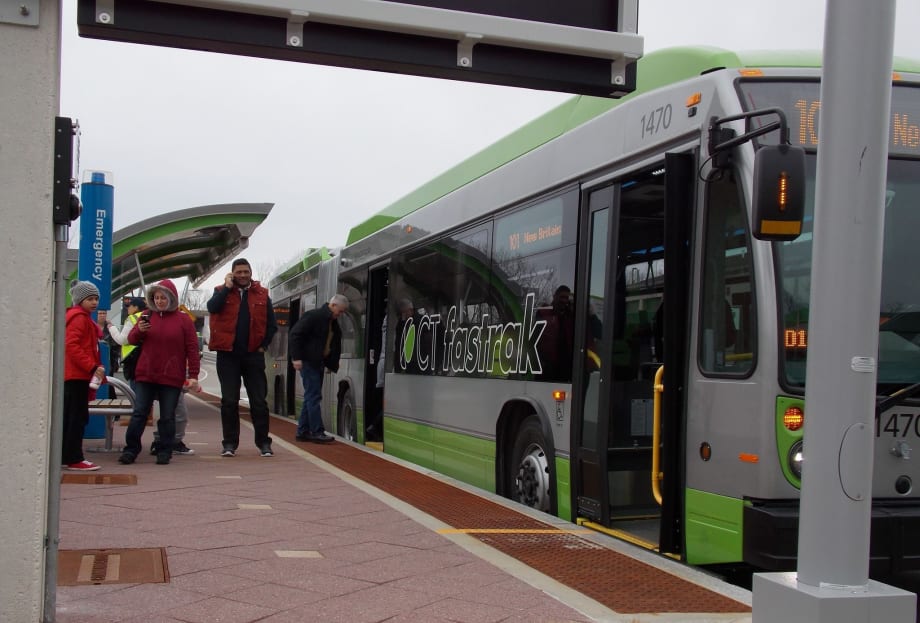
Eighty percent of Americans say public transportation is important to communities because it helps businesses flourish, by bringing both workers and customers to businesses, according to the MTI survey.
CTtransit
Eighty percent of Americans say public transportation is important to communities because it helps businesses flourish, by bringing both workers and customers to businesses, according to the MTI survey.
CTtransit
As the U.S. Congress deliberates on investments in the nation's infrastructure, 74% of Americans say Congress should increase spending on public transportation, according to a survey directed by the Mineta Transportation Institute (MTI) National Transportation Finance Center along with its Social Science Research Center (SSRC) serving as the data collection agent. The survey, which was conducted for the American Public Transportation Association (APTA), shows that 80% of Americans support use of their tax dollars for creating, expanding, and improving public transportation in their community.
"Americans understand that investment in public transportation is an essential element to help their communities grow," said APTA President/CEO Paul P. Skoutelas. "Public transit garners this overwhelming support because it is an important link to connect employees to jobs, customers to businesses, and to the things that improve peoples' quality of life."
Eighty percent of Americans say public transportation is important to communities because it helps businesses flourish, by bringing both workers and customers to businesses, according to the MTI survey. In addition, of those surveyed, 80% said public transit is valuable to communities because it provides people with vital connections to fundamental resources such as jobs, schools, and medical facilities.
The nation's support for public transit continues as Americans have more mobility options such as car and bike sharing apps; and as other multi-transit opportunities evolve, according to the data. Seventy-five percent of Americans say public transportation remains an important option for daily commuters concerned with issues of costs and traffic, according to the research.
APTA officials note that this survey is proof that there is agreement among the public and both Houses of Congress to increase investment in public transportation.
In fact, 2018 is an historic year because the U.S. Congress appropriated, and the President signed into law, $13.5 billion for public transit investment and $2.8 billion for intercity passenger rail grants. This amount exceeded what was authorized in the FAST Act.
"We are hopeful that this bi-partisan effort will continue," added Skoutelas. "The U.S. House and the Senate have each introduced a bill for their 2019 budget that continues on the path of providing an increase beyond what was authorized in the FAST Act for the coming fiscal year."
The MTI National Transportation Finance Center directed the survey for APTA and its SSCR collected the data. The survey consists of a total of 1,201 interviews with individuals across the U.S. The margin of error is plus or minus 2.83%, at the 95% confidence level. For more information, click here.
More Management

METRO Opens Submissions for 2026 Motorcoach Awards
Nominations are now being accepted for METRO Magazine’s Operator of the Year and Innovative Operator of the Year awards.
Read More →
New York MTA Advances Final Contract for Second Avenue Subway Expansion
Contract Four is the largest in the Second Avenue Subway Phase 2 project and includes construction of station infrastructure, tracks, and signals for the subway expansion, MTA officials said. Work on Contract Four will begin in 2027.
Read More →
Transit Agencies Highlight Safety Gains at National Summit
Leaders from 15 major transit systems shared crime-reduction results and safety initiatives while discussing the role of continued federal support.
Read More →

NITA Names New Leadership, Expands Reduced-Fare Program at First Board Meeting
The new regional transit authority appointed its first board chair and interim executive director while extending reduced fares across CTA, Metra, and Pace for eligible riders.
Read More →
Beyond the Checklist: A Structured Approach to Transit Maintenance
Reliability-Centered Maintenance helps transit agencies move beyond routine checklists to focus limited resources on the assets and failures that have the greatest impact on safety, reliability, and service.
Read More →
APTA 2026 Nominating Committee Selects Leadership Slate, Names Chair and Vice Chair Nominees
Leadership changes will help shape the association’s priorities and its representation of the transportation industry during the 2026–2027 term.
Read More →
DART Launches Major Security, Fare Enforcement Initiative
The 90-day demonstration will deploy coordinated security teams at five light rail stations while testing controlled access and gathering data to guide future investments.
Read More →
Advancing Fare Collection Through Technology and Innovation
Learn about delivering 1300 gates at 91 stations while managing fare evasion. Explore the large scale deployment, solution customization and real-world results that affect the region. Prepare for deployment in your region now.
Read More →
Game Day in Motion: Moving Millions During the 2026 World Cup
Between packed transit stations and team motorcoaches, see how agencies and operators across North America tackled the transportation demands of the 2026 FIFA World Cup.
Read More →
Surface Transportation Extension Averts Shutdown, Leaves Transit Funding Gap
The stopgap keeps federal transportation programs moving, but missing advance funding could complicate the transit and rail projects agencies are planning next.
Read More →