



APTA chair talks agenda, how to be a better board member
David M. Stackrow Sr. was elected chair of APTA's board of directors last fall.

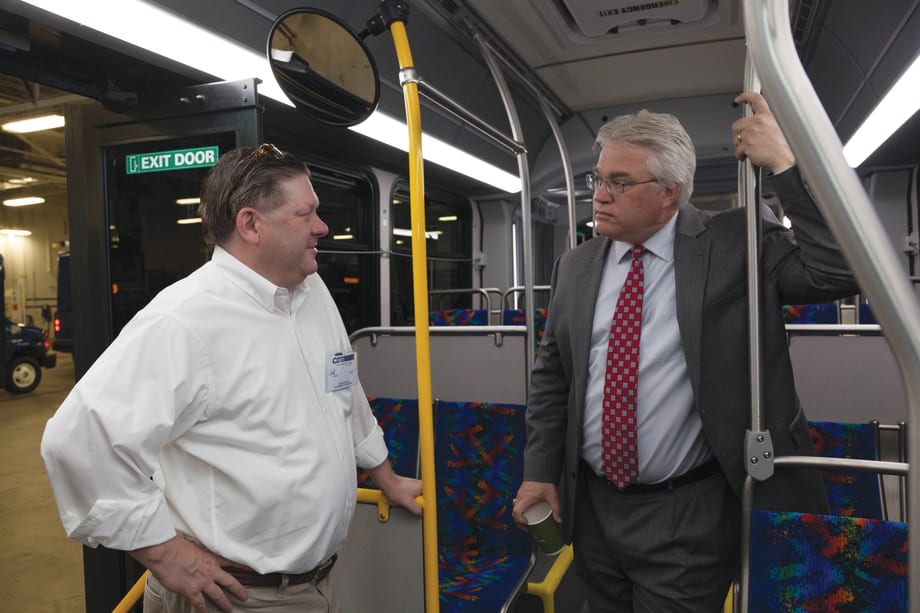
“I am working to foster a culture that encourages us to embrace new partners and ideas,” says APTA Chair David Stackrow (shown right).
Photos courtesy CDTA
“I am working to foster a culture that encourages us to embrace new partners and ideas,” says APTA Chair David Stackrow (shown right).
Photos courtesy CDTA
Capital District Transportation Authority (CDTA) Board member and former Board Chairman David M. Stackrow Sr. was elected as Chair of the American Public Transportation Association (APTA) Board of Directors last fall. Since that time, he has been working to help “redefine the future for the association and the industry.”
We spoke with Stackrow about his priorities, including his plans for advancing the vision and value of the new mobility paradigm. He also gave us insight on what it takes to be a good board member.
What are key objectives of your agenda as APTA chair and how will they help the association and its members?
Before becoming APTA Chair, I spent time with APTA President and CEO Paul Skoutelas and his senior staff gaining an understanding of what APTA needed me to promote as Chair. It was important to me that my agenda be in lock step with APTA’s needs. My agenda focuses on three primary areas.
If we’re going to redefine our future as an association and industry, we need a solid strategic plan to guide us. So, my first focus is to shepherd a new three-year strategic plan through a transparent, thorough, and inclusive process — a process that reflects our diverse hopes and our shared values. We will re-examine APTA’s mission and vision and take a fresh look at the services that APTA provides, to best align those with the needs of the members.
My second area of priority is to continue to advance the vision and value of the emerging shared-mobility paradigm. This issue will be our central focus for now and years to come. I am working to foster a culture that encourages us to embrace new partners and ideas. As an industry, we work hard to reduce or eliminate risk, but in this case, there can be no progress without taking risk.
My final priority is to ensure that our association, and as an extension, our industry, speaks with a single, strong voice. This is essential as we help write the next FAST Act and influence other issues. To make our size and variety of membership true advantages, we need to be able to deliver cogent, unified positions. This year, as we continue the fight for public resources and public support, we will strengthen our solidarity. We will put our passion for public transportation before our parochial pursuits.

Stackrow
What is the status of those objectives and how are you working to implement them?
The strategic plan process is well underway, guided by a diverse group of strategic plan steering committee members. The steering committee recommended a new purpose statement for board approval, and that approval occurred on March 16. The purpose statement replaces the previous mission and vision and states that ‘APTA leads public transportation in a new mobility era, advocating to connect and build thriving communities.’ The steering committee has developed a strategic plan outline to be presented to the Executive Committee on May 18 and then to the Board of Directors on June 22. Following those presentations, we will have a period of member comment on the draft plan over the summer, with the goal of submitting a final strategic plan for board approval on October 12.
The New Mobility Paradigm remains a high-priority area. Many of our APTA committees are having conversations and hearing presentations in this area. Past Chair Nat Ford is leading a mobility task force, coordinating all of the efforts underway in our various committees. Nat provides a direct connection to the executive committee and has moderated discussion panels at recent board meetings and seminars. Our international study mission to Europe this June will be focused on ‘Integrated Mobility: Being Mobility as a Service Ready.’ I’m pleased to co-lead this mission along with APTA President and CEO Paul Skoutelas. The New Mobility paradigm has also been a high-priority topic in the strategic planning process.
Finally, Diana Mendes and Leanne Redden have been leading the surface transportation authorization effort. This effort has been open and transparent throughout and has sought input from every corner of the APTA membership. There have been multiple opportunities for input and review as the process has progressed. The process is on schedule with the final goal of presentation to the APTA Board for its approval on October 12.
None of the work that we do could happen without the leadership of our dedicated and talented APTA staff. I’m sincerely thankful to all of them for the work that they do.
How has your experience as a board member informed your role as chair?
I’m in my 24th year as a board member at the Capital District Transportation Authority in Albany, New York. I’ve had the privilege of serving as CDTA’s board chair on three different occasions, working with four CEOs. Each of them helped me to be a better board member and each of them provided me with opportunities to become active within APTA. Those relationships were all built on a foundation of mutual trust and respect. As a board member, I’ve had the opportunity to learn about the industry and the process of good governance, to learn how to be engaged and to stay out of the weeds, to understand the high level view, and to think more strategically, to be a stronger advocate. All of this has helped me to be a better board member and chair.
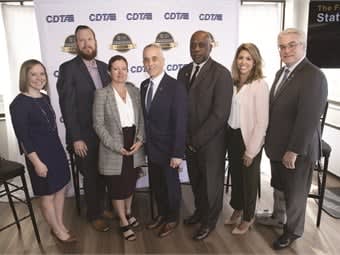
Stackrow (shown far right with CDTA’s Carm Basile, center) is in his 24th year as a board member at the Capital District Transportation Authority in Albany, NY.
What led you to become a board member for CDTA?
I was appointed by Governor George Pataki in 1995 and subsequently confirmed by the New York State Senate. All of the CDTA board seats are appointed by the Governor. The recommendation to the Governor comes from the County political Chair for the same political party as the Governor. I had been active politically and had asked to be considered for a state board seat, if the opportunity arose. My County Chairman nominated me for appointment to the CDTA Board. Upon hearing this, I respectfully asked if there were any other opportunities. I knew absolutely nothing about public transportation and didn’t see how I could be helpful when I had never used the system. I grew up in a rural area of my county and there was no public transportation where I lived. I was assured that I would be fine and that I would be given all of the tools I needed to be successful. I’m certainly glad to have had the opportunity. Like most people involved in our industry, I became hooked by it. We fill a tremendous need in our communities and there is no way to not feel good about that.
What are some of the key takeaways to having a successful relationship with transit agency leadership?
My friend and colleague Doug Eadie and I have just released a new book on this topic titled ‘Building a Solid Board-CEO Partnership — A Practical Guidebook for Transit Board Members, CEOs, and CEO-Aspirants.’ First and foremost, for the board to have a successful relationship with agency leadership, the CEO needs to embrace the responsibility of making the board the best it can be. Supporting and developing the board can take as much as a quarter to a third of the CEOs time. Time spent with the board as a body and with individual board members helps to ensure, through open and transparent communication, that the relationship remains healthy. Engage the board early on in the key strategic decisions that it will ultimately be asked to vote on also aids in strengthening the relationship. Engaging the board and obtaining ‘buy in’ is critically important, especially in areas where there is an element of risk. The stronger the bond of trust between the board and the CEO, the more successful the relationship will likely be. Finally, board members need to be respectful of agency leadership, allowing them to do their job. Individual board members should never be directing staff. That is the CEO’s job. The board, as a body, gives direction and guidance to the CEO.
Are you seeing the role of board members change in terms of the shift to the new mobility paradigm?
Over the past quarter century, I’ve seen the role of board members change from a role of approving finished staff work to a role of being engaged in the strategic planning for the agency’s future. This change is due primarily to the CEOs who believe that an engaged board leads to board members being satisfied with their work. This transition has positioned board members well as we are confronted with the shift to the new mobility paradigm. By being more engaged in the strategic planning work that our agencies do, we are prepared to take on this new challenge head on. Agencies are shifting from identifying primarily by mode, to being identified as providers of mobility. Our customers don’t care about mode, they care about how we can help them get from point A to point B. As we are confronted by new opportunities, we need to be comfortable with taking risk. Sometimes risk can result in failure and we need to be ok with that. Boards that are truly engaged in the strategic decision planning will take ownership of the strategic decisions that they approve, whether those decisions result in success or failure.
More Management

METRO Opens Submissions for 2026 Motorcoach Awards
Nominations are now being accepted for METRO Magazine’s Operator of the Year and Innovative Operator of the Year awards.
Read More →
New York MTA Advances Final Contract for Second Avenue Subway Expansion
Contract Four is the largest in the Second Avenue Subway Phase 2 project and includes construction of station infrastructure, tracks, and signals for the subway expansion, MTA officials said. Work on Contract Four will begin in 2027.
Read More →
Transit Agencies Highlight Safety Gains at National Summit
Leaders from 15 major transit systems shared crime-reduction results and safety initiatives while discussing the role of continued federal support.
Read More →

NITA Names New Leadership, Expands Reduced-Fare Program at First Board Meeting
The new regional transit authority appointed its first board chair and interim executive director while extending reduced fares across CTA, Metra, and Pace for eligible riders.
Read More →
Beyond the Checklist: A Structured Approach to Transit Maintenance
Reliability-Centered Maintenance helps transit agencies move beyond routine checklists to focus limited resources on the assets and failures that have the greatest impact on safety, reliability, and service.
Read More →
APTA 2026 Nominating Committee Selects Leadership Slate, Names Chair and Vice Chair Nominees
Leadership changes will help shape the association’s priorities and its representation of the transportation industry during the 2026–2027 term.
Read More →
DART Launches Major Security, Fare Enforcement Initiative
The 90-day demonstration will deploy coordinated security teams at five light rail stations while testing controlled access and gathering data to guide future investments.
Read More →
Advancing Fare Collection Through Technology and Innovation
Learn about delivering 1300 gates at 91 stations while managing fare evasion. Explore the large scale deployment, solution customization and real-world results that affect the region. Prepare for deployment in your region now.
Read More →
Game Day in Motion: Moving Millions During the 2026 World Cup
Between packed transit stations and team motorcoaches, see how agencies and operators across North America tackled the transportation demands of the 2026 FIFA World Cup.
Read More →
Surface Transportation Extension Averts Shutdown, Leaves Transit Funding Gap
The stopgap keeps federal transportation programs moving, but missing advance funding could complicate the transit and rail projects agencies are planning next.
Read More →