



California mandates fleets to operate zero-emission buses by 2040
The mandate also calls for agencies to use this transition to invest in workforce development training programs.

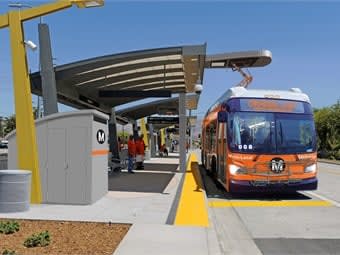
Overall, the early response from California transit agencies was positive, especially with many including LA Metro already making the move to zero-emission buses. Photo: New Flyer

Overall, the early response from California transit agencies was positive, especially with many including LA Metro already making the move to zero-emission buses. Photo: New Flyer
The California Air Resources Board voted to mandate that all transit agencies in California operate 100% zero-emission transit buses by 2040, and to use this transition to invest in workforce development training programs in manufacturing, infrastructure installation, and maintenance.
Overall, the early response from California transit agencies was positive, especially with many including LA Metro already making the move to zero-emission buses.
“We are already ahead of the curve,” LA Metro Spokesman Rick Jager told METRO Magazine. “Earlier this year Metro’s Board of Directors committed the agency to convert its entire bus fleet from natural gas to all zero-emission buses by 2030. Metro plans to have zero-emission electric buses operating on the Metro Orange and Silver Lines in the next two years. Toward this end, Metro has already purchased nearly 100 all-electric buses.”
“Our Board of Directors recently adopted a goal to go 100% zero-emissions with our fleet by 2030,” added Jerry Estrada, GM for the Santa Barbara Metropolitan Transit District. “While we know this will present many challenges, we plan to outpace the CARB mandate. We are extremely lucky to have operated battery-electric buses for the past 27 years, so we have seen the ups and downs of the industry, and we have lived them.”
Likewise, response from bus suppliers was also positive.
“We stand ready to deliver and make the transition to zero emission buses a reality,” said BYD President Stella Li in a statement. “Our Lancaster facility has the capacity to produce 1500 buses and we have partnered with Generate Capital to make a leasing program available to accelerate this transition. We also provide solar and storage products that can help customers charge their new buses. We are excited to work with leaders across the state to transition their fleets.”
According to the LA Times, transit agencies are worried about cost and reliability of the technology because it is in its early stages of commercial use. There are about 130 zero-emission buses in operation in the state, officials say, and 650 more are planned to hit the road in near future, the LA Times reported.
To that end, transit agencies are hopeful that the evolution will be smooth.
“We are hopeful that as time goes by and CARB tracks the progress of ZEB manufacturers, utility support, and industry readiness, California transit operators will successfully start to transition to a reliable suite of fleet options,” Estrada said.
The rule, which includes language calling for good jobs and resolving to develop further workforce policies, was passed after years of advocacy from a broad coalition of labor, environmental, and economic justice organizations, including the Sierra Club, Earthjustice, Union of Concerned Scientists, American Lung Association, BlueGreen Alliance, Coalition for Clean Air, Jobs to Move America, CWA District 9, the International Brotherhood of Electrical Workers (IBEW) Local 11, IBEW Local 569, and IBEW LMCC.
“The passing of this rule is a huge win for many in our communities who, despite working hard for years, have been unable to benefit from the Silicon Valley tech boom and infrastructure investment,” said Jobs to Move America Senior Policy Coordinator Abhilasha Bhola. “Not only will this rule reduce greenhouse-gas emissions, it has, the potential to create and support tens of thousands of jobs in our state.”
According to research from the University of Massachusetts-Amherst, if all of the buses purchased under this mandate were built in the U.S., this mandate could support up to 41,380 U.S. jobs. With policies such as the U.S. Employment Plan, California transit agencies will be able to incentivize bus companies to hire local workers as they transition to zero-emission fleets. Such policies can also ensure historically excluded populations, including women and communities of color, have access to these jobs.
More Management

METRO Opens Submissions for 2026 Motorcoach Awards
Nominations are now being accepted for METRO Magazine’s Operator of the Year and Innovative Operator of the Year awards.
Read More →
New York MTA Advances Final Contract for Second Avenue Subway Expansion
Contract Four is the largest in the Second Avenue Subway Phase 2 project and includes construction of station infrastructure, tracks, and signals for the subway expansion, MTA officials said. Work on Contract Four will begin in 2027.
Read More →
Transit Agencies Highlight Safety Gains at National Summit
Leaders from 15 major transit systems shared crime-reduction results and safety initiatives while discussing the role of continued federal support.
Read More →

NITA Names New Leadership, Expands Reduced-Fare Program at First Board Meeting
The new regional transit authority appointed its first board chair and interim executive director while extending reduced fares across CTA, Metra, and Pace for eligible riders.
Read More →
Beyond the Checklist: A Structured Approach to Transit Maintenance
Reliability-Centered Maintenance helps transit agencies move beyond routine checklists to focus limited resources on the assets and failures that have the greatest impact on safety, reliability, and service.
Read More →
APTA 2026 Nominating Committee Selects Leadership Slate, Names Chair and Vice Chair Nominees
Leadership changes will help shape the association’s priorities and its representation of the transportation industry during the 2026–2027 term.
Read More →
DART Launches Major Security, Fare Enforcement Initiative
The 90-day demonstration will deploy coordinated security teams at five light rail stations while testing controlled access and gathering data to guide future investments.
Read More →
Advancing Fare Collection Through Technology and Innovation
Learn about delivering 1300 gates at 91 stations while managing fare evasion. Explore the large scale deployment, solution customization and real-world results that affect the region. Prepare for deployment in your region now.
Read More →
Game Day in Motion: Moving Millions During the 2026 World Cup
Between packed transit stations and team motorcoaches, see how agencies and operators across North America tackled the transportation demands of the 2026 FIFA World Cup.
Read More →
Surface Transportation Extension Averts Shutdown, Leaves Transit Funding Gap
The stopgap keeps federal transportation programs moving, but missing advance funding could complicate the transit and rail projects agencies are planning next.
Read More →