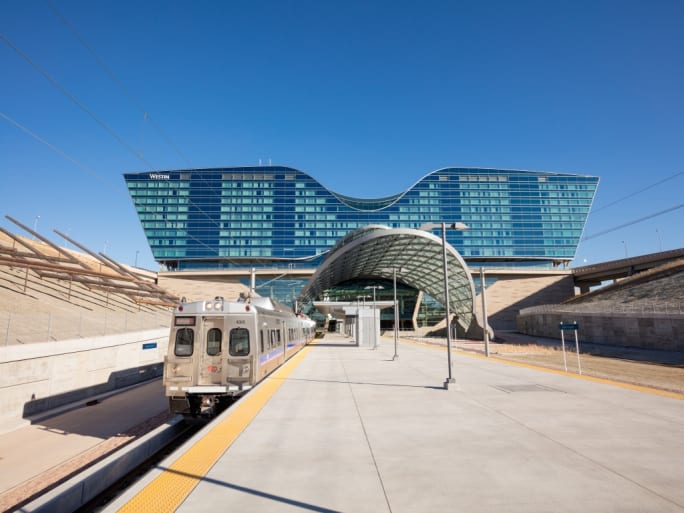
Denver's RTD 'Zero Fare for Better Air' Program Boosts Ridership
When compared with the same period last year, an additional 1,106,567 customer boardings occurred on RTD’s system during the months of July and August.
Boardings during the two-month initiative reflect the largest number of customers RTD has had on its system since the COVID-19 pandemic impacted ridership in March 2020.
When compared with the same period last year, an additional 1,106,567 customer boardings occurred on RTD’s system during the months of July and August.
Ad Loading...
Boardings during the two-month initiative reflect the largest number of customers RTD has had on its system since the COVID-19 pandemic impacted ridership in March 2020.
Mode
July 2022*
August 2022
July 2023
August 2023
Bus
3,199,117
4,055,264
3,935,371
4,472,626
Light Rail
1,222,832
1,393,608
1,153,929
1,134,846
Commuter Rail
724,454
832,433
882,657
894,360
Paratransit
51,417
68,992
82,450
98,445
Total
5,197,820
6,350,297
6,054,407
6,600,277
*The Zero Fare for Better Air initiative in 2022 did not include the month of July.
Year-Over-Year Growth
In comparison with the same period last year, mode-specific highlights include:
Bus saw a 16% increase in boardings.
Commuter rail experienced a 14% increase in boardings.
Ridership on the A Line increased 14% year-over-year, and it accounted for nearly three-fourths of commuter rail’s boardings during July and August.
Light rail saw a 13% decrease in boardings, much of which can be attributed to months-long planned maintenance projects that impacted the E, H, and R lines.
Paratransit saw a 50% increase in boardings.
“RTD was pleased to welcome many new and returning customers to its system in July and August,” said GM/CEO Debra A. Johnson. “The agency and its partners worked together to encourage people in the Denver metro area to explore new commuting habits. As RTD looks ahead to the future, the agency is focused on providing value over volume to ensure the region’s mobility needs are met.”
Ad Loading...
In early August, RTD conducted an extensive customer intercept survey to better understand ridership decisions, commuting trends and customer behaviors relating to the Zero Fare for Better Air initiative.
Photo: Denver RTD
Surveying Ridership
In early August, RTD conducted an extensive customer intercept survey to better understand ridership decisions, commuting trends and customer behaviors relating to the Zero Fare for Better Air initiative.
The survey directly engaged RTD’s customers onboard buses and trains and at key stops and stations. The intercept survey was distributed across the entire Denver metro region to align responses with ridership numbers.
Major findings from the customer intercept survey include:
74% of respondents said that the zero-fare initiative influenced their decision to use RTD’s services on the day they were surveyed.
84% of respondents said that cost savings was an important factor regarding their decision to use RTD’s services.
85% of respondents indicated that the environmental benefits of the initiative influenced their decision to take a bus or train.
72% of respondents planned to increase their usage of RTD’s services during the initiative.
33% of respondents said that the primary purpose of their trip was work related.
23% of respondents indicated that they would have driven themselves if they were not using it.
The collaborative, statewide Zero Fare for Better Air initiative was funded through a grant program created by Colorado Senate Bill 22-180 in an effort to reduce ground-level ozone during peak periods by increasing the community’s use of public transit.
Photo: Denver RTD
Environmental Impact
RTD has also partnered with the Regional Air Quality Council (RAQC) to determine the overall impact on emissions and ground-level ozone. RAQC, which is lending its subject-matter expertise in this field, is analyzing RTD’s ridership numbers and responses to the customer survey to quantify and better understand the two-month initiative’s impact on air quality.
Ad Loading...
RAQC’s analysis will be included in the final report that RTD submits to the Colorado Energy Office as part of its grant agreement with the state. The full report is expected to be submitted in November and will be publicly released at that time.
A separate employee survey was also conducted by RTD to engage frontline staff and garner information about the initiative’s impact on their jobs. Approximately half of employees surveyed felt that the Zero Fare for Better Air initiative fostered a welcoming transit environment for customers. An additional 26% of respondents expressed a neutral perspective to the question.
More than half of frontline employees also indicated that they are “somewhat supportive” or “strongly supportive” of the agency being part of a similar, statewide initiative in 2024.
The collaborative, statewide Zero Fare for Better Air initiative was funded through a grant program created by Colorado Senate Bill 22-180 in an effort to reduce ground-level ozone during peak periods by increasing the community’s use of public transit. This year, RTD expanded its zero-fare offering from one month to two, to align with Colorado’s highest ozone months of July and August and leveraged available state funding appropriated for the Ozone Season Transit Grant Program.
A full report of RTD’s boardings from July and August 2023 is available online in the October 2023 Board Briefing Documents here.
Contract Four is the largest in the Second Avenue Subway Phase 2 project and includes construction of station infrastructure, tracks, and signals for the subway expansion, MTA officials said. Work on Contract Four will begin in 2027.
The new regional transit authority appointed its first board chair and interim executive director while extending reduced fares across CTA, Metra, and Pace for eligible riders.
Reliability-Centered Maintenance helps transit agencies move beyond routine checklists to focus limited resources on the assets and failures that have the greatest impact on safety, reliability, and service.
The 90-day demonstration will deploy coordinated security teams at five light rail stations while testing controlled access and gathering data to guide future investments.
Learn about delivering 1300 gates at 91 stations while managing fare evasion. Explore the large scale deployment, solution customization and real-world results that affect the region. Prepare for deployment in your region now.
Between packed transit stations and team motorcoaches, see how agencies and operators across North America tackled the transportation demands of the 2026 FIFA World Cup.
The stopgap keeps federal transportation programs moving, but missing advance funding could complicate the transit and rail projects agencies are planning next.