



LA Metro Names Inaugural Chief to Lead New Public Safety Department
With more than 35 years of law enforcement experience, including eight years as Chief of Police in San Francisco and 27 years with the LAPD, Bill Scott returns to the city where he built his career to lead one of the most significant public safety transitions in LA Metro’s history.

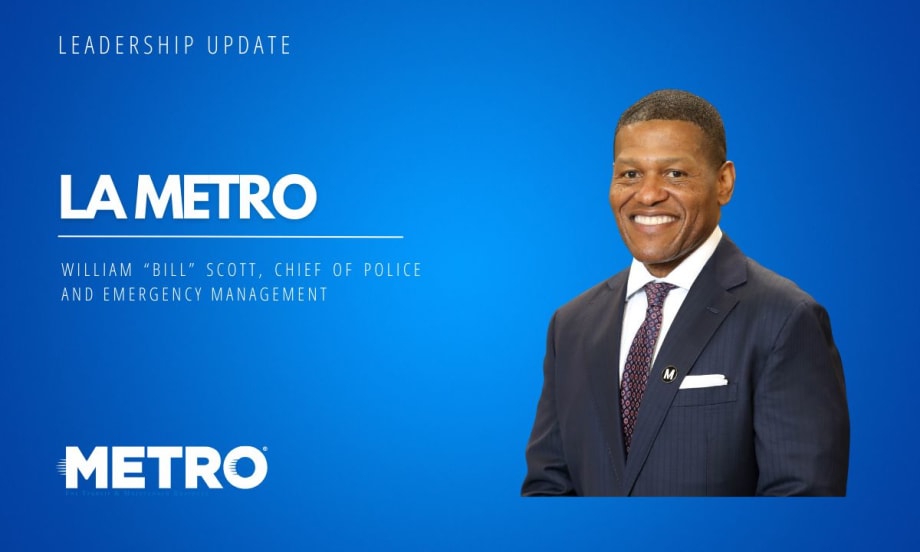
Bill Scott joins Metro to lead its new public safety department, which was approved by LA Metro’s board last June as the Transit Community Public Safety Department and is expected to unify and oversee all of the agency’s safety operations under one command structure.
Photo: LA Metro/METRO Magazine
The Los Angeles County Metropolitan Transportation Authority (Metro) named William “Bill” Scott as its first Chief of Police and Emergency Management.
With more than 35 years of law enforcement experience, including eight years as Chief of Police in San Francisco and 27 years with the Los Angeles Police Department (LAPD), Scott returns to the city where he built his career to lead one of the most significant public safety transitions in LA Metro’s history.
The decision follows an extensive engagement process with LA Metro’s board, employees, and community stakeholders to identify the qualities essential for the department’s next leader.
Leadership at a Pivotal Time
Scott joins Metro to lead its new public safety department, which was approved by LA Metro’s board last June as the Transit Community Public Safety Department (TCPSD) and is expected to unify and oversee all of the agency’s safety operations under one command structure.
As Chief, Scott will be responsible for building the department from the ground up, overseeing everything from command staff selection and training standards to uniforms, technology systems, and deployment strategies, said LA Metro officials.
Chief Scott will also lead LA Metro’s security coordination for many upcoming high-profile global events, including the 2026 FIFA World Cup, 2027 Super Bowl, and 2028 Olympic and Paralympic Games.
“We heard the community’s call for a leader who is calm under pressure, emotionally intelligent and politically astute,” said LA Metro CEO Stephanie Wiggins in an LA Metro press release. Someone who can balance enforcement with empathy and collaboration. Chief Scott brings all of that and more. His experience leading reform in San Francisco, coupled with his decades of service in our own neighborhoods with LAPD, make him uniquely qualified to deliver the safe, responsive and equitable security system our riders deserve. This is a defining moment for Metro’s public safety strategy.”
A History of Safety and Security
During his tenure in San Francisco, Scott was nationally recognized for implementing 21st Century policing reforms, completing all 272 U.S. Department of Justice recommendations.
Under his leadership, the San Francisco Police Department (SFPD) significantly reduced use-of-force incidents, prioritized de-escalation training, and improved violent crime clearance rates well above national averages, LA Metro officials said. He also introduced innovative tools like Automated License Plate Recognition (ALPR) cameras and drones to address organized retail theft and property crime.
As Chief of SFPD, he oversees safety and security on San Francisco’s Muni system, and over his tenure, crime on their transit system has decreased precipitously — just 2.3 crimes per 100,000 miles of travel in March 2025.
“This is an incredible opportunity at this point in my career,” said Chief Scott. “How many people can say they have built a public safety operation from the very beginning? I’m honored to be back in L.A., but even more honored to have this chance to lead this next chapter for LA Metro. Together, we have an opportunity to create something that reflects the values of this region, supports our frontline teams, and earns the trust of the public we serve.”
Scott will also focus on building a strong internal leadership team, strengthening relationships with local law enforcement agencies, and reinforcing LA Metro’s safety culture through clear, consistent communication, agency officials said.
Key priorities will include engagement with community-based organizations, strengthening ties with the District Attorney’s Office, and ensuring fairness and transparency in enforcement policies.
Chief Scott will officially assume his role on June 23.
More Management

METRO Opens Submissions for 2026 Motorcoach Awards
Nominations are now being accepted for METRO Magazine’s Operator of the Year and Innovative Operator of the Year awards.
Read More →
New York MTA Advances Final Contract for Second Avenue Subway Expansion
Contract Four is the largest in the Second Avenue Subway Phase 2 project and includes construction of station infrastructure, tracks, and signals for the subway expansion, MTA officials said. Work on Contract Four will begin in 2027.
Read More →
Transit Agencies Highlight Safety Gains at National Summit
Leaders from 15 major transit systems shared crime-reduction results and safety initiatives while discussing the role of continued federal support.
Read More →

NITA Names New Leadership, Expands Reduced-Fare Program at First Board Meeting
The new regional transit authority appointed its first board chair and interim executive director while extending reduced fares across CTA, Metra, and Pace for eligible riders.
Read More →
Beyond the Checklist: A Structured Approach to Transit Maintenance
Reliability-Centered Maintenance helps transit agencies move beyond routine checklists to focus limited resources on the assets and failures that have the greatest impact on safety, reliability, and service.
Read More →
APTA 2026 Nominating Committee Selects Leadership Slate, Names Chair and Vice Chair Nominees
Leadership changes will help shape the association’s priorities and its representation of the transportation industry during the 2026–2027 term.
Read More →
DART Launches Major Security, Fare Enforcement Initiative
The 90-day demonstration will deploy coordinated security teams at five light rail stations while testing controlled access and gathering data to guide future investments.
Read More →
Advancing Fare Collection Through Technology and Innovation
Learn about delivering 1300 gates at 91 stations while managing fare evasion. Explore the large scale deployment, solution customization and real-world results that affect the region. Prepare for deployment in your region now.
Read More →
Game Day in Motion: Moving Millions During the 2026 World Cup
Between packed transit stations and team motorcoaches, see how agencies and operators across North America tackled the transportation demands of the 2026 FIFA World Cup.
Read More →
Surface Transportation Extension Averts Shutdown, Leaves Transit Funding Gap
The stopgap keeps federal transportation programs moving, but missing advance funding could complicate the transit and rail projects agencies are planning next.
Read More →