



NYC, S.F., Boston ranked 'Best Cities for Public Transit'
Transit Score, a tool by Redfin company Walk Score®, rates locations based on how convenient they are to public transportation.

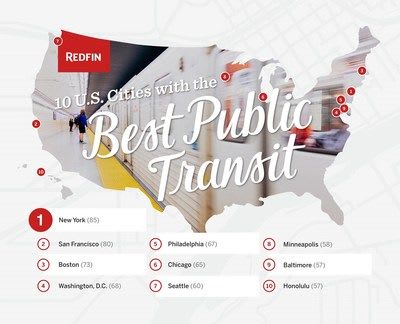
Transit Score, a tool by Redfin company Walk Score, rates locations based on how convenient they are to public transportation.
Image: Redfin
New York , San Francisco, and Boston are 2018's best cities for public transit according to new Transit Score rankings by Redfin, the next-generation real estate brokerage. Transit Score, a tool by Redfin company Walk Score, rates locations based on how convenient they are to public transportation. Each of the top three cities has a Transit Score above 70, meaning it has an excellent transit rating, with public transportation being a convenient option for most trips.
2018 Transit Score Top 10
While the rank order for the six best cities for public transit has stayed the same since 2012 when Transit Score first launched, there was a lot of movement at the bottom of the top-10 list.
In seventh place, Seattle has a Transit Score of 59.6, up 2.6 points since 2016, the biggest jump among the top 10. In the past two years, Seattle has expanded its Link light rail service, adding two new stations in 2016, making it easier and faster to get to Capitol Hill and the University of Washington. A 2017 survey by the Seattle Department of Transportation found that public transit use had increased by 48% in the past seven years.
"Seattle is not only the coolest city in the country — we are now one of the most transit-friendly cities," said Seattle Mayor Jenny Durkan. "For our visitors, commuters and residents, public transit is safe, affordable, and a vital component in making sure our city is accessible to all. With the opening of new light rail stations and one of the highest bus riderships in the country, Seattle is making significant strides towards becoming a world-class transit city."
Honolulu gained 1.6 points of Transit Score since 2016 and entered the top 10 list for the first time, replacing Miami. More than 69 million passengers in Honolulu ride TheBus annually and the city is planning a new rail system to further improve public transportation.
"Honolulu has been a public transportation city for many years now and the fact that our residents and visitors use TheBus an average of 214,000 trips every weekday is a testament to this fact," said Honolulu Mayor Kirk Caldwell.
Ranking of the top 10 U.S. cities (with populations of more than 300,000) for public transit
Rank | City | Transit Score | Change from 2016 | Previous Rank (2016) |
1 | New York City | 85.3 | +1.2 | 1 |
2 | San Francisco | 80.4 | 0 | 2 |
3 | Boston | 72.6 | -1.8 | 3 |
4 | Washington, D.C. | 68.5 | -2.2 | 4 |
5 | Philadelphia | 66.8 | +0.1 | 5 |
6 | Chicago | 65.0 | +0.3 | 6 |
7 | Seattle | 59.6 | +2.6 | 10 |
8 | Minneapolis | 57.6 | 0 | 9 |
9 | Baltimore | 57.2 | -0.6 | 8 |
10 | Honolulu | 57.2 | +1.7 | 11 |
Washington, D.C., had the largest decrease among all major cities in Transit Score, dropping 2.2 points over the past two years to 68.5 in 2018. The decrease can be attributed to changes in Metrobus and Metrorail scheduling, where some bus routes were discontinued and the frequency of trains during rush hour was lowered.
"Once touted as the gold standard for public transit, D.C.'s Metro is now reckoning with decades of deferred maintenance," said Redfin Washington, D.C. Agent John Marcario. "Tough decisions to reduce service and shut down lines for extended periods for repair are causing short-term frustration, but will hopefully make the system better in the long run. Despite the fall in Transit Score, access to transit remains a top priority for D.C. home buyers, who are still willing to pay a premium to live near a metro station."
Bakersfield, Calif. (-2.2), Miami (-2.2), Boston (-1.8), and Baltimore (-0.6) rounded out the cities with the biggest Transit Score decreases from 2016 to 2018.
With the addition of 600 new U.S. cities and more than 4,000 new neighborhoods, Transit Score ratings are now available for more than 900 cities and nearly 15,000 neighborhoods on walkscore.com. Among the newly added cities are big ones like Jacksonville, Fla. (22.4) and Charlotte, N.C. (27.4), along with smaller cities with Transit Score ratings like Hartford, Conn. (54.2) and Syracuse, N.Y. (44.1).
More Management

METRO Opens Submissions for 2026 Motorcoach Awards
Nominations are now being accepted for METRO Magazine’s Operator of the Year and Innovative Operator of the Year awards.
Read More →
New York MTA Advances Final Contract for Second Avenue Subway Expansion
Contract Four is the largest in the Second Avenue Subway Phase 2 project and includes construction of station infrastructure, tracks, and signals for the subway expansion, MTA officials said. Work on Contract Four will begin in 2027.
Read More →
Transit Agencies Highlight Safety Gains at National Summit
Leaders from 15 major transit systems shared crime-reduction results and safety initiatives while discussing the role of continued federal support.
Read More →

NITA Names New Leadership, Expands Reduced-Fare Program at First Board Meeting
The new regional transit authority appointed its first board chair and interim executive director while extending reduced fares across CTA, Metra, and Pace for eligible riders.
Read More →
Beyond the Checklist: A Structured Approach to Transit Maintenance
Reliability-Centered Maintenance helps transit agencies move beyond routine checklists to focus limited resources on the assets and failures that have the greatest impact on safety, reliability, and service.
Read More →
APTA 2026 Nominating Committee Selects Leadership Slate, Names Chair and Vice Chair Nominees
Leadership changes will help shape the association’s priorities and its representation of the transportation industry during the 2026–2027 term.
Read More →
DART Launches Major Security, Fare Enforcement Initiative
The 90-day demonstration will deploy coordinated security teams at five light rail stations while testing controlled access and gathering data to guide future investments.
Read More →
Advancing Fare Collection Through Technology and Innovation
Learn about delivering 1300 gates at 91 stations while managing fare evasion. Explore the large scale deployment, solution customization and real-world results that affect the region. Prepare for deployment in your region now.
Read More →
Game Day in Motion: Moving Millions During the 2026 World Cup
Between packed transit stations and team motorcoaches, see how agencies and operators across North America tackled the transportation demands of the 2026 FIFA World Cup.
Read More →
Surface Transportation Extension Averts Shutdown, Leaves Transit Funding Gap
The stopgap keeps federal transportation programs moving, but missing advance funding could complicate the transit and rail projects agencies are planning next.
Read More →