




Related: MTA introduces first of its new state-of-the-art buses
NYC Transit's maintenance program key for ensuring summer comfort
Temperatures in New York City have already reached the high 80s and that’s only a taste of what it will be like when the real summer weather hits. Fortunately for customers, the operation takes a year-round approach to HVAC maintenance and that means a cool ride for everyone.
June 7, 2016

NYC Transit
5 min to read
NYC Transit
By Charles Seaton, MTA New York City Transit, Director Corporate Communications
Temperatures in New York City have already reached the high 80s and that’s only a taste of what it will be like when the real summer weather hits. Fortunately for customers, MTA New York City Transit (NYC Transit) takes a year-round approach to HVAC maintenance and that means a cool ride for everyone.
It may seem like ancient history but there was a time when, unlike today, traveling on a bus or subway train that was adequately cooled in summer or heated in winter was not so much a given as a gamble. Riders now benefit from vehicle fleets that are 100% air conditioned, while improved maintenance practices ensure that the heating, ventilation and air conditioning (HVAC) systems are calibrated properly and working as designed.
Capital Program funding has made a huge difference, as it was the funding source for new and overhauled subway cars. Of the rebuilt railcars, nearly 1,400 were originally manufactured without air conditioning. Current transit buses are designed with newly engineered systems, which help increase efficiency and reliability while improved maintenance practices keep the systems operating at peak performance.
“Temperatures in New York City range from the single digits to the 90s and we maintain the systems of more than 10,000 buses and subway cars to maintain the level of comfort year round.” said NYC Transit President Ronnie Hakim.
Before we were cool
Transit bus air conditioning has gone through two distinct phases and is currently in a third. During the initial stage, customers viewed a chilled bus interior as a novelty. A little later on it attained luxury status meaning you were fortunate to board a bus where the A/C actually worked. Today, however, putting a bus on the street with a well-functioning climate-control system is a necessity that NYC Transit’s bus customers have come to expect.
“We look at our operation as 'Buses as a Business,' and as with any business you must give the customer what they are paying for. It is in the bargain that we offer our customers service that is safe, efficient and comfortable. A well-functioning HVAC system is very much a part of that bargain,” said Darryl Irick, president, MTA Bus/sr. VP, New York City Transit Department of Buses.
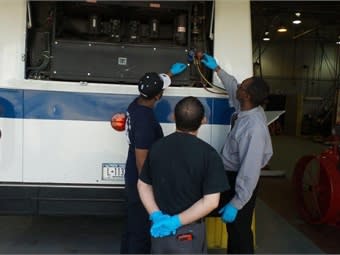
The HVAC system on board buses receive major bi-annual inspections to help meet the bus HVAC performance and reliability expectations. A comprehensive preventative maintenance inspection is performed annually, followed six months later by a supplementary "running” inspection. Air conditioning compressor belt tension, refrigerant state of charge and the health of the whole system are checked during both procedures.
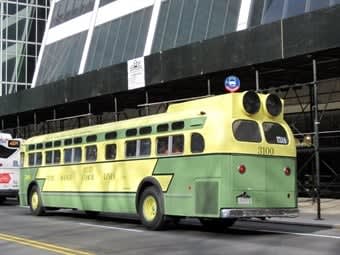
) Bus 3100 in NYCT Museum fleet. First A/C transit bus to operate in New York City. The demonstrator was purchased by Fifth Avenue Coach Lines from General Motors.
Joseph Caronetti
Return air filters are changed out every 30 days during the summer and every 60 days throughout the rest of the year. All scheduled HVAC maintenance is performed between the months of September and June to ensure that the climate-control systems are in top operating condition at the beginning of the A/C season.
This pro-active system tuning allows climate-control qualified personnel available to quickly resolve any problems that may occur during the peak season. Periodically, audits of bus HVAC system operation are conducted. HVAC “target” decals are installed on every bus to ensure these audits are conducted accurately and consistently.
Fresh engineering to keep customers cool and the environment green
New buses are delivered with 407C and 134A refrigerants, which is more environmentally friendly than older R-22. HVAC system manufacturers have redesigned their entire systems for optimum performance. A/C units are now mounted on the roof of the bus instead of the rear of the bus. This configuration results in less dirt accumulation and makes it easier for maintenance personnel to replace filters and service the units.
Taking advantage of new technologies, the HVAC systems on new buses have monitoring capabilities that can detect problems and send error messages directly to depots, which can speed up diagnostic and repair time. Other innovations designed to improve efficiency, fuel economy and reliability are being evaluated, including an all-electric climate control system.
NYC Transit
Cooling beneath the streets
Controlling the climate onboard NYC Transit subway trains was no less challenging than buses and the effort began in July of 1967 when a ten-cat train of R38 model subway cars was placed into service along the F Line.
Subsequent orders of lettered-line cars were delivered with A/C but the comfort featured remained elusive for riders on the numbered lines. In 1975, however, a pair of ten-car trains was placed in service along the numbered lines. This effort capped more than two decades of work to develop a unit compact enough to fit in the car body of the smaller IRT cars yet powerful enough to keep comfortable a full rush hour passenger load.
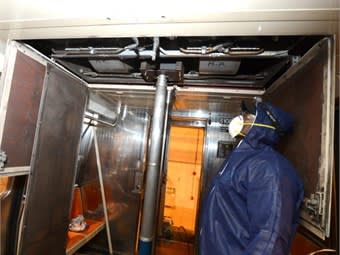
Reliability is a major concern with any HVAC system and NYC Transit subway cars are no exception. Aside from regular routine inspection and maintenance, the systems undergo an extensive scheduled maintenance system overhaul every 14 years. This effort includes a detailed tear down of the subcomponents, replacement of long-term wear items, coolant and pressure testing, cleaning and lubrication of all moving parts, and complete functional performance testing.
NYC Transit makes every effort to maintain customer comfort. When a system fault is reported, the train is removed from service and the problem corrected. On the newer car classes, however, a failed unit does not translate into a hot car. Transit’s “new technology” cars are designed with dual roof mounted units. This is a redundant design system which allows minimum cooling in the event one of the overhead units fail while the train is in service.
Fast and efficient maintenance
The units are also designed to be removed from the car as a single unit and replaced by another while under repair. “This design means that there is a minimum of downtime for the train. Swapping out a problem unit for a good one means that the train stays in the barn for the shortest time possible,” explained Joseph Bromfield, chief mechanical officer, Department of Subways.
So, as temperatures rise you can be certain that an army of men and women in NYC Transit’s maintenance facilities are working diligently to keep you comfortable as you travel around the City.
More Management

METRO Opens Submissions for 2026 Motorcoach Awards
Nominations are now being accepted for METRO Magazine’s Operator of the Year and Innovative Operator of the Year awards.
Read More →
New York MTA Advances Final Contract for Second Avenue Subway Expansion
Contract Four is the largest in the Second Avenue Subway Phase 2 project and includes construction of station infrastructure, tracks, and signals for the subway expansion, MTA officials said. Work on Contract Four will begin in 2027.
Read More →
Transit Agencies Highlight Safety Gains at National Summit
Leaders from 15 major transit systems shared crime-reduction results and safety initiatives while discussing the role of continued federal support.
Read More →

NITA Names New Leadership, Expands Reduced-Fare Program at First Board Meeting
The new regional transit authority appointed its first board chair and interim executive director while extending reduced fares across CTA, Metra, and Pace for eligible riders.
Read More →
Beyond the Checklist: A Structured Approach to Transit Maintenance
Reliability-Centered Maintenance helps transit agencies move beyond routine checklists to focus limited resources on the assets and failures that have the greatest impact on safety, reliability, and service.
Read More →
APTA 2026 Nominating Committee Selects Leadership Slate, Names Chair and Vice Chair Nominees
Leadership changes will help shape the association’s priorities and its representation of the transportation industry during the 2026–2027 term.
Read More →
DART Launches Major Security, Fare Enforcement Initiative
The 90-day demonstration will deploy coordinated security teams at five light rail stations while testing controlled access and gathering data to guide future investments.
Read More →
Sponsored•September 9, 2026
Advancing Fare Collection Through Technology and Innovation
Learn about delivering 1300 gates at 91 stations while managing fare evasion. Explore the large scale deployment, solution customization and real-world results that affect the region. Prepare for deployment in your region now.
Read More →
Game Day in Motion: Moving Millions During the 2026 World Cup
Between packed transit stations and team motorcoaches, see how agencies and operators across North America tackled the transportation demands of the 2026 FIFA World Cup.
Read More →
Surface Transportation Extension Averts Shutdown, Leaves Transit Funding Gap
The stopgap keeps federal transportation programs moving, but missing advance funding could complicate the transit and rail projects agencies are planning next.
Read More →