MARTA continues to show fiscal responsibility, balancing the budget for a 13th straight year without a fare increase and reconfirming two AAA bond ratings.
The $1.6 billion budget includes $654.5 million in net operating funds and $909.2 million for capital programming.
Ad Loading...
MARTA’s Balanced Budget
MARTA continues to show fiscal responsibility, balancing the budget for a 13th straight year without a fare increase and reconfirming two AAA bond ratings.
In an ongoing commitment to customer service and system improvement, the budget prioritizes projects necessary to ensure customer safety, those associated with the arrival of the new railcars and new buses and infrastructure, station rehabilitation, new fare collection equipment, and technological upgrades to service information.
“The budget underscores our priorities of keeping the current system in a state of good repair, building the MARTA of the future, and growing ridership,” said MARTA GM/CEO Collie Greenwood. “After much engineering, planning, and design work, we are putting shovels in the ground so to speak. Customers will see multiple improvement and expansion projects systemwide over the next year. MARTA is 45 years old. It’s time to invest in the next 45 and beyond.”
MARTA derives a significant part of its operating budget from sales tax revenue which remains robust, and ridership, while still below pre-COVID levels, continues to increase and has returned for large events.
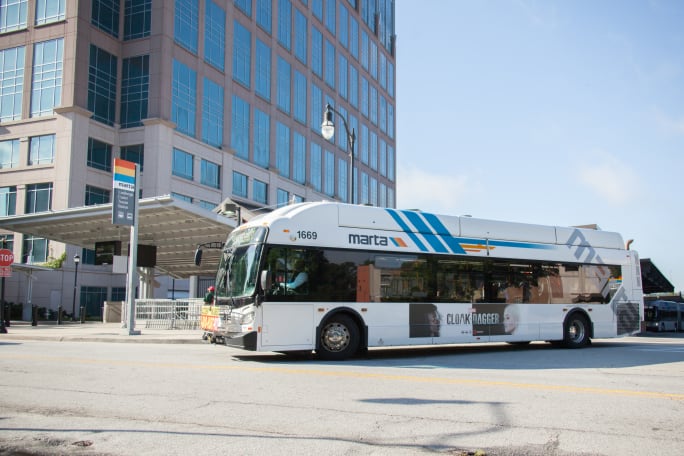
Photo: MARTA
Funding and Capital Programs
MARTA derives a significant part of its operating budget from sales tax revenue which remains robust, and ridership, while still below pre-COVID levels, continues to increase and has returned for large events.
The operating budget assumes a four percent salary increase for non-represented employees, and fully funds the collective bargaining agreement obligations, as well as accounts for inflation and ongoing supply chain issues.
Ad Loading...
“The MARTA board of directors is mindful of the challenges facing the transit industry from procurement to ridership,” said MARTA Board Chair Katie Powers. “We also recognize that MARTA is faring better than other agencies in many regards due to sound financial decisions. My fellow board members and I remain committed to ensuring MARTA is a good steward of public money.”
MARTA’s Capital Improvement Program continues to advance, with several projects either under construction, such as MARTA Rapid Summerhill, the region’s first bus rapid transit line that opens for service next year, or entering the construction phase, such as the Five Points Transformation set to get underway in July.
The budget includes $76 million for the multi-year Station Rehabilitation Program and $92 million for the procurement of new railcars, the first of which arrives in Atlanta later this year for testing.
Additionally, the budget allocates $32 million for the procurement of new buses, $25 million to advance the Clayton County Operations and Maintenance Facility project, and $20 million to continue the development and implementation of a new fare collection system.
Innovations in autonomous and zero-emission transportation, standout transit systems, and industry leadership took center stage among this year's honorees.
Transit leaders, manufacturers, and industry professionals gathered in Chicago to explore new technologies, share ideas, and discuss the future of public transportation.
Dr. Carol Parker Walsh discusses leadership development, employee retention, workplace culture, and preparing transit’s workforce for AI and automation.
After 45 years, APTA returns to Chicago with a focus on next-generation fleets, AI, connected transit networks, and the funding strategies shaping public transportation’s future.
The agency said tariffs on specialized imported components could reduce the purchasing power of its $23 billion investment in new subway cars, railcars, and buses.
The APTA award-winning agency is pairing rapid system expansion with investments in workforce, safety, technology, and the fundamentals of transit service.
In this episode of Bus Tech Talk, Complete Coach Works’ Business Development Manager Mark Hollenbeck and METRO’s Executive Editor Alex Roman sit down with Obed Mejia, Senior Technical Trainer for Bus Maintenance, at LA Metro to discuss how rapidly evolving bus technology is changing the maintenance shop — and the skills technicians need to keep pace.