




Keep Reading: How Transit Architecture Is Reshaping the Rider Journey
When the Buses Are Ready, and the System Isn’t
Transit agencies have moved past pilot projects, but scaling electrification is exposing a harder truth: the real challenge isn’t vehicles, it’s everything around them.
May 11, 2026
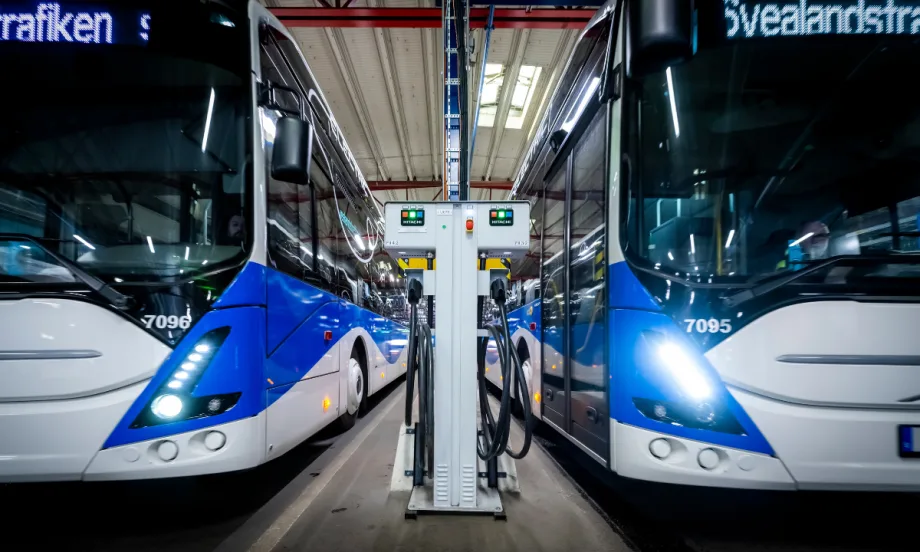
Vehicle procurement tends to draw public attention, but the pace of electrification is often driven by less visible issues.
Credit:
Hitachi Energy
7 min to read
- Transit agencies have progressed beyond pilot projects in their electrification efforts.
- The greatest challenges in scaling electrification lie in the infrastructure and systems surrounding the vehicles, not the vehicles themselves.
- Addressing infrastructure and systemic issues is essential for the successful expansion of electrified transit fleets.
*Summarized by AI
Public transit electrification in North America is well past the experimental phase. For most agencies, the “if” question has largely been answered. What transit leaders are dealing with now is more practical: how fast can they scale, and how do they make that transition work in the real world?
That change is underway, as agencies that once tested a handful of battery-electric buses now plan for broader fleet transitions.
A recent Hitachi Energy report, “Scaling Up: Electrifying Public Transit Fleets in North America,” examines what it takes to make that transition work in practice, and its central point is a useful one for agency leaders: scaling electric fleets depends on more than the physical vehicles.
Grid capacity, charging infrastructure, depot design, workforce readiness, and digital tools all play a role in whether electrification succeeds or stalls.
The broader market signals back that up. According to the Hitachi Energy white paper, battery costs fell about 14% between 2022 and 2023, while agencies are also responding to pressure for “cleaner, quieter” service and long-term fleet modernization. Hitachi officials also note that more than half of agencies already operate low- or zero-emission buses, and nearly 70% expect to be fully electric by 2040.
That’s the good news. The harder part begins when agencies move past pilots and demonstration projects into systemwide operations.
Why Successful Pilots Don’t Survive First Contact With Scale

Hitachi Energy's Daniel Simounet said that successful agencies are keeping track of technology and industry best practices, which are "in constant and rapid evolution."
Credit:
Hitachi Energy
“One of the biggest gaps is underestimating the complexity of scaling infrastructure and operations,” said Daniel Simounet, vice president, transportation sector in North America, at Hitachi Energy. “Pilots often work because they’re small, flexible, and heavily supported, but those conditions don’t automatically extend to fleets of 100 or several hundred buses.”
That idea will sound familiar to just about any transit leader who has run a successful pilot and then tried to map it to full-service operations. A pilot can absorb many workarounds, but full deployment cannot.
Once electric buses become part of regular service, agencies have to simultaneously think through charging windows, route design, workforce training, maintenance workflows, utility coordination, procurement timing, and daily operational resilience.
Though success depends on more than just technology, it requires transit agencies to embed electrification into daily operations and build flexible systems that can withstand the test of time.
That’s also why many agencies are discovering that the bottleneck is not the bus itself.
“A significant portion of the challenge lies squarely in the charging infrastructure and the grid,” Simounet explained. “Vehicles are only half the equation — without sufficient power capacity and the right electrical infrastructure, buses simply sit idle.”
This is one of the more important reframes for agency leadership. Vehicle procurement tends to draw public attention, but the pace of electrification is often driven by less visible issues: substation upgrades, distribution capacity, permitting, utility crew availability, and the physical realities of older depots.
Hitachi Energy’s report is explicit on this point, noting that grid modernization and infrastructure readiness are among the biggest barriers to scaling and that agencies need to plan fleet transitions and infrastructure upgrades in tandem. Simounet warns that if charging capacity lags behind vehicle deliveries, agencies risk ending up with electric buses parked and unused because the grid isn’t ready.
The Grid Is the Gatekeeper, but It’s Not Ready on Demand
It seems like a good time to mention that timing is everything here.
“Early coordination with utilities and infrastructure manufacturers is absolutely critical,” Simounet said. “It can be the difference between a smooth transition and years of delays.”
That may be one of the most practical takeaways for transit agency executives. Utility engagement cannot be treated as a problem to be addressed later, after fleet decisions are made. Grid upgrades can take years, particularly when substations or new distribution circuits are involved. If utility planning, depot planning, and fleet rollout schedules are not aligned early, agencies can face misaligned timelines, added costs, and missed funding windows.
Simounet noted that when planning is done too late, agencies can even end up with vehicles arriving on schedule while the infrastructure is not ready to support them.
…and Don’t Forget the Depot
The same goes for depots, which are easy to overlook until agencies get into the details. Many existing transit yards were never designed to support high-power charging, and retrofitting them is not as simple as adding equipment. It often involves:
- Structural assessments.
- Space reconfiguration.
- Coordination with existing mechanical and electrical systems.
- Tradeoffs around traffic flow, maintenance access, and fire and life safety.
These challenges are noticeable in dense urban environments, where agencies have no way to expand horizontally. Hitachi officials argue that agencies planning for scale from day one are better positioned because they can design depots, substations, and route schedules for future growth rather than scrambling through costly retrofits later. The report also points to solutions that reduce floor-mounted equipment, preserve traffic flow, and allow more vehicles to connect within the same footprint.
An example illustrating this strategy comes from Québec City. Réseau de transport de la Capitale piloted a centralized charging approach that minimized equipment on the depot floor and simplified cabling. According to the white paper, the design cut physical space requirements by about 60%, helping the agency expand electrification within its existing yards. The case is especially relevant for agencies trying to electrify in constrained facilities, because it shows that depot design is a core operating strategy.
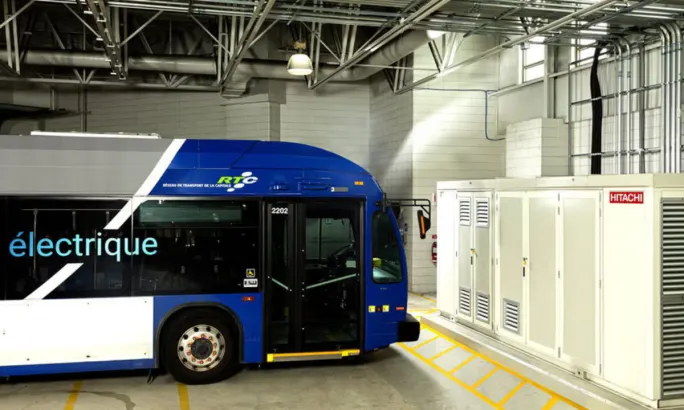
In Québec City, Réseau de transport de la Capitale piloted a centralized charging approach that minimized equipment on the depot floor and simplified cabling.
Credit:
Hitachi Energy
Digital Tools Are Becoming the Backbone of Reliability
As transit systems become more multifaceted, digital tools start to matter more, too.
“Charging and energy management platforms, predictive analytics, and asset monitoring systems help agencies integrate electric fleets into existing scheduling, maintenance, and operations workflows,” Simounet said.
Digitalization and interoperability are essential to managing uptime, forecasting maintenance, and coordinating buses, chargers, depots, and the grid as one system. For transit leaders, that matters because reliability remains the standard against which electric fleets will ultimately be judged.
Hitachi officials also said that digital platforms can help shorten the “maturity curve” by giving agencies better visibility into asset health, charging cycles, and long-term performance.
For example, predictive analytics can improve bus availability by identifying faults before they occur, along with digital twins that simulate wear from daily operations and environmental stress.
That being said, system design is important. Electric buses do not operate in isolation. They sit inside a broader network that already depends on scheduling software, depot management, maintenance systems, labor practices, and energy planning. Electrification works best when agencies connect those pieces early rather than layering new technology on top of old workflows and hoping it all syncs later.
That’s why Simounet emphasized the need for scale planning even at the pilot stage.
“Agencies that succeed are keeping track of technology and industry best practices, which are in constant and rapid evolution,” Simounet said. “They tend to plan for scale from day one, even if they’re starting with a pilot.”
Other Barriers to Electrification Implementation
- Workforce development and organizational readiness: Operators, mechanics, and labor groups all need training and updated workflows. Workforce change management can take longer and require more resources than vehicle procurement or infrastructure installation. Remember, it’s a people transition, too.
- Funding and finances: Public funding has helped move the market, but it does not solve everything. The report outlines major U.S. and Canadian programs, including the Infrastructure Investment and Jobs Act and Canada’s Zero Emission Transit Fund, while also stressing that many of these programs have fixed timelines or limited windows. Funding is a catalyst, but the differentiator is how agencies use that funding to build future-ready infrastructure and digital solutions.
Transit agencies will likely need a mix of grants, private financing, and service-based models to sustain electrification over the long term.
Scaling is an Operational Overhaul
The next phase of electrification will not be won on vehicle orders alone.
It will be won on planning discipline, utility coordination, depot strategy, operational integration, and the ability to build systems that can scale without falling apart under real-life conditions.
For agencies just getting started, Simounet explained in straightforward terms:
“The most important first step is conducting a comprehensive feasibility and planning assessment before procuring large numbers of vehicles,” he said. “Agencies need a clear understanding of their power requirements, depot constraints, grid readiness, and operational impacts.”
That may not be the flashiest part of fleet electrification, but it is probably the most important. Because at this stage of the transition, success is not defined by how many electric buses an agency can buy, but by how well those buses fit into existing operations.
Quick Answers
The primary challenge is not the vehicles themselves but the infrastructure and systems surrounding them.
*Summarized by AI
Subscribe to Our Newsletter
More Management

Indian River Transit’s Community-Focused Approach Earns National Recognition
Named APTA’s 2026 Outstanding Public Transportation System in its size category, Florida’s Indian River County transit system continues to grow ridership through fare-free service and a focus on evolving community needs.
Read More →
ENC Lands MATA Contract and More in Biz Briefs
In this edition of Biz Briefs, we spotlight the latest developments shaping the future of mobility.
Read More →
From Surviving to Thriving: Building Stronger Transportation Organizations
Bus Business Consultants founder Brian Dickson shares lessons on leadership, organizational health, and creating options for long-term success in a changing transportation industry.
Read More →

Everett Transit, Community Transit Outline Consolidation Agreement
The proposed agreement calls for a 50% increase in bus service in Everett, a new microtransit zone, continued paratransit service, and the transfer of Everett Transit operations to Community Transit.
Read More →
Strada360’s Steve Lassey on Turning Transit Data Into Better Decisions
From breaking down data silos to preparing for AI, Strada360 CEO Steve Lassey discusses how transit agencies can use technology to improve operations, customer information, and long-term decision-making.
Read More →
People Movement: Phil Washington Joins HNTB, Denver RTD Launches CEO Search, and More
In this edition, we also spotlight recent personnel moves at STV, the Eno Center for Transportation, and more, highlighting the people taking on new roles across the transportation industry.
Read More →
SEPTA Details Accelerate Vision for Transit System
The plan outlines investments in trolley modernization, new Metro and Regional Rail vehicles, accessible stations, and more frequent bus and rail service.
Read More →
FTA Ends Direct Oversight of MBTA Safety Actions
The federal agency closed its remaining special directive to the Massachusetts Department of Public Utilities following a safety review that began in 2022.
Read More →
Report: Transit Bus Manufacturing Supports 34,100 Jobs, $5.1B in GDP
The “Buses Mean Business” report examines the transit bus manufacturing industry’s economic footprint, supply chain, and rising demand for vehicle replacements.
Read More →
LIT Marks 10-Year Milestone at Annual Summit
Hosted by the COTA from September 10 to 13, the Summit carried the theme “Celebrating 10 Years of Excellence, Leadership, and Impact,” with every part of the program honoring the people, agencies, and partners who built LIT over its first decade.
Read More →