




Keep Reading: Why Transit Agencies Are Rethinking the Farebox, and the Technology Behind It
What It Really Takes To Move a Stadium Crowd
Behind every sold-out game is a transit playbook built on data, partnerships, and precision timing to move thousands of fans. Here’s how agencies make it work.
April 8, 2026
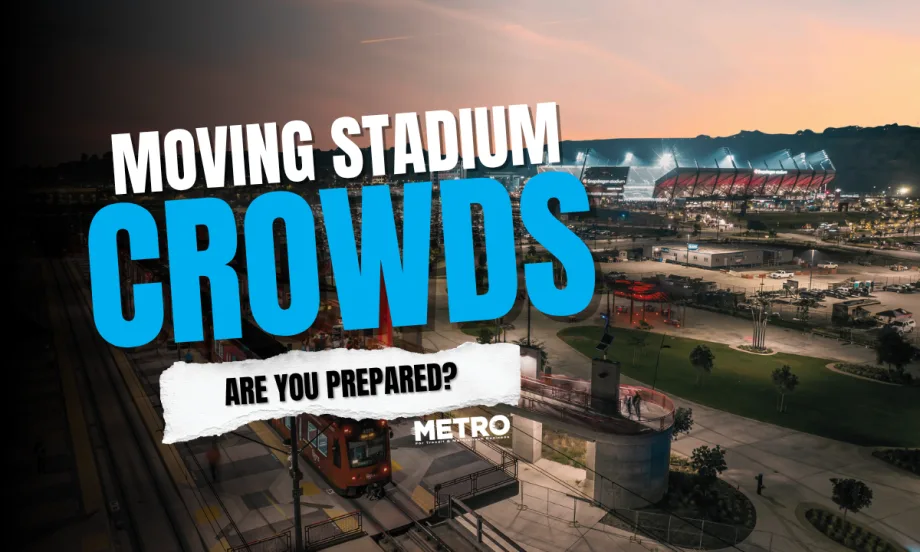
Unlike traditional commute patterns, sports events create uneven surges that require a different kind of planning. So, how do transit agencies tackle that?
Credit:
San Diego Metropolitan Transit System/METRO
7 min to read
- Stadium crowd movement relies on a detailed transit strategy that integrates data analysis, collaborative partnerships, and meticulous timing.
- Transit agencies may work to manage the influx and outflow of fans to prevent traffic congestion near venues.
- Successful crowd management at large sporting events demands precise coordination among transit agencies and special events operations.
*Summarized by AI
On game day, the real action might seem like it’s only on the field or the court, but it also plays out on platforms, in bus lanes, and across entire transit networks, working behind the scenes to move tens of thousands of fans. Well, not just move them, but move them fast.
From Major League Soccer and NFL matches in Nashville to women’s soccer in San Diego and global events like the 2026 FIFA World Cup, which will span 16 host cities across North America, public transit agencies are refining how they plan and partner to meet the unique demands of sports crowds.
The result blends a ton of coordination and marketing efforts that look a lot different from everyday service. Agencies aren’t adding a few extra trips and calling it a day. They need to build a system that flexes in real time and form partnerships that make public transit worth riding during game day.
Unlike traditional commute patterns, sports events create uneven surges that require a different kind of planning. So, how do agencies tackle that?
California’s San Diego Metropolitan Transit System (MTS) leans heavily on experience and data to prepare for events at Snapdragon Stadium, for example. Aaron Pitt, MTS manager of special operations, said the agency uses historical ridership trends to determine how much service to add and when.
“MTS uses previous ridership data to inform the service plans for the specific type of event,” Pitt explained. For large events, that means running additional services at times when traffic sees sharp spikes.
“Before each event, the crowds begin to trickle into the venue, starting a couple of hours ahead of the scheduled start time. Then demand increases as the start time approaches,” Pitt said. “After the event concludes, the opposite occurs, with the demand being much greater immediately after.”
To handle that surge, MTS runs as many trains as the system can support — sometimes every 7.5 minutes — and uses standby shuttles to clear crowds within about an hour.
WeGo Public Transit in Nashville follows a similar model, relying on data and operator insights to anticipate demand.
“We detect and forecast these pre- and post-game surges through ridership data, operator insights, and post-event observations,” the agency said in a statement to METRO.
The approach allows agencies to do more than guesswork and build service plans that match the rhythm of each event.
Routes, Access, and the Case for Right-Sized Service
What’s one of the biggest decisions transit agencies face during sporting events? How to design a service that works for both fans and the system. At WeGo, the agency didn’t create entirely new routes for Nashville Soccer Club matches. Instead, it built on existing high-ridership corridors.
“Routes 52 and 77 are the primary services for fans, as they both run directly along corridors adjacent to GEODIS Park,” the agency noted, adding that the routes already serve neighborhoods with frequent home match attendees.
This tactic allows for easier scaling. Like adding capacity without reinventing the wheel.
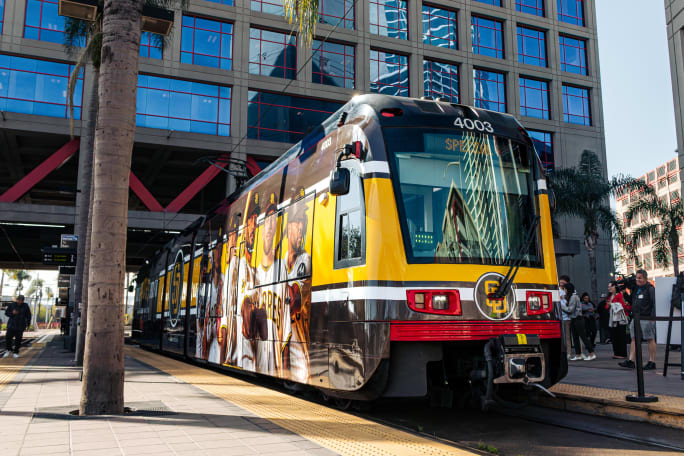
Sport partnerships with transit agencies show up in everything from branded trolley wraps to social media campaigns and all-season transit passes.
Credit:
San Diego Metropolitan Transit System
At the same time, agencies are expanding access beyond immediate urban areas. For weekend matches, WeGo’s Route 84 park-and-ride service brings fans in from suburbs like Murfreesboro and Antioch, offering a lower-cost alternative to parking at the stadium. Route 84 offers a discounted rate of $2 and averages 72 riders per game.
Similarly, MTS relies heavily on its park-and-ride network, which includes more than 8,000 free parking spaces.
“These park-and-ride locations help keep cars off the roads around the event, easing traffic congestion,” Pitt said. Plus, riders using parking stations save money by removing the need to pay high parking rates near the event and lessening individual fuel costs.
That said, the most effective game-day service would be one that builds on what already works. Agencies that layer additional capacity onto high-performing routes and extend access through park-and-ride options can scale efficiently, manage demand, and attract riders without overcomplicating things.
Partnerships That Go Beyond Service
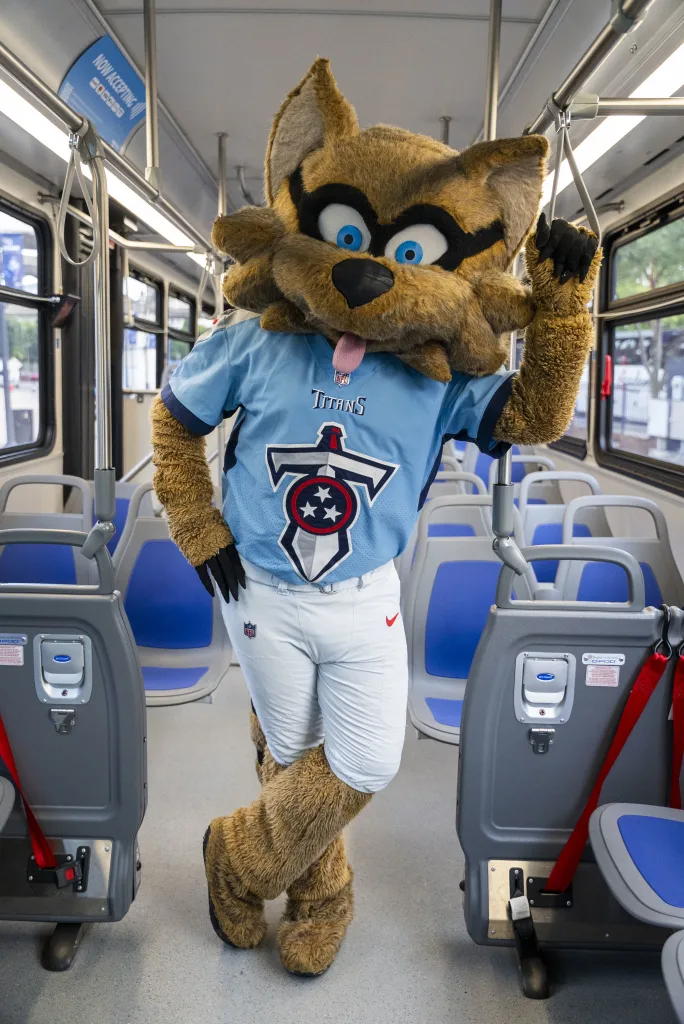
The NFL's Tennessee Titans' mascot, T-Rac, is a raccoon and was debuted in 1999.
Credit:
WeGo Transit
While operations matter greatly, partnerships often determine whether fans actually choose transit.
WeGo’s Community Impact Partnership (CIP) program has been key to working with teams like Nashville SC and the Tennessee Titans. The goal is fairly simple: expand transportation options while reducing congestion.
“Major events like professional sports games create significant travel demand, and transit plays an important role in helping cities manage that demand,” said Caitlin Okrzesik, partnerships and business development manager for WeGo Public Transit.
These partnerships include coordinated planning, shared messaging and marketing, and incentives like free or discounted rides on game days.
MTS takes a similarly integrated approach, partnering with teams to promote transit as part of the fan experience. It also doesn’t hurt that these partnerships with local teams heighten the visibility of public transit and the pros of using it. That visibility shows up in everything from branded trolley wraps to social media campaigns and all-season transit passes.
The goal is to make transit feel like the default for fans traveling to the stadiums.
Scaling Up for the World Stage
If regular game days are complex, international events take that complexity to another level.
In Los Angeles, preparations for the 2026 FIFA World Cup are pushing coordination across at least 10 regional transit partners. Service plans are designed to move global crowds efficiently while keeping fares simple and accessible.
Enhanced service will connect fans to the stadium from locations across the region, including Union Station and LAX/Metro Transit Center, with trains and buses running up to three hours before kickoff and continuing 90 minutes after matches conclude.
To support first-time riders and international visitors, the agency is also investing in multilingual wayfinding, additional staff, and on-the-ground support. These tactics will also be useful for the 2028 Summer Olympics hosted in LA.
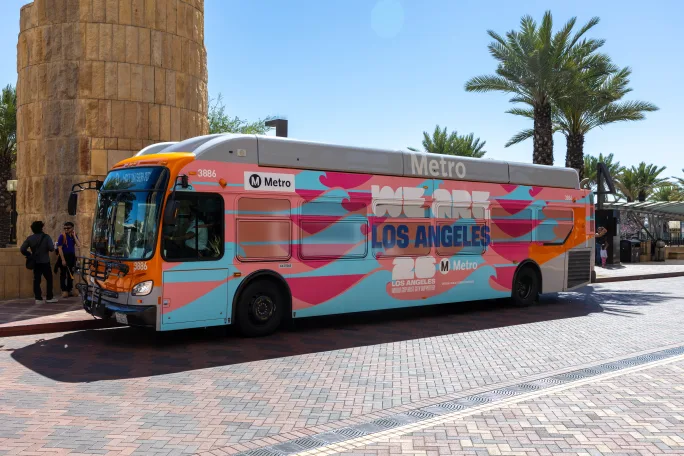
To support first-time riders and international visitors, LA Metro is also investing in multilingual wayfinding, additional staff, and on-the-ground support.
Credit:
LA Metro
Other World Cup host cities in the U.S. include Atlanta, Boston, Dallas, Houston, Kansas City, Miami, New York-New Jersey, Philadelphia, Seattle, and the San Francisco Bay Area. All of which have their own plans for getting riders to and from each installment of this iconic soccer event.
The Metropolitan Atlanta Rapid Transit Authority (MARTA) in Georgia recently launched a new fare payment system in March as it prepares to welcome hundreds of thousands of visitors this summer to the Atlanta Stadium, which will host eight 2026 FIFA World Cup matches. The new system features tap-to-pay, allowing international or out-of-city travelers to tap their bank cards or mobile wallets to use public transit.
Missouri’s Kansas City introduced ConnectKC26, the city’s official transportation services for the World Cup. The initiative offers direct motorcoach services to matches and regional attractions, as well as from downtown to the airport (and back), complementing existing transit options.
In Philadelphia, SEPTA has been preparing its service and infrastructure since last year to improve key travel points, such as City Hall and NRG stations. Some infrastructure upgrades include signal and track work, painting, new signage, improved lighting, accessibility enhancements, and installation of new fare gates. The agency will also adjust service levels on certain routes and deploy ambassadors at major stations to assist riders.
These efforts reflect how transit agencies must focus on moving every type of rider, not just local, as they prepare to host the world.
Making Transit Part of the Experience
At the end of the day, game-day service shapes how attendees experience the event itself. And, to be honest, most people want their event experience to be as easy as possible. If that means eliminating parking or passenger cars from the equation, that can be done.
“All-season transit passes and contactless payments play a big role in having successful operations during special events,” Pitt said. “This means that fans can focus more on having fun rather than trying to figure out how to pay a fare.”
Plus, this can turn a one-time rider into a repeat customer.
As cities continue to grow, sports partnerships are becoming a proving ground for what transit can do. They test how systems handle surges, how agencies collaborate across regions, and how effectively transit can compete with driving.
But maybe most importantly, they introduce thousands of new riders to public transportation in a way that feels seamless, social, and, ideally, a little less stressful than sitting in traffic.
If transit agencies get it right, the trip becomes part of the event and not just a way to get there.
Subscribe to Our Newsletter
More Management

Indian River Transit’s Community-Focused Approach Earns National Recognition
Named APTA’s 2026 Outstanding Public Transportation System in its size category, Florida’s Indian River County transit system continues to grow ridership through fare-free service and a focus on evolving community needs.
Read More →
ENC Lands MATA Contract and More in Biz Briefs
In this edition of Biz Briefs, we spotlight the latest developments shaping the future of mobility.
Read More →
From Surviving to Thriving: Building Stronger Transportation Organizations
Bus Business Consultants founder Brian Dickson shares lessons on leadership, organizational health, and creating options for long-term success in a changing transportation industry.
Read More →

Everett Transit, Community Transit Outline Consolidation Agreement
The proposed agreement calls for a 50% increase in bus service in Everett, a new microtransit zone, continued paratransit service, and the transfer of Everett Transit operations to Community Transit.
Read More →
Strada360’s Steve Lassey on Turning Transit Data Into Better Decisions
From breaking down data silos to preparing for AI, Strada360 CEO Steve Lassey discusses how transit agencies can use technology to improve operations, customer information, and long-term decision-making.
Read More →
People Movement: Phil Washington Joins HNTB, Denver RTD Launches CEO Search, and More
In this edition, we also spotlight recent personnel moves at STV, the Eno Center for Transportation, and more, highlighting the people taking on new roles across the transportation industry.
Read More →
SEPTA Details Accelerate Vision for Transit System
The plan outlines investments in trolley modernization, new Metro and Regional Rail vehicles, accessible stations, and more frequent bus and rail service.
Read More →
FTA Ends Direct Oversight of MBTA Safety Actions
The federal agency closed its remaining special directive to the Massachusetts Department of Public Utilities following a safety review that began in 2022.
Read More →
Report: Transit Bus Manufacturing Supports 34,100 Jobs, $5.1B in GDP
The “Buses Mean Business” report examines the transit bus manufacturing industry’s economic footprint, supply chain, and rising demand for vehicle replacements.
Read More →
LIT Marks 10-Year Milestone at Annual Summit
Hosted by the COTA from September 10 to 13, the Summit carried the theme “Celebrating 10 Years of Excellence, Leadership, and Impact,” with every part of the program honoring the people, agencies, and partners who built LIT over its first decade.
Read More →