



BRT represents a significant enhancement from traditional bus service, and capital costs can be as little as $10 million per mile.
Cities look to where the future lies with bus rapid transit
BRT represents a significant enhancement from traditional bus service, and capital costs can be as little as $10 million per mile.
by By Kimberly Slaughter and Mark Huffer
October 21, 2019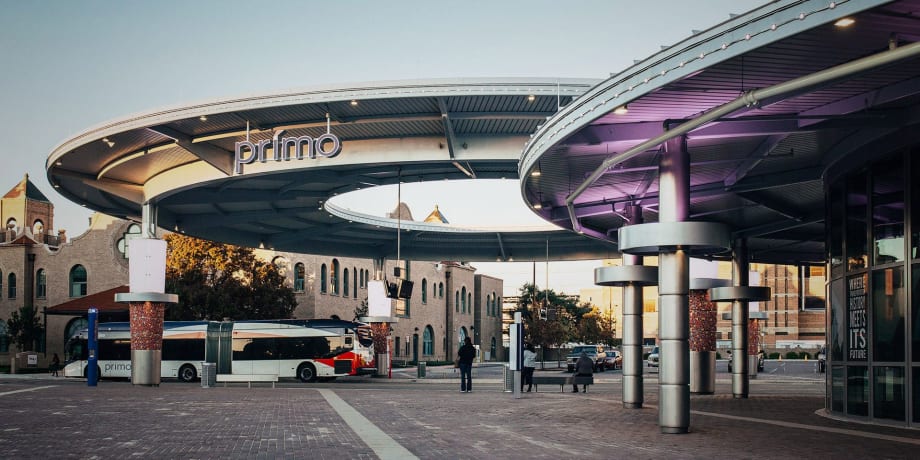
5 min to read
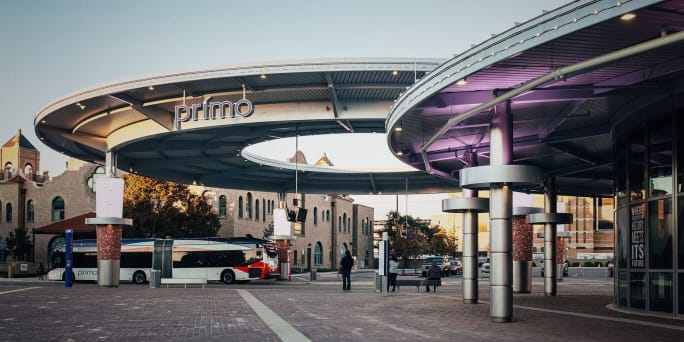
VIA Metropolitan Transit’s Primo bus-rapid transit service in San Antonio. HNTB
When bus rapid transit (BRT) systems first started becoming popular in the U.S. a decade or so ago, no one could have predicted how they would change the landscape of how transit is provided. Technology advances and a renewed focus on the customer will change it yet again.
With enhanced stations, dedicated travel lanes, level (or near-level) boarding, and off-board fare payment, BRT represents a significant enhancement from traditional bus service, and BRT capital costs can be as little as $10 million per mile, depending on the type of system and length of the corridor. By comparison, rail project costs can exceed $100 million per mile. For less cost than a single rail mile, communities can offer a robust BRT line.
In a little over a decade, BRT has become a staple of the transit industry. While BRT has grown, technology advancements are poised to deliver new enhancements that will mean even more changes to BRT design and operations.
Particularly popular in many smaller and mid-sized cities and regions without a tradition of high transit ridership or rail transit options, BRT was viewed as a way to provide a significant upgrade in transit services in a cost-effective manner.
In the mid-2000s BRT operations existed in only a handful of cities. Today, you can find BRT throughout the country in cities and regions of all sizes. Even the largest metropolitan areas with large bus and rail systems are implementing BRT.
Cities currently adding or expanding their BRT systems include Kansas City, Mo.; Tulsa, Okla.; Jacksonville, Minn., Chicago, San Antonio, and many others. In cities where operational, BRT systems are well received and often achieve significant ridership.
Vehicle Technology
BRT applications led the way to significant changes in vehicle design in the last decade, with doors that open on both sides and sleek body styling. The next major change involving BRT vehicles is likely to be associated with technology.
Improved radar technology and GPS capabilities are likely to set the stage for precision docking at stations. This will allow transit operators to abandon rub rails or Kassel curbs in exchange for technology which produces much higher results, much more consistently.
The challenge for transit officials is planning for the upcoming technology changes. Transit officials ordering a bus today, which has a 12-year lifespan, don’t want to have an obsolete vehicle in just a few years. They want to know that a bus purchased today can be upgraded or updated with developing technology within the lifespan of the vehicle.
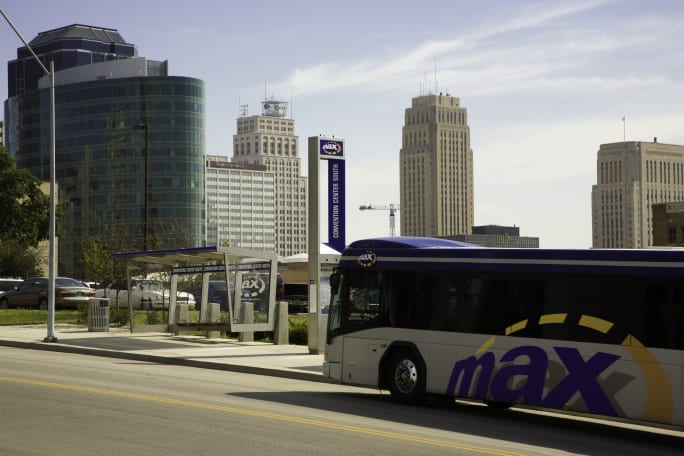
The MAX BRT in Kansas City, one of the nation’s first BRT systems. HNTB
Guideway
All BRT systems have some form of dedicated lanes or fixed guideway. For most operators this is some combination of lane marking and road signage. Many operators use a BAT (Business Access and Turn) lane configuration, thereby sharing the lane with automobile drivers accessing businesses or perpendicular streets.
As BRT matures, operators are increasing the exclusivity of BRT lanes to assure greater service reliability and higher operating speed. For example, LA Metro is designing railroad-type crossing gates at intersections on its Orange Line BRT. Houston, Minneapolis, Miami and other systems are planning to operate BRT in interstate managed lanes.
Painted lanes are traditionally a way to delineate BRT from general traffic lanes. Looking ahead, as BRT continues to be implemented in heavily congested urban corridors, we can expect to see higher levels of lane separation in order to achieve higher operating speeds, and greater service reliability.
Electric Vehicles
Battery electric buses may fundamentally change the make-up of bus fleets throughout the country. While still a small number of total buses nationwide, their number is growing. Dozens of cities have taken delivery of or ordered electric buses and this trend is expected to continue. The Red Line in Indianapolis became the country’s first all-electric BRT line when it opened earlier this year.
Communities can expect cleaner, quieter operations, and agencies will benefit from simpler maintenance and environmentally friendlier fleets.
Automated Vehicles/Connected Vehicles
Finally, nothing has the potential to change BRT operations more than automated and connected vehicle technology. The capabilities fast becoming reality allow BRT systems to add significant capacity and precision to their operations, positioning them to rival commuter rail lines’ service and ridership with unmatched flexibility to meet marketplace changes.
Imagine three or four automated bus-length vehicles, tethered front-to-back by connected vehicle technology, platooning in a dedicated lane with just inches between them. With each vehicle carrying dozens of passengers and docking precisely at station platforms with level boarding, they will resemble trains with tires. But because they are electronically connected, not physically, it is very easy for vehicles to be reassigned to other routes, the maintenance garage or a charging facility, only to reform again at rush hour when the need is greatest.
Longer “trains” of electronically tethered vehicles will require new engineering and construction for longer station approaches and exits. The investment, however, will yield enormous operational, safety and ridership benefits that will keep BRT moving in cities coast to coast.
The Basics
Technology alone shouldn’t be the only evolution of BRT. Transit patrons still value the basics done right, including station shelter, adequate lighting, appropriate signage, next-bus arrival information, and easy-to-understand fare payment systems. Patrons may also still want the low-tech human voice when there is a problem or issue.
Forward-thinking agencies are embracing the fundamentals and delivering an experience that makes riding BRT as easy and dependable as possible.
BRT is breaking through in cities across the country. Its evolutionary path, driven by technology advancements and customer service fundamentals, presents transit agencies exciting opportunities to significantly enhance mobility in their communities both now and well into the future.
Kimberly Slaughter (kslaughter@hntb.com) is senior VP and national rail/transit practice consultant for HNTB Corp. Mark Huffer (mhuffer@hntb.com) is project director and bus rapid transit practice leader at the firm.
Subscribe to Our Newsletter
More Blog Posts
Building a Winning FTA Grant Proposal: Why Propane Autogas is the Pragmatic Choice for Fleet Resilience
With $610 million available through the FY 2026 Buses and Bus Facilities Competitive Program and the Low or No Emission Grant Program, agencies must build a compelling case before the September 21 deadline that balances environmental compliance with operational feasibility.
Read More →
Velo-city Conference 2026: Latest Trends in Cycling as Part of Urban Mobility
The global cycling conference highlighted how cities are integrating bicycles into multimodal transportation networks, expanding cycle tourism and reshaping urban mobility.
Read More →
Kindness Isn’t Soft...It’s Strategic.
Mike Bismeyer — often known as “The Kindness Guy” — has spent more than 17 years in public transit and mobility, serving in industry leadership roles, speaking across North America, and advocating for stronger workplace cultures. But his message doesn’t come from theory. It comes from lived experience.
Read More →
Inside ITF 2026: Transport Reacts to A Challenging World
Transport leaders from around the world gathered in Leipzig, Germany, for the 2026 International Transport Forum to discuss resilience, climate impacts, supply chains and the future of sustainable mobility.
Read More →
Every Ride Tells a Story — But You’re Not Just Selling the Ride
You’re selling the moment, the meaning, and the emotion behind it.
Read More →
How Digital Signage is Reshaping the Traveler Experience at Transportation Hubs
What was once a landscape of static signs has evolved into a responsive, immersive environment powered by real-time visual communication.
Read More →
Latest Trends in Urban Mobility from Polis Conference 2025
Polis comprises cities and regions, as well as corporate partners, from across Europe, promoting the development and implementation of sustainable mobility. This year’s event had over a thousand attendees across various policy forums and an exhibition.
Read More →
Why Transit Leaders Require Better Tools for Operational Clarity In Today’s Tech-Fragmented Environment
Across North America and beyond, transit agency officials are contending with a perfect storm of operational headaches and strategic challenges that hamper daily service and long-term progress.
Read More →
The Powerless Brokers: Why California Can’t Build Transit
It is no secret that transit in the U.S. is slow and expensive to build.
Read More →
Why Transport Sustainability Should Focus on People Instead of Cars
Simply incentivizing electrification is not enough to make a meaningful impact; we must shift our focus toward prioritizing public transportation and infrastructure.
Read More →