



SEPTA Pulls Out All the Stops to Transport DNC Attendees
The recently adjourned 2016 Democratic National Convention put Philadelphia in the national — and international — spotlight once again. For the third time in four years, the Southeastern Pennsylvania Transportation Authority transported thousands of visitors to the City of Brotherly Love and its surrounding counties. As with the U.S. Open in 2013 and the World Meeting of Families and Papal Visit in 2015, public transit was a key component for all event activities.


Delegates boarding SEPTA's Broad Street Line subway at AT&T Station, which was located just outside of the Wells Fargo Center (site of the DNC). Photo: SEPTA
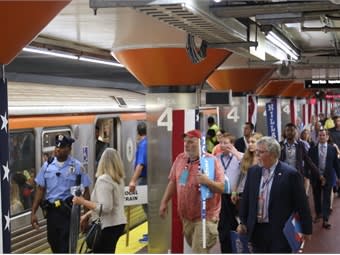
Delegates boarding SEPTA's Broad Street Line subway at AT&T Station, which was located just outside of the Wells Fargo Center (site of the DNC). Photo: SEPTA
The recently adjourned 2016 Democratic National Convention put Philadelphia in the national — and international — spotlight once again. For the third time in four years, the Southeastern Pennsylvania Transportation Authority (SEPTA) transported thousands of visitors to the City of Brotherly Love and its surrounding counties.
As with the U.S. Open in 2013 and the World Meeting of Families and Papal Visit in 2015, public transit was a key component for all event activities. “In addition to our city’s and our region’s historical significance, a good mass transportation network has helped Philadelphia attract many large-scale events in recent years,” said SEPTA Board Chairman Pasquale T. Deon Sr. “The Wells Fargo Center, the venue for the DNC, is located at AT&T Station, the terminal of our Broad Street Line subway. That meant that delegates, members of the media and other DNC attendees could directly get to the convention from Center City [downtown] Philadelphia in a matter of minutes.”
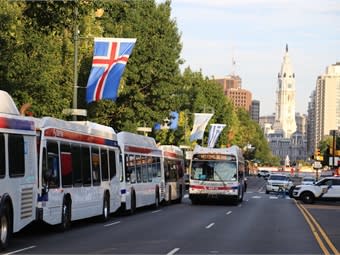
SEPTA buses staged on the Benjamin Franklin Parkway to transport delegates from events at the Philadelphia Museum of Art. Photo: SEPTA
In addition to enhancing service on the Broad Street Line (adding seven additional trains and providing service until 1 a.m. or later), 125 SEPTA buses operated on 11 delegate shuttle routes from Center City and Philadelphia International Airport hotels to the Wells Fargo Center. Almost 120 buses were used on Sunday evening prior to the DNC’s opening, transporting delegates to festivities at the Philadelphia Museum of Art and Kimmel Center. “The buses were stored and maintained at the Wells Fargo Center lot, rather than coming from a variety of our depots every day,” said SEPTA GM Jeffrey Knueppel.
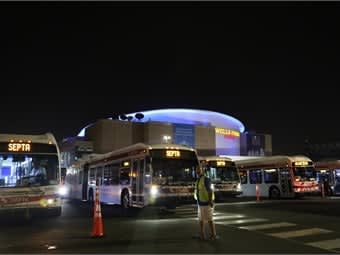
SEPTA buses at site of Democratic National Convention. Photo: SEPTA
To accommodate bus operations at the Convention site, SEPTA transportation and maintenance personnel created a satellite depot — staffed by mechanical and operational staff around the clock beginning two days before the events started until well after the balloons dropped on Thursday, July 28. The on-site SEPTA facility, located in a portion of the arena’s parking lot and under the adjacent Interstate 95, was comparable in size to one of the Authority’s smaller surface transportation depots.
“There were about 200 SEPTA personnel on that site every day throughout the course of the DNC,” said Knueppel. “From operators and mechanics to transportation managers, instructors, schedulers and our employee ambassadors, it was all hands on deck making sure our buses were running properly, delegates boarded buses quickly and efficiently and vehicles were parked and ready to go the next day. It was a phenomenal team effort.”
On Monday and Tuesday evenings, SEPTA buses transported approximately 9,000 delegates each night from the Wells Fargo Center to their hotels. That passenger load jumped to about 12,000 on both Wednesday and Thursday evenings. “Our operation ran each day into the very early hours of the next morning, but our crews were always ready to go and prepared to make any necessary logistical changes and address special requests,” said Mike Liberi, SEPTA’s chief surface transportation officer. “At the end of the event, ETA [the company contracted to oversee DNC transportation services] said it was ‘the best experience’ they had ever had with a transit agency for any event they had coordinated. That made the long hours even more gratifying.”
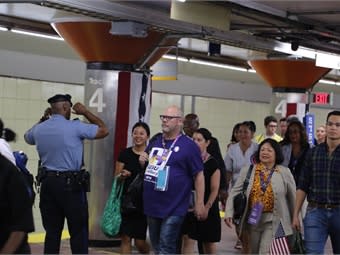
Photo: SEPTA
After the announcement that the DNC was coming to Philadelphia in 2015, SEPTA senior management met bi-weekly, and then later weekly, planning for this enormous event. “We have a good relationship with the City’s Office of Emergency Management (OEM), police department and fire department, working closely with them on all major events taking place in Philadelphia,” said Knueppel. “We had staff positioned at the OEM’s Joint Information Center (JIC) and the Command Center at SEPTA’s headquarters was open for the duration of the Convention. Having staff at the JIC and our Command Center allowed us to quickly update our website and tweet service changes when demonstrations or heavy traffic conditions forced us to make temporary changes to our service plans.”
The 270 members of SEPTA’s Transit Police Department partnered with local, state and federal law enforcement agencies to protect guests and residents at stations and key locations throughout Philadelphia. Even the four-legged members of SEPTA’s K-9 unit were on duty, preserving the security of SEPTA property. “Our officers worked long shifts. I thank all law enforcement units for their efforts to maintain safe and peaceful conditions,” said Knueppel.
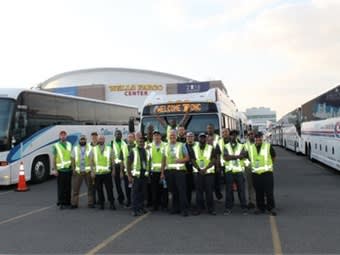
Members of SEPTA's operations staff on site at the Wells Fargo Center with buses. Photo: SEPTA
To help guide the delegates and visitors to their destinations, SEPTA relied on more than 450 employee ambassadors. Wearing bright blue SEPTA shirts, ambassadors were dispersed across the city — at Philadelphia International Airport, Amtrak’s 30th Street Station, hotels, the Authority’s Center City Regional (commuter) Rail stations, Market-Frankford and Broad Street Line stations and the Wells Fargo Center shuttle bus locations.
“During the DNC, there was blistering heat, extreme humidity and a few torrential thunderstorms,” said Knueppel. “Our employees showed great professionalism and fantastic customer service in welcoming delegates, volunteers and the press. I am proud of another job well done.”
More Blog Posts
Building a Winning FTA Grant Proposal: Why Propane Autogas is the Pragmatic Choice for Fleet Resilience
With $610 million available through the FY 2026 Buses and Bus Facilities Competitive Program and the Low or No Emission Grant Program, agencies must build a compelling case before the September 21 deadline that balances environmental compliance with operational feasibility.
Read More →
Velo-city Conference 2026: Latest Trends in Cycling as Part of Urban Mobility
The global cycling conference highlighted how cities are integrating bicycles into multimodal transportation networks, expanding cycle tourism and reshaping urban mobility.
Read More →
Kindness Isn’t Soft...It’s Strategic.
Mike Bismeyer — often known as “The Kindness Guy” — has spent more than 17 years in public transit and mobility, serving in industry leadership roles, speaking across North America, and advocating for stronger workplace cultures. But his message doesn’t come from theory. It comes from lived experience.
Read More →
Inside ITF 2026: Transport Reacts to A Challenging World
Transport leaders from around the world gathered in Leipzig, Germany, for the 2026 International Transport Forum to discuss resilience, climate impacts, supply chains and the future of sustainable mobility.
Read More →
Every Ride Tells a Story — But You’re Not Just Selling the Ride
You’re selling the moment, the meaning, and the emotion behind it.
Read More →
How Digital Signage is Reshaping the Traveler Experience at Transportation Hubs
What was once a landscape of static signs has evolved into a responsive, immersive environment powered by real-time visual communication.
Read More →
Latest Trends in Urban Mobility from Polis Conference 2025
Polis comprises cities and regions, as well as corporate partners, from across Europe, promoting the development and implementation of sustainable mobility. This year’s event had over a thousand attendees across various policy forums and an exhibition.
Read More →
Why Transit Leaders Require Better Tools for Operational Clarity In Today’s Tech-Fragmented Environment
Across North America and beyond, transit agency officials are contending with a perfect storm of operational headaches and strategic challenges that hamper daily service and long-term progress.
Read More →
The Powerless Brokers: Why California Can’t Build Transit
It is no secret that transit in the U.S. is slow and expensive to build.
Read More →
Why Transport Sustainability Should Focus on People Instead of Cars
Simply incentivizing electrification is not enough to make a meaningful impact; we must shift our focus toward prioritizing public transportation and infrastructure.
Read More →