



Transportation funding and service cuts affect more than just riders
Across the country, transit is experiencing record ridership growth. The increase in commuters is not only good for transit organizations’ revenue; proximity to train stations and transportation centers can boost property values for surrounding communities and spur new construction of transit-oriented developments, shopping centers and other businesses. But what happens to communities when the “T” in the TODs is no longer there?

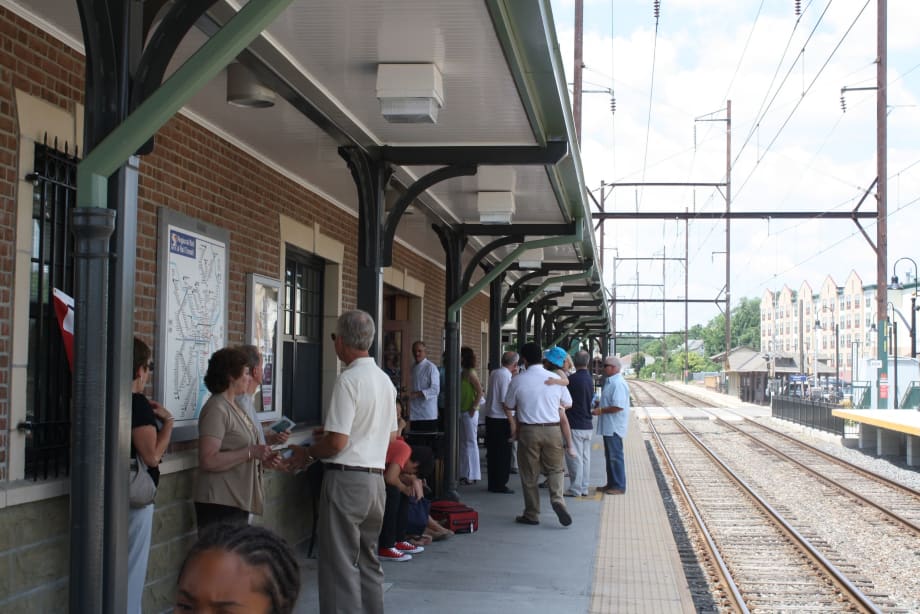
One of the platforms of SEPTA's Ambler Station, which is located on the transit system’s Lansdale/Doylestown Regional (commuter) Rail line, just outside of Philadelphia in Montgomery County, Pa.
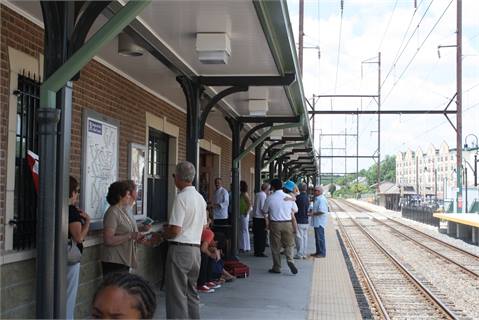
One of the platforms of SEPTA's Ambler Station, which is located on the transit system’s Lansdale/Doylestown Regional (commuter) Rail line, just outside of Philadelphia in Montgomery County, Pa.
Across the country, public transit is experiencing record ridership growth. The increase in commuters is not only good for transit organizations’ revenue; proximity to train stations and transportation centers can boost property values for surrounding communities and spur new construction of transit-oriented developments (TODs), shopping centers and other businesses.
But what happens to communities when the “T” in the TODs is no longer there?
The Southeastern Pennsylvania Transportation Authority’s (SEPTA’s) funding issues have been well-documented: a $300 million capital budget with a current $5 billion state-of-good-repair backlog that is estimated to grow to $6.5 billion by 2023 without additional state capital funding.
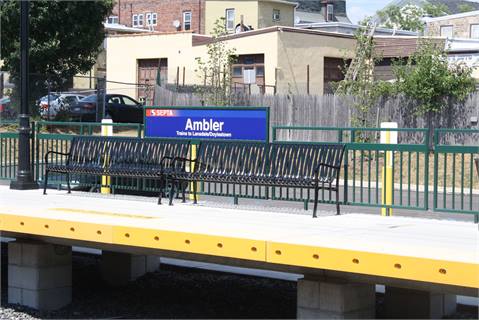
Another platform at the Ambler Station. The short train ride to and from Philadelphia from this station has made the town desirable for businesses, restaurants and real estate.
Without this money, which is necessary for critical infrastructure repairs and aging vehicle replacement, SEPTA could be forced to implement a service realignment plan that suspends nine of 13 Regional Rail (commuter) lines and truncates two others over the next 10 years, as well as convert trolleys to bus and reduce subway service levels. The plan would be put into effect beginning next year short of an immediate infusion of additional capital funding to defer the cuts.
Lack of financial support for public transportation not only inconveniences millions of riders who rely on buses, trains and trolleys to get to and from work, school and shopping, but cuts in services can have a devastating impact on a community’s property values, too, potentially affecting even non-transit users.
“The Impacts of SEPTA Regional Rail Service on Suburban House Prices,” a recent study of the four suburban counties surrounding Philadelphia (Bucks, Chester, Delaware and Montgomery) serviced by SEPTA — specifically its commuter rail system — examines data on recent housing transactions in conjunction with the transit system’s Regional Rail lines to determine the incremental value of being located near a station. The study found that that the average property value premium for the 754,000 single-family homes located in those four counties is $7,900 (approximately $6 billion a total property value). In communities with higher levels of Regional Rail service and parking capacity, the property value premium averages between $31,000 and $37,000 per house.
The study, commissioned by SEPTA and conducted independently by Econsult Solutions Inc., a Philadelphia-based economic consulting firm specializing in areas such as transportation, public infrastructure and real estate, looked at single-family house transactions from 2005 to 2012 in Bucks, Chester, Delaware and Montgomery Counties and examined the property value premium that results from being located close to a Regional Rail station. The report, available at www.econsultsolutions.com, states that the property value premiums could vanish if SEPTA is forced to implement the realignment plan.
“You can really learn a lot about how much people value things by looking at the housing market,” said Richard P. Voith, president, Econsult Solutions. “It is absolutely clear that access to SEPTA rail service adds to property values.”
This bleak scenario in the Greater Philadelphia region is one that could possibly be repeated in cities across the country. For example, in the October 8, 2013 Boston Globe, columnist Paul McMorrow writes that inadequate funding for the MBTA could “stunt Boston’s growth”, as well as that of its surrounding communities.
As Voith said, “Whether you use the system or not, it is in your best interests for [SEPTA] to continue to have a robust level of rail service. [SEPTA] contributes a lot to the overall attractiveness of the region.”
In case you missed it...
Read our METRO blog, "Intelligent transportation systems and the urban parking crunch"
More Blog Posts
Building a Winning FTA Grant Proposal: Why Propane Autogas is the Pragmatic Choice for Fleet Resilience
With $610 million available through the FY 2026 Buses and Bus Facilities Competitive Program and the Low or No Emission Grant Program, agencies must build a compelling case before the September 21 deadline that balances environmental compliance with operational feasibility.
Read More →
Velo-city Conference 2026: Latest Trends in Cycling as Part of Urban Mobility
The global cycling conference highlighted how cities are integrating bicycles into multimodal transportation networks, expanding cycle tourism and reshaping urban mobility.
Read More →
Kindness Isn’t Soft...It’s Strategic.
Mike Bismeyer — often known as “The Kindness Guy” — has spent more than 17 years in public transit and mobility, serving in industry leadership roles, speaking across North America, and advocating for stronger workplace cultures. But his message doesn’t come from theory. It comes from lived experience.
Read More →
Inside ITF 2026: Transport Reacts to A Challenging World
Transport leaders from around the world gathered in Leipzig, Germany, for the 2026 International Transport Forum to discuss resilience, climate impacts, supply chains and the future of sustainable mobility.
Read More →
Every Ride Tells a Story — But You’re Not Just Selling the Ride
You’re selling the moment, the meaning, and the emotion behind it.
Read More →
How Digital Signage is Reshaping the Traveler Experience at Transportation Hubs
What was once a landscape of static signs has evolved into a responsive, immersive environment powered by real-time visual communication.
Read More →
Latest Trends in Urban Mobility from Polis Conference 2025
Polis comprises cities and regions, as well as corporate partners, from across Europe, promoting the development and implementation of sustainable mobility. This year’s event had over a thousand attendees across various policy forums and an exhibition.
Read More →
Why Transit Leaders Require Better Tools for Operational Clarity In Today’s Tech-Fragmented Environment
Across North America and beyond, transit agency officials are contending with a perfect storm of operational headaches and strategic challenges that hamper daily service and long-term progress.
Read More →
The Powerless Brokers: Why California Can’t Build Transit
It is no secret that transit in the U.S. is slow and expensive to build.
Read More →
Why Transport Sustainability Should Focus on People Instead of Cars
Simply incentivizing electrification is not enough to make a meaningful impact; we must shift our focus toward prioritizing public transportation and infrastructure.
Read More →