



Untangling the jumbled path towards the ultimate connected city
Smartphone owners feel connected much of the time, for better or worse. But shouldn’t that be the goal for physical movement as well, to be literally that connected — with a transportation system that could take one anywhere at any time? That’s a big ask. But what’s exciting is how realistic the vision is for cities that dramatically alter outdated transportation planning.


Photo: Sam Kittner for Mobility Lab
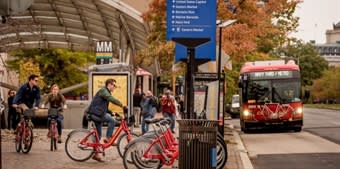
Photo: Sam Kittner for Mobility Lab
This is part one of a two-part series, originally posted by MobilityLab, on how advocates can create connected cities, examining how public agencies can reshape their priorities. Part two will detail how they can then move beyond conventional projects.
Smartphone owners feel connected much of the time, for better or worse. But shouldn’t that be the goal for physical movement as well, to be literally that connected — with a transportation system that could take one anywhere at any time?
That’s a big ask. But what’s exciting is how realistic the vision is for cities that dramatically alter outdated transportation planning. And this is not just about the New Yorks and San Franciscos; auto-oriented towns and cities can develop completely new blueprints for how people get around.
Many people and organizations have taken cracks at defining the connected city. Often these delve into the realm of "Internet of Things"-type technology. And beacons, smart traffic lights, and sensors will be a big part of cities in the future.
But from Mobility Lab’s standpoint, we look at the connected city as more about access, and making sure people can get to jobs, shopping, family and friends, and healthcare as easy as possible. And that they can do this without owning a car if necessary. Affordable, efficient, easy access from anywhere, anytime is the heart of a “connected city.”
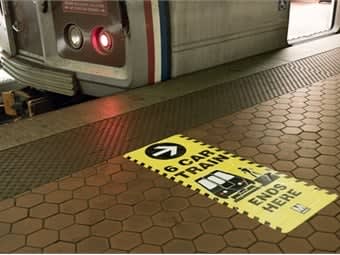
New adhesives clarify for Metrorail riders where the end of six-car trains stop at the platform.Photo: WMATA
Finding new funding
Of course, the major elephant in the room is always funding, most of which still goes to highways and roads, which have both divided and connected our cities over the past century. The good news is that autonomous vehicles and an increasing focus on making places bikeable and walkable could offer avenues for bringing mass-transit funding up above its typical level of 20% of the overall transportation budget. The bad news is that it’s still unclear whether the growth of services like Uber and Lyft will compromise transit funding sources or expand their pool of possible riders.
“Fortunately, communities are increasingly willing to tax themselves” to fund transit expansions, says Darnell Grisby, director of policy development and research at the American Public Transportation Association, who spoke at an “Ultimate Connected City” panel I moderated at TransportationCamp DC in January. “There will be a whole new way that agencies are structured with new connectivity coming online.”
Public agencies must dramatically adjust their planning
The National League of Cities 2016 “Cities of the Future” report [PDF] made even clearer how cities are woefully prepared for new transportation technologies. Of the 68 metropolitan areas analyzed, only 3% considered the effects of app-based, on-demand companies like Uber and Lyft in their city plans. Only 6% considered the effects of driverless technology. Meanwhile, 50 percent have explicit plans for new highway construction.
The federal government has taken some recent steps in the right direction, with an Obama administration report [PDF: pages 34-35] recommending pilots, workforce training, company and city partnerships, and research into future transportation engineering for autonomous vehicles.
Some places are already making headway on these guidelines. In San Francisco, if new mobility providers meet the necessary requirements, the S.F. Office of Innovation’s new City Transportation Platform grants them access to public rights of way. On a smaller, short-term scale, Washington, D.C’s Metrorail has been aggressively asking customers how it can improve, notes that “competitors” are really partners in connecting the region, and has been implementing some customer suggestions. These are the kinds of elements that need to go into comprehensive, nimble, flexible local transportation plans.
APTA’s Grisby adds, “We would need to re-invent government. How do we maintain social equity? How can we show we’re going to be responsible with taxpayer money while making these changes? All of these changes need capital, cash, and this requires trust. We need trust.”
Public agencies must see advantages to competing confidently
Despite some remaining hesitancy, city leaders are beginning to dabble in this space. Joshua Schank, LA Metro’s first chief innovation officer, says, “As long as we continue to run mass transit systems that are treated like social services, instead of treating them as if they’re trying to attract customers and they’re trying to compete, then you’re going to have real problems in terms of trying to get our capacity to be used more effectively.”
The vision statements in many of the U.S. DOT Smart City Challenge applications show the beginnings of lights turning on. But other local officials still have a long way to go to research and understand carsharing, ridesharing, new technologies, and the needs of their constituents. Getting all of this mobility right will be a significant competitive advantage for cities, according to a recent report from McKinsey and Bloomberg.
To make one or multiple connected cities happen, local governments – and perhaps the feds as well — will simply have to start jumping in the water more than they have so far. In Finland, a government bureau called Liikennelabra (Traffic Lab) works to bring inexpensive transit providers to cities. Part of the answer may be that simple – a more fluid array of public options.
“What an agency looks like today may look different 20 years from now. A transit agency might be a contract manager, partnering with all sorts of entities. The question is: can we encourage folks to try? To not be afraid of failure?” Grisby asks.
Many transit agencies are already on the right track, but often fail to communicate the true benefits of key transit service. Transit planner Jarrett Walker recently wrote:
“The most urgent thing transit agencies need to do, right now, is start talking more confidently about what their fixed-route, high-ridership transit service is achieving, so that they negotiate with the new players from a position of strength and confidence.”
One example: Seattle has consistently supported its bus and rail transit in recent years, drawing higher rates of transit ridership to its booming downtown in a time when bus ridership is dropping in most cities.
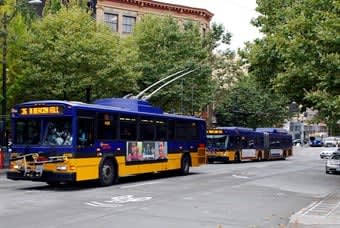
Seattle buses, which are given dedicated space in parts of the city’s downtown. Photo: BeyondDC
Educating and informing connective habits
It’s a bit surprising how successful transit projects are across the country. We’re still largely a drive-alone culture in which carpool rates have fallen consistently since the 1980s. To truly have a connected city, where people can move around seamlessly, people must be willing to share rides, and they must be aware of the availability of these options.
There is indeed hope that people are increasingly understanding that they have non-driving transportation options available. More than 30 percent of households do not own a car in six of the 30 largest U.S. cities. And people want these options, as seems apparent by the 77 cities that applied for the Smart City Challenge and the influx of younger residents to places with transit and walking options.
Connected cities must be woven into the fabric of people’s lives. There’s little doubt that Los Angeles is successfully experimenting with this concept. LA Metro is seeing a surge of new light rail riders to Rams football games because the Expo line offers a much-better deal than expensive parking at the stadium. Coordination around big events is a great way to help change people’s habits, and LA’s Olympic committee wants to further embed non-car culture into the city through its planning for the 2024 Games.
Consumer-oriented technology certainly has a big role to play in educating people, too. Apps such as Metropia, which incentivizes people to drive or travel during off-peak hours, or like Mobidot, which helps people monitor and improve their travel behavior, offer new options. Education efforts like these might be key puzzle pieces for creating connected cities.
Next, a look into how cities are finding creative ways to enhance the connectivity of their transportation systems.
Mobility Lab technology reporter Andrew Carpenter contributed to this article.
Photos, from top: D.C.’s Eastern Market, where Metro riders can connect to the DC Circulator or Capital Bikeshare (Sam Kittner for Mobility Lab, www.kittner.com). A six-car Metrorail sticker (WMATA). Buses in Seattle (BeyondDC, Flickr, Creative Commons).
More Blog Posts
Building a Winning FTA Grant Proposal: Why Propane Autogas is the Pragmatic Choice for Fleet Resilience
With $610 million available through the FY 2026 Buses and Bus Facilities Competitive Program and the Low or No Emission Grant Program, agencies must build a compelling case before the September 21 deadline that balances environmental compliance with operational feasibility.
Read More →
Velo-city Conference 2026: Latest Trends in Cycling as Part of Urban Mobility
The global cycling conference highlighted how cities are integrating bicycles into multimodal transportation networks, expanding cycle tourism and reshaping urban mobility.
Read More →
Kindness Isn’t Soft...It’s Strategic.
Mike Bismeyer — often known as “The Kindness Guy” — has spent more than 17 years in public transit and mobility, serving in industry leadership roles, speaking across North America, and advocating for stronger workplace cultures. But his message doesn’t come from theory. It comes from lived experience.
Read More →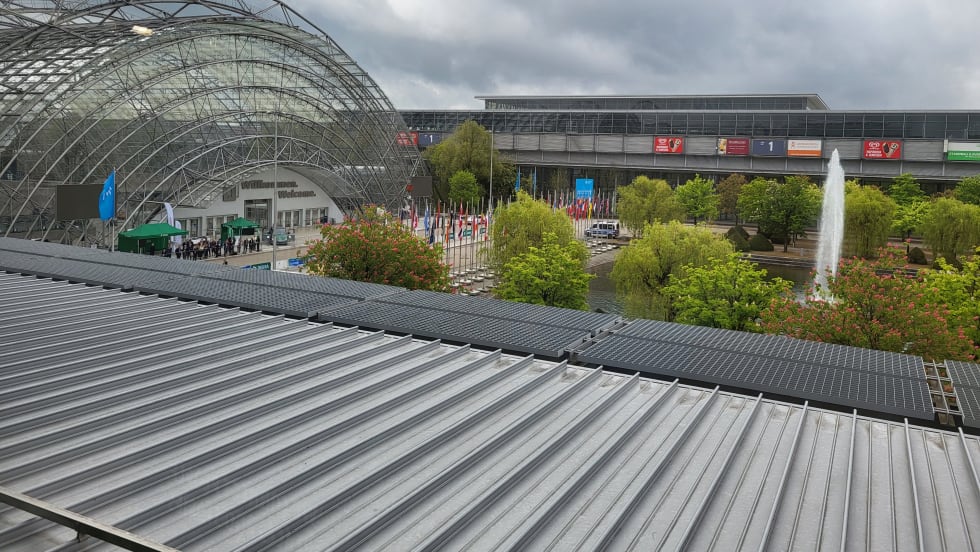
Inside ITF 2026: Transport Reacts to A Challenging World
Transport leaders from around the world gathered in Leipzig, Germany, for the 2026 International Transport Forum to discuss resilience, climate impacts, supply chains and the future of sustainable mobility.
Read More →
Every Ride Tells a Story — But You’re Not Just Selling the Ride
You’re selling the moment, the meaning, and the emotion behind it.
Read More →
How Digital Signage is Reshaping the Traveler Experience at Transportation Hubs
What was once a landscape of static signs has evolved into a responsive, immersive environment powered by real-time visual communication.
Read More →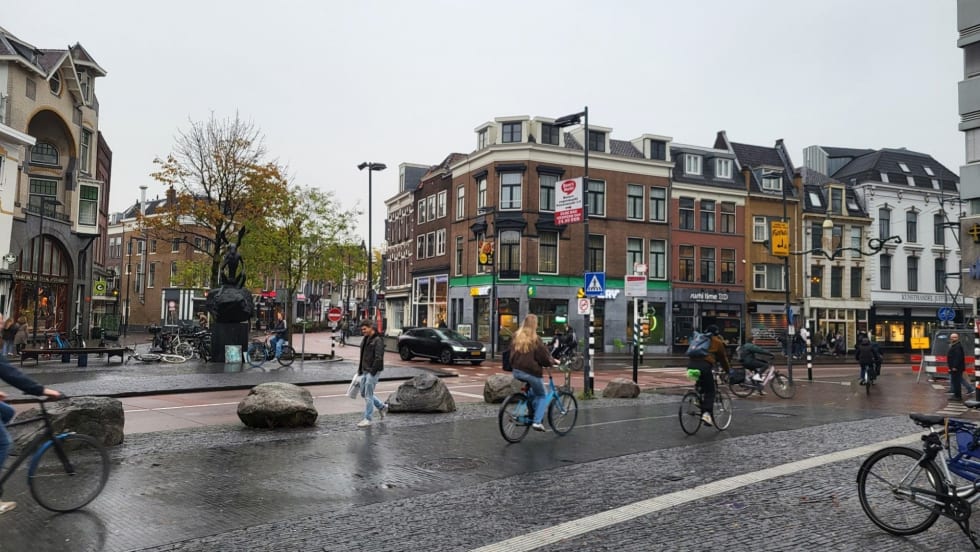
Latest Trends in Urban Mobility from Polis Conference 2025
Polis comprises cities and regions, as well as corporate partners, from across Europe, promoting the development and implementation of sustainable mobility. This year’s event had over a thousand attendees across various policy forums and an exhibition.
Read More →
Why Transit Leaders Require Better Tools for Operational Clarity In Today’s Tech-Fragmented Environment
Across North America and beyond, transit agency officials are contending with a perfect storm of operational headaches and strategic challenges that hamper daily service and long-term progress.
Read More →
The Powerless Brokers: Why California Can’t Build Transit
It is no secret that transit in the U.S. is slow and expensive to build.
Read More →
Why Transport Sustainability Should Focus on People Instead of Cars
Simply incentivizing electrification is not enough to make a meaningful impact; we must shift our focus toward prioritizing public transportation and infrastructure.
Read More →