




[Study] also highlighted a distinct lack of support from the state when it comes to transit funding — pointing to Bi-State Development as a local example.
Public transit's impact in Missouri exceeds $3.67B, study finds
Highlighted a distinct lack of support from the state when it comes to transit funding — citing Bi-State Development as a local example.
October 23, 2019

Bi-State Development, which operates the MetroBus and MetroLink in St. Louis, has a $2.68 billion impact on the region and supports 21,080 jobs.
St. Louis Metro
3 min to read
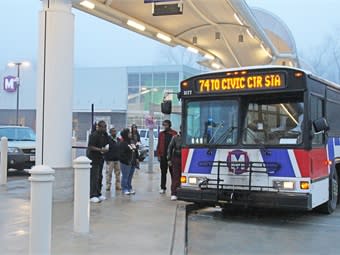
Bi-State Development, which operates the MetroBus and MetroLink in St. Louis, has a $2.68 billion impact on the region and supports 21,080 jobs.
St. Louis Metro
The direct and indirect impact of public transit in Missouri this year exceeds $3.67 billion, according to the findings of a new study by Citizens for Modern Transit. The six-month study was designed to quantify the economic impact of public transit services in the state of Missouri.
Findings from the first-of-its-kind study, commissioned in partnership with the Missouri Public Transit Association and AARP in St. Louis, included:
There is a total of 34 transit providers in the Missouri. They collectively spend $675 million each year on operations, capital improvements, and labor compensation for the 4,500 individuals who are employed at an average salary of $64,200.
Missouri public transit providers provide an annual average of 60.1 million rides, which is equivalent to 9.8 rides per year, per Missouri resident. In conjunction with these trips, transit riders are spending $600 million on goods and services. This translates into a direct economic impact of $1.28 billion each year in Missouri.
The direct spending triggers another $2.4 billion in statewide economic activity, including $1.03 billion in added household earnings for Missourians. These indirect, or multiplier effects, further support another 24,680 jobs in the state that pay an average of $30,200 per year. Because of all the economic activity and job creation triggered by transit operations and riders, the State of Missouri collects an estimated $48.8 million in taxes per year.
The direct and indirect economic output supported by public transit’s annual operations in 2019 exceeds $3.67 billion in Missouri. This includes $2.65 billion in the St. Louis Metro Area, $786.4 million in the Kansas City Metro Area and $251.9 million throughout the rest of the state.
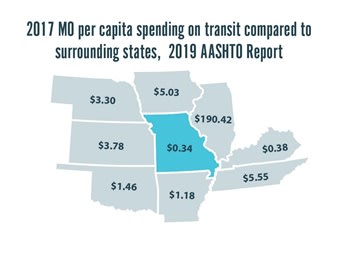
The $175 million invested in transit amounts to 34 cents per Missouri resident, which is similar to Kentucky, but less than a third of Arkansas and one quarter of Oklahoma and is almost insignificant when compared to Illinois.
AARP/CMT
The study also confirmed that Missouri transit providers serve every county in the state. The highest density of transit utilization is found in the urban areas of St. Louis and Kansas City, but there is access to public transportation in all rural areas and small towns.
It also highlighted a distinct lack of support from the state when it comes to transit funding — pointing to Bi-State Development as a local example. Bi-State Development, which operates the MetroBus and MetroLink in St. Louis, has a $2.68 billion impact on the region and supports 21,080 jobs. Yet, it received less than $1 million from the state of Missouri for its FY2017 budget of $303 million. The remainder came from federal funding and local sources.
“This pinch is not limited to St. Louis — it is being felt across the state as Missouri currently allocates $1.75 million per year for public transit, a total that must be divided among all 34 transit providers,” said Lewis. “This amounts to 34 cents per Missouri resident, which is similar to Kentucky, but less than a third of Arkansas and one quarter of Oklahoma and is almost insignificant when compared to Illinois. Of nine bordering states, Missouri has the 8th largest GDP and the slowest growing GDP since the Great Recession.”
After Lewis reported his findings, a panel of local stakeholders weighed in on the outcomes and discussed how the information can be utilized to build the case for more state and federal funding for transit.
More Management

METRO Opens Submissions for 2026 Motorcoach Awards
Nominations are now being accepted for METRO Magazine’s Operator of the Year and Innovative Operator of the Year awards.
Read More →
New York MTA Advances Final Contract for Second Avenue Subway Expansion
Contract Four is the largest in the Second Avenue Subway Phase 2 project and includes construction of station infrastructure, tracks, and signals for the subway expansion, MTA officials said. Work on Contract Four will begin in 2027.
Read More →
Transit Agencies Highlight Safety Gains at National Summit
Leaders from 15 major transit systems shared crime-reduction results and safety initiatives while discussing the role of continued federal support.
Read More →

NITA Names New Leadership, Expands Reduced-Fare Program at First Board Meeting
The new regional transit authority appointed its first board chair and interim executive director while extending reduced fares across CTA, Metra, and Pace for eligible riders.
Read More →
Beyond the Checklist: A Structured Approach to Transit Maintenance
Reliability-Centered Maintenance helps transit agencies move beyond routine checklists to focus limited resources on the assets and failures that have the greatest impact on safety, reliability, and service.
Read More →
APTA 2026 Nominating Committee Selects Leadership Slate, Names Chair and Vice Chair Nominees
Leadership changes will help shape the association’s priorities and its representation of the transportation industry during the 2026–2027 term.
Read More →
DART Launches Major Security, Fare Enforcement Initiative
The 90-day demonstration will deploy coordinated security teams at five light rail stations while testing controlled access and gathering data to guide future investments.
Read More →
Sponsored•September 9, 2026
Advancing Fare Collection Through Technology and Innovation
Learn about delivering 1300 gates at 91 stations while managing fare evasion. Explore the large scale deployment, solution customization and real-world results that affect the region. Prepare for deployment in your region now.
Read More →
Game Day in Motion: Moving Millions During the 2026 World Cup
Between packed transit stations and team motorcoaches, see how agencies and operators across North America tackled the transportation demands of the 2026 FIFA World Cup.
Read More →
Surface Transportation Extension Averts Shutdown, Leaves Transit Funding Gap
The stopgap keeps federal transportation programs moving, but missing advance funding could complicate the transit and rail projects agencies are planning next.
Read More →