



Biz Briefs: Luminator Launches AI Technology to Monitor Bus Stop Conditions and More
In METRO's latest installment, we also take a look at recent news from Masabi, Troman Industries, ioki, CCW, and more partnerships making headlines across the transportation sector.

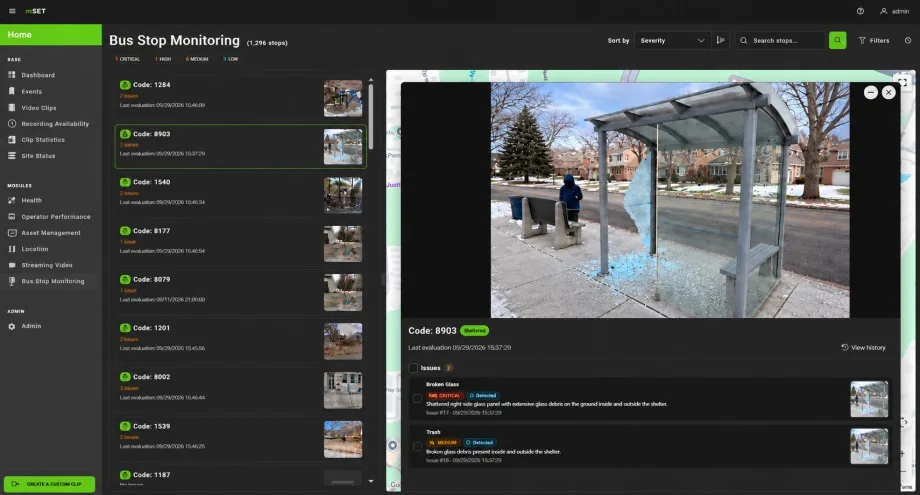
Luminator
- Luminator Technology Group introduced Transit Environment Intelligence (TEI), using AI to monitor bus stop conditions via images captured by transit vehicles.
- The system allows transit agencies to view and analyze the condition of stops and shelters, enhancing visibility and management.
- TEI uses mobile video systems and mSET software to detect issues like graffiti or broken glass, simplifying maintenance workflows.
*Summarized by AI
From strategic partnerships and acquisitions to service expansions and technology investments, the transportation industry continues to evolve at a rapid pace.
In this edition of Biz Briefs, we spotlight the latest developments shaping the future of mobility. From manufacturers and suppliers to transit agencies and motorcoach operators, these updates offer a snapshot of the projects, partnerships and business moves driving the industry forward.
In METRO's latest installment, we take a look at recent news from Masabi, Troman Industries, ioki, CCW, and more partnerships making headlines across the transportation sector.
Luminator Launches AI Technology to Monitor Bus Stop Conditions
Luminator Technology Group introduced Transit Environment Intelligence (TEI), a new capability that uses images captured by transit vehicles during normal service, together with location data, mSET, and AI-assisted analysis, to give agencies visibility into the condition of bus stops and shelters across their network.
Luminator’s Transit Environment Intelligence capability is the first of its kind in the transit industry, and is available now for agencies to pilot.
TEI brings stop and shelter conditions into view and into a workflow agencies can act on. Building on Luminator's mobile video systems and mSET software, it lets agencies:
- Use buses in normal service to capture up-to-date images of stops and shelters, with or without a shelter.
- View every stop with its latest images and find locations quickly by search or map.
- Apply AI to flag visible issues such as graffiti, trash, or broken glass, presenting the images alongside AI-interpreted details.
- Review, prioritize, and act on flagged issues through mSET workflows, with the ability to route issues to the responsible parties expanding over time.
TEI helps agencies explore new approaches to maintenance prioritization, asset stewardship, accessibility visibility, and passenger environment management. This focus allows agencies to be strong community partners and ensure safe, comfortable travel experiences, officials said.
Halifax Transit, Masabi Launch Account-Based Ticketing
Canada’s Halifax Transit launched Account-Based Ticketing (ABT) across its full bus and ferry network in partnership with Masabi. With the new system, riders using the HFXGO app can now board with their phone, without needing to decide which ticket or pass to buy before they travel.
Riders can scan the HFXGO app on a Justride Validator (JRV) when boarding a bus or when entering the platform at a ferry terminal. With fare capping, riders never pay more than the price of a day pass, currently $7.50 for adults, regardless of how many journeys they make. The same applies across the month, with spend capped at the value of a monthly pass, currently $90. Concession and youth fares are also capped at their own reduced rates, and occasional riders now get the same value regular pass holders have always had, without committing money upfront.
Bus and ferry journeys count toward the same caps, so a commuter who rides a bus to the terminal and crosses the harbor by ferry is treated as making one journey through one network, not two trips through two fare systems.
The launch builds on Halifax Transit's HFXGO mobile ticketing rollout with Masabi in November 2023. The modular design of Masabi’s Justride platform allowed the agency to add account-based fares and validation on top of its existing digital foundation, keeping day-to-day operations stable through the transition. Riders who prefer to keep buying tickets and passes as they do today can continue to do so. Continuing that program of modernization, Halifax Transit will deploy Open Payments in the coming months, enabling riders to pay directly with a contactless bank card or mobile wallet.
Optibus Launches Real-Time Suite to Improve CAD/AVL Accuracy
Optibus launched its Real-Time Suite, a cloud-native intelligence layer designed to enhance the CAD/AVL systems public transportation agencies and operators already use. Part of Optibus Control, the software works with existing systems without requiring additional hardware.
The Real-Time Suite uses schedule data and live vehicle information to provide more accurate estimated arrival times, live fleet monitoring, automatic detour detection, passenger alerts, and centralized compliance reporting. The platform is designed to help agencies address challenges including inaccurate ETAs, limited real-time visibility for dispatchers, fragmented passenger information, and time-consuming reporting.
Built within the Optibus platform, the technology sits between existing CAD/AVL hardware and passenger-facing and reporting tools. According to Optibus, agencies can use the software to identify service issues and detours more quickly, synchronize service alerts across channels, and generate reports from a centralized source.
MCI expands Metrolinx Order with 47 Additional Coaches
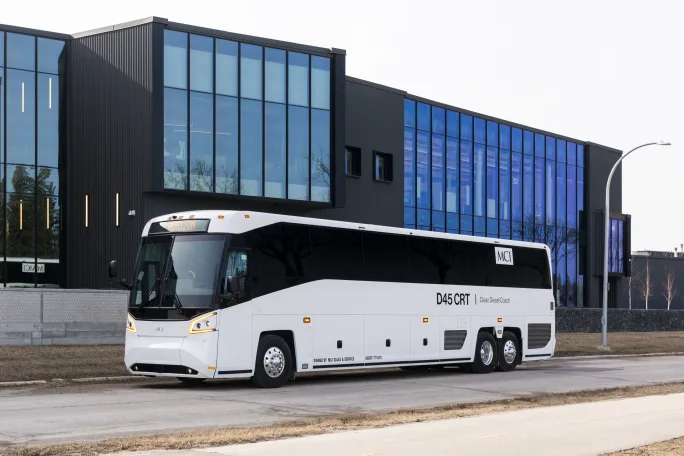
MCI’s D45 CRT commuter coach is specialized for high-capacity commuter and regional transportation.
MCI
Motor Coach Industries (MCI) expanded its order with Metrolinx for 47 additional 45-foot D45 CRT diesel commuter coaches.
The expanded order comes through two agreements, one for 33 coaches and another for 14 coaches, expanding the 97-coach order announced in early July 2025 to a total of 144 coaches. With Metrolinx’s initial purchase of 80 coaches announced in the first quarter of 2025, the additions bring Metrolinx’s total commitment to 224 MCI coaches. The latest order will replace aging MCI coaches in the agency’s fleet.
MCI’s D45 CRT commuter coach is specialized for high-capacity commuter and regional transportation. The additional coaches will support Metrolinx as it continues to provide efficient regional transit and respond to transportation needs across the Greater Toronto and Hamilton Area.
CCW Awarded Refurbished Bus Contract in Washington State
Complete Coach Works (CCW) was awarded a contract to supply and refurbish one 2013 30-foot Gillig Low Floor diesel transit bus for Jefferson Transit Authority in Port Townsend, Washington. Jefferson Transit Authority purchased the Washington State Department of Enterprise Services (DES) cooperative purchasing contract.
By purchasing through the Washington State cooperative contract, Jefferson Transit Authority streamlined procurement and moved forward efficiently while remaining fully compliant with public purchasing requirements. The state-approved contract provides agencies with a faster path to modernizing their fleets by reducing administrative timelines and allowing projects to begin sooner than traditional procurement methods.
The project reflects Jefferson Transit Authority's commitment to maintaining a safe, reliable fleet while making strategic investments that maximize the value of public transportation resources. Upon completion, the refurbished bus will enter service supporting transit operations throughout Jefferson County.
ioki to Launch First U.S. Transit Service with Georgetown University
ioki, a provider of on-demand software, and Georgetown University (Washington, D.C.) announced an on-demand late-night safe ride service for students and staff, which will launch later this month. It will mark the first deployment of the ioki software in the U.S.
Georgetown University's Office of Transportation Management (OTM) commissioned the service, called GUTS-2-Go, which runs on the ioki Platform and includes passenger and driver apps, as well as operations management tools.
Georgetown selected the ioki Platform to support its transit service, drawing on the company’s experience operating more than 200 transit services in Europe since 2018, officials said. The platform provides a dedicated booking app, live shuttle tracking and arrival countdowns, while also allowing on-demand trips to connect with other public transit services.
In Europe, the platform has been deployed in areas and during periods where demand may not support traditional fixed-route service, including nights and weekends, lower-density areas, and first- and last-mile connections. The software supports both fixed-route and on-demand operations and is used by transit agencies, municipalities, and universities.
Troman, HCT Announce Global Partnership to Advance Battery Fire Protection
Troman Industries and Hazard Control Technologies Inc. (HCT) announced a global partnership for mobile applications, primarily focused on advancing fire protection for public vehicles.
The partnership brings together Troman's Trident thermal detection, notification, and suppression platform with HCT's F-500 Encapsulator Agent technology and portable firefighting equipment to address the evolving fire protection needs of transit fleets.
Trident is designed to identify developing thermal hazards and communicate critical information in real time. HCT's F-500 technology provides a complementary suppression capability, with demonstrated performance in suppressing lithium-ion battery fires through cooling and fuel encapsulation.
Together, these capabilities support a clear objective: detect a developing battery event sooner and enable suppression at the earliest actionable moment. Earlier deployment can help control heat and limit escalation before a localized battery incident develops into a larger vehicle fire.
By combining Troman's transit experience and connected detection capabilities with HCT's suppression expertise, the companies aim to give transit agencies a more complete response to battery fire hazards — from the first indication of trouble through suppression, said officials.
Spare Unveils Agency-Wide AI Platform for Transit
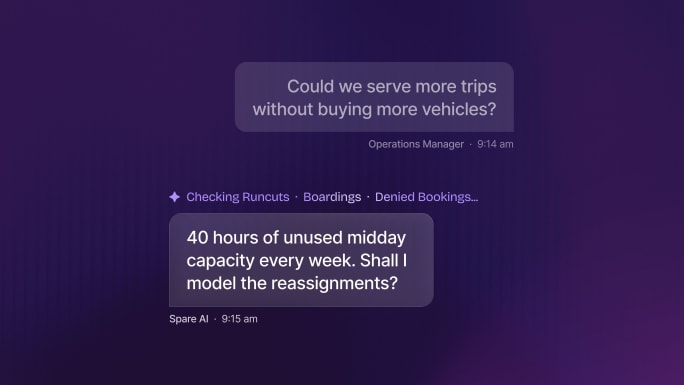
Alongside the announcement, Spare is opening the Spare AI Founding Agency Program, a small cohort of transit agencies and cities that will work directly with Spare to guide the platform's development.
Spare unveiled Spare AI, an agency-wide AI platform that connects the information, systems, and workflows transit agencies and cities rely on.
Spare AI connects systems and data across a transit agency, providing employees with access to information without requiring them to know where the data is stored. The platform uses AI agents and automated workflows to perform tasks across connected systems, including investigating issues, preparing outputs, monitoring changes, and identifying items that may require attention. The system also includes controls intended to support data security, compliance, and accuracy.
The Spare AI platform brings together four core capabilities:
- Conversational access. Employees ask questions in natural language and get source-backed answers specific to their role, without needing to know where the information lives. Connectors link Spare AI to the operations, maintenance, finance, HR, and productivity systems agencies already use.
- Cross-system intelligence and agency context. Spare AI combines the agency's operational data and institutional knowledge, including policies, procedures, contracts, and board records, into one shared picture of what's happening. Agencies can also opt in to learn from the wider Spare community through peer benchmarks, the practices behind better results, and what worked and didn't, while controlling exactly what they share.
- Governance and role-based control. Agencies decide what employees and AI can access, which actions AI can take, how sensitive information is handled, and when a person must review or approve.
- Agentic workflows. AI agents can gather information, analyze changes, prepare and carry out work, and monitor conditions across connected systems, escalating issues that need human attention.
Alongside the announcement, Spare is opening the Spare AI Founding Agency Program, a small cohort of transit agencies and cities that will work directly with Spare to guide the platform's development.
Participating organizations will receive early access to Spare AI, subsidized AI credits for their first year, direct support from Spare's product and engineering teams for configuration and implementation, and a meaningful role in shaping the product roadmap.
Quick Answers
Transit Environment Intelligence (TEI) is a new capability introduced by Luminator Technology Group that uses AI and images captured by transit vehicles to monitor and assess the condition of bus stops and shelters.
*Summarized by AI
More Technology

Public Transit Conference Returning to GFX in 2027, Call for Papers Now Open
The Call for Papers is now open, allowing transit agency professionals and industry experts to help shape the PTC educational program by submitting session ideas for consideration.
Read More →
ENC Lands MATA Contract and More in Biz Briefs
In this edition of Biz Briefs, we spotlight the latest developments shaping the future of mobility.
Read More →
Strada360’s Steve Lassey on Turning Transit Data Into Better Decisions
From breaking down data silos to preparing for AI, Strada360 CEO Steve Lassey discusses how transit agencies can use technology to improve operations, customer information, and long-term decision-making.
Read More →
Almaviva Looks to Open Architecture to Advance Transit Technology
Eric Reese discusses how interoperability, open architecture, and modular design can help transit agencies control costs, reduce vendor lock-in, and upgrade technology without starting over.
Read More →
Driving Smarter Paratransit
John Hanlon shares how AlphaRoute is leveraging AI-powered technology to help paratransit providers optimize operations, support frontline staff, and enhance the rider experience.
Read More →
From Hardware to Digital Partner: Luminator Charts Its Next Chapter
CEO Magnus Friberg discusses Luminator’s shift toward becoming a digital partner, the growing importance of software and interoperability, and how AI can help agencies improve operations and passenger experience.
Read More →
Beyond the Checklist: A Structured Approach to Transit Maintenance
Reliability-Centered Maintenance helps transit agencies move beyond routine checklists to focus limited resources on the assets and failures that have the greatest impact on safety, reliability, and service.
Read More →
NJ TRANSIT Advances Bus Technology Upgrades Across Statewide Fleet
More than 1,500 buses now feature upgraded technology designed to improve arrival predictions and provide free Wi-Fi, with deployment expected to reach nearly 2,000 buses by the end of 2026.
Read More →
Building a Flexible Path to Transit Electrification
John Hroncich discusses BAE Systems’ modular and scalable approach, lessons learned from decades of real-world operations, and how agencies can identify electrification strategies that fit their fleets.
Read More →
Biz Briefs: Alstom Lands Canadian Contract, LYT to Supply California TSP, and More
In METRO's latest installment, we take a look at recent news from Complete Coach Works, Beep, FlixBus, and more partnerships making headlines across the transportation sector.
Read More →