L.A. Metro Sees 16th Straight Month of Ridership Growth
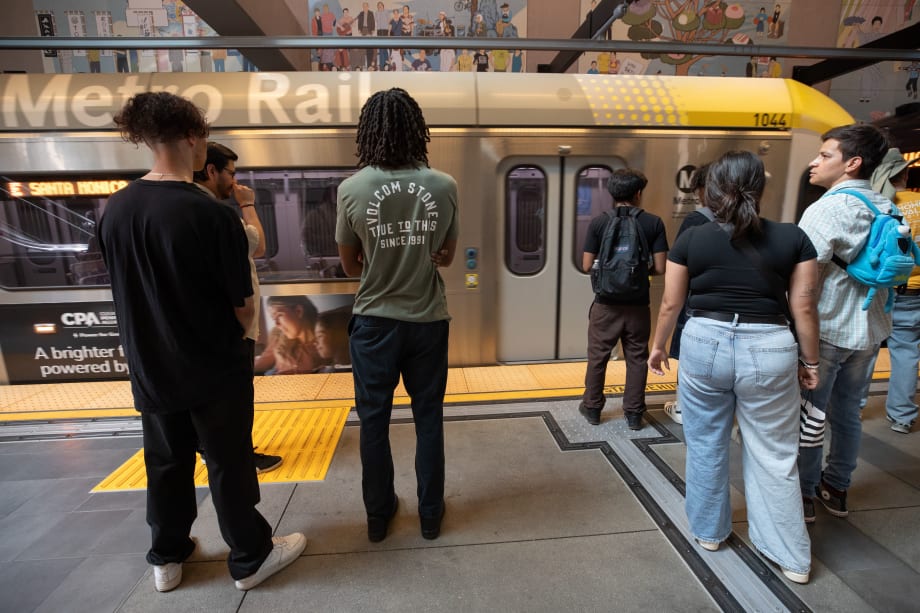
Average weekday rail ridership saw a 6.4% increase in boardings over March 2023, surpassing 200,000 boardings for the second time since the beginning of the pandemic.
Metro has updated its monthly ridership numbers dating back to April 2022 to correct a data validation error, which inaccurately counted ridership at an average of 5% lower than actual ridership on Metro’s light rail lines (A, E, L, C and K).
Average weekday rail ridership saw a 6.4% increase in boardings over March 2023, surpassing 200,000 boardings for the second time since the beginning of the pandemic.
Ad Loading...
Metro’s 16-Month Growth
March 2024 marked the 16th consecutive month of year-over-year ridership growth.
In March 2024, Metro had a total of 25,880,698 boardings on its bus and rail services. An average of 955,918 rides were taken each weekday with Saturday boardings averaging 606,255 and Sunday boardings averaging 555,029.
Metro’s March total bus and rail ridership combined was at 81.5% of its March 2019 pre-pandemic level. Total weekend ridership in March was 89.2% of pre-pandemic (March 2019) levels and total March weekday ridership was 79.5% of its March 2019 pre-pandemic level.
Metro's March Rail Ridership
March 2024 was an impressive month for Metro rail ridership. The new A and E Lines were up 25.6% on weekdays and 26.3% on weekends.
During the month, the light rail A Line saw 1,412,523 total weekday boardings and surpassed the subway B Line, which saw 1,385,496 boardings, as Metro’s busiest weekday rail line. The C Line average weekday ridership was up 22.2% and the K Line also saw a 6.5% increase in average weekday ridership. Total March rail boardings were 5,717,630 with 4,311,720 trips taken on weekdays.
Ad Loading...
Metro’s March Bus Ridership
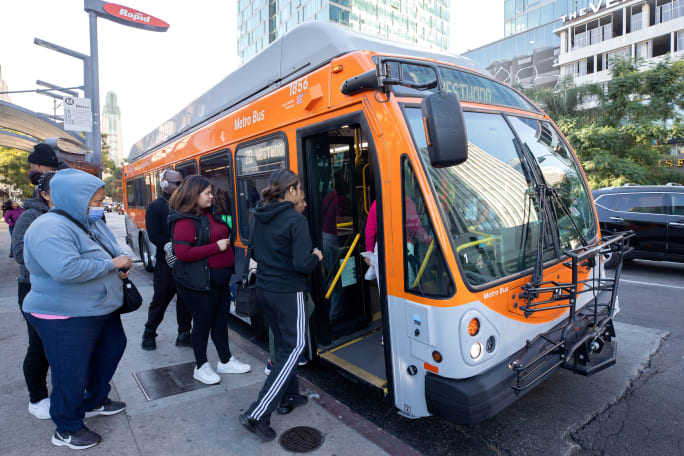
Metro bus ridership in March saw an 11.3% year-over-year increase over March 2023. More than 20 million (20,163,068) rides were taken on Metro buses, with total bus ridership in March 2024 at 85.6% of its pre-pandemic (March 2019) level.
Metro recorded an average of 750,598 bus boardings on weekdays in March, an average of 460,779 boardings on Saturdays and an average of 419,323 boardings on Sundays.
Ridership continues to grow as Metro furthers its human-centric, multilayered approach to safety, improved cleanliness, improved reliability, and frequency of service as well as fully restored bus service.
Metro bus ridership in March saw an 11.3% year-over-year increase over March 2023. More than 20 million (20,163,068) rides were taken on Metro buses, with total bus ridership in March 2024 at 85.6% of its pre-pandemic (March 2019) level.
Photo: LA Metro
Leisure Travelers Helping Growth
Weekends continue to show the strongest ridership recovery as leisure travelers are turning to Metro for travel to activities throughout the county. Average boardings on bus and rail combined on Saturdays reached 85.5% of March 2019 levels and on Sundays during the month average combined boardings reached 93.7% of March 2019 pre-pandemic levels.
During March, weekend activities such as the CONCACAF Soccer Championship, the LA Wine and Food Festival, the 96th Annual Academy Awards (Oscars), plus LAFC, Chivas, Clippers, and Dodger fans took advantage of Metro’s service boosting weekend ridership.
Ad Loading...
Fare Programs Making an Impact
Metro also continues to provide programs that make riding more affordable for everyone.
The agency’s reduced-price transit pass programs, such as the student GoPass pilot program, which offers free transit passes to K-12 and community college students, and its Low-Income Fare is Easy (LIFE) program, which provides free rides and reduced fares to low-income customers, are helping those who need it most.
In March, the GoPass Pilot Program saw 1,985,314 total boardings versus 1,771.640 in March 2023, reflecting a 12% year-over-year increase. The LIFE Program observed an 18% year-over-year increase in March ridership with 1,484,150 boardings compared to 1,260,155 in March 2023.
Ridership Calculation Adjustments
Metro has updated its monthly ridership numbers dating back to April 2022 to correct a data validation error, which inaccurately counted ridership at an average of 5% lower than actual ridership on Metro’s light rail lines (A, E, L, C and K).
The error did not affect bus and heavy rail ridership numbers and occurred when manual adjustments were made to Metro’s Automatic Passenger Counting system to account for non-transit activity, such as security personnel, custodians and supervisors helping to clear and clean the trains at the end of the line.
Ad Loading...
During the manual process, some transit passengers were undercounted. Metro has corrected its data validation procedures to account for this error and has added additional validations to avoid such an error occurring again.
The error had no effect on Metro’s operations or finances. Metro discovered this error through a public discussion on Reddit and thanks a devoted transit enthusiast for identifying this issue.
Contract Four is the largest in the Second Avenue Subway Phase 2 project and includes construction of station infrastructure, tracks, and signals for the subway expansion, MTA officials said. Work on Contract Four will begin in 2027.
The new regional transit authority appointed its first board chair and interim executive director while extending reduced fares across CTA, Metra, and Pace for eligible riders.
Reliability-Centered Maintenance helps transit agencies move beyond routine checklists to focus limited resources on the assets and failures that have the greatest impact on safety, reliability, and service.
The 90-day demonstration will deploy coordinated security teams at five light rail stations while testing controlled access and gathering data to guide future investments.
Learn about delivering 1300 gates at 91 stations while managing fare evasion. Explore the large scale deployment, solution customization and real-world results that affect the region. Prepare for deployment in your region now.
Between packed transit stations and team motorcoaches, see how agencies and operators across North America tackled the transportation demands of the 2026 FIFA World Cup.
The stopgap keeps federal transportation programs moving, but missing advance funding could complicate the transit and rail projects agencies are planning next.