




Read More: Metra Celebrates Completion of Blue Island Vermont St. Station Rehab
Chicago's Metra Proposes Fare Revisions, New Fare Products
The plan will be the subject of public feedback, including hearings, before the Metra Board of Directors votes in November.
October 11, 2023
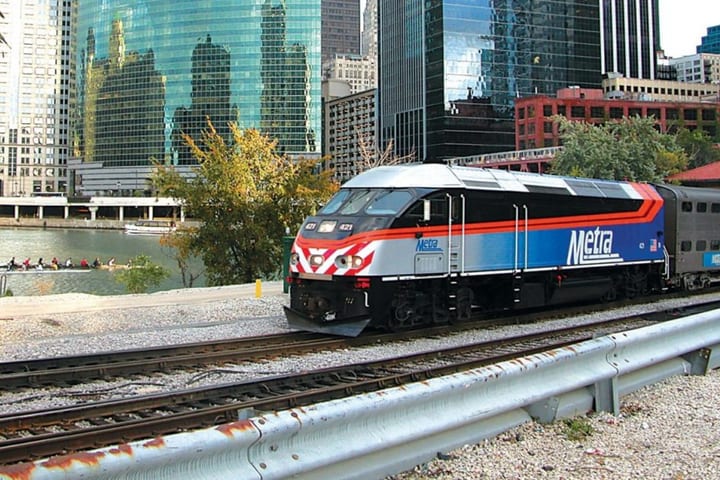
The operating budget incorporates a revision to the Metra fare structure that was proposed this summer. Under the new structure, fares will be equal to or lower than pre-pandemic levels.
Photo: Metra
2 min to read
Metra announced a $1.1 billion operating budget for 2024 that includes a revision to its fare structure and a new mix of fare products. It also proposed a $574.9 million capital budget that continues significant investment in railcars, bridges, and stations.
The plans will be the subject of public feedback, including hearings, before the Metra Board of Directors votes in November.
The operating budget is 4.9% higher than the 2023 budget (excluding $65 million in added costs that will be reimbursed by the Northern Indiana Commuter Transportation District, or NICTD). The increase is largely driven by expected inflationary (general, medical premiums, fuel, insurance) and contractual (union agreements) increases.
Changes to Metra Fare Structure
The operating budget incorporates a revision to the Metra fare structure that was proposed this summer. Under the new structure, fares will be equal to or lower than pre-pandemic levels. Changes would include:
Replacing the existing 10-zone distance-based structure with a simplified four-zone structure
Discontinuing the promotional the $6 and $10 Day Passes and $100 Super Saver Monthly Pass
Replacing the 10-Ride Ticket with a Day Pass Five-Pack available only in the Ventra app
Discontinuing “incremental fares” – a surcharge to travel beyond the zones indicated on a ticket
Full details can be found here.
The operating budget projects Metra will start the year at 47% of pre-pandemic (2019) ridership and finish the year at about 54 % of pre-pandemic levels. This results in a projection of $243.9 million in system-generated revenues, mostly fares. To cover the rest of the expected operating costs, Metra would use $560.4 million in regional sales taxes and $223.7 million in federal COVID relief funding.
Metra and the region’s other transit agencies – the RTA, CTA, and Pace – are projecting that COVID-relief funding will run out in 2026, creating a “fiscal cliff.”
Additional funding sources must be found, or public transportation agencies must implement other budget-balancing actions in 2026 to cover the anticipated deficit.
What the Operating Budgets Will Fund
The capital budget of $574.9 million funds 97 projects throughout the system. About 63% of the budget will fund work in four categories:
Bridge and retaining wall replacement and rehabilitation: $143.8 million
Stations and parking rehabilitations: $77.5 million
Yard improvements, including facility acquisitions: $71.1 million
Railcar rehabilitation $67.6 million
The capital budget is funded by:
$252.1 million in federal formula funding
$117 million USDOT Mega grant for Union Pacific North Line bridges
$73.8 million in Illinois PAYGO funds
$130 million in RTA bonds
$2 million in RTA Section 5310 funds
Public hearings about the budget will be held throughout the region on Nov. 1 and 2 between 4 p.m. and 6 p.m.
More Management

LIT Marks 10-Year Milestone at Annual Summit
Hosted by the COTA from September 10 to 13, the Summit carried the theme “Celebrating 10 Years of Excellence, Leadership, and Impact,” with every part of the program honoring the people, agencies, and partners who built LIT over its first decade.
Read More →
People Movement: Dan Dipert Coaches Adds Third-Generation Leader, Keolis Names New Valley Metro VP/GM, and More
In this edition, we also cover recent appointments and announcements at the Wabtec, SilverRide, HNTB, and more, showcasing the individuals helping to shape the future of transportation.
Read More →
METRO Opens Submissions for 2026 Motorcoach Awards
Nominations are now being accepted for METRO Magazine’s Operator of the Year and Innovative Operator of the Year awards.
Read More →

New York MTA Advances Final Contract for Second Avenue Subway Expansion
Contract Four is the largest in the Second Avenue Subway Phase 2 project and includes construction of station infrastructure, tracks, and signals for the subway expansion, MTA officials said. Work on Contract Four will begin in 2027.
Read More →
Transit Agencies Highlight Safety Gains at National Summit
Leaders from 15 major transit systems shared crime-reduction results and safety initiatives while discussing the role of continued federal support.
Read More →
NITA Names New Leadership, Expands Reduced-Fare Program at First Board Meeting
The new regional transit authority appointed its first board chair and interim executive director while extending reduced fares across CTA, Metra, and Pace for eligible riders.
Read More →
Beyond the Checklist: A Structured Approach to Transit Maintenance
Reliability-Centered Maintenance helps transit agencies move beyond routine checklists to focus limited resources on the assets and failures that have the greatest impact on safety, reliability, and service.
Read More →
APTA 2026 Nominating Committee Selects Leadership Slate, Names Chair and Vice Chair Nominees
Leadership changes will help shape the association’s priorities and its representation of the transportation industry during the 2026–2027 term.
Read More →
DART Launches Major Security, Fare Enforcement Initiative
The 90-day demonstration will deploy coordinated security teams at five light rail stations while testing controlled access and gathering data to guide future investments.
Read More →
Sponsored•September 9, 2026
Advancing Fare Collection Through Technology and Innovation
Learn about delivering 1300 gates at 91 stations while managing fare evasion. Explore the large scale deployment, solution customization and real-world results that affect the region. Prepare for deployment in your region now.
Read More →