



Ohio's SARTA Passes Balanced Budget
The spending plan, drafted after the auditing firm Jefferson Wells conducted a meticulous, line-by-line review of the agency’s finances, closes a $5 million gap in the original draft of the system’s budget for 2025 caused by declining sales tax revenue and less than anticipated federal assistance.

In addition to presenting the board with a budget for this year, SARTA CEO Kirt Conrad and his finance team also prepared proposed spending plans for 2026 and 2027.
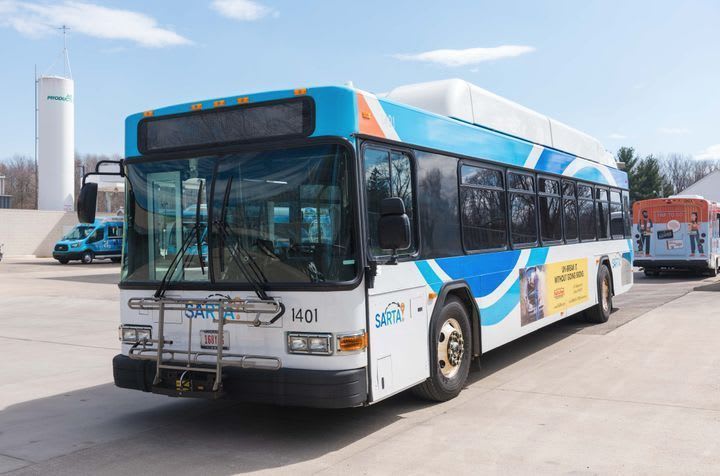
Photo: SARTA
Canton, Ohio’s Stark Area Regional Transit Authority (SARTA) adopted balanced operating and capital budgets totaling $39,057,095 for 2025, which is projected to produce a $84,703 surplus at year’s end.
The spending plan, drafted after the auditing firm Jefferson Wells conducted a meticulous, line-by-line review of the agency’s finances, closes a $5 million gap in the original draft of the system’s budget for 2025 caused by declining sales tax revenue and less than anticipated federal assistance.
“The balanced budgets we passed tonight accurately align our revenue and expenses, protect our $6 million reserve fund, and place on solid financial ground, and will enable us to continue providing the safe, affordable, reliable, and convenient public transit service the residents of Stark County need, expect, and deserve,” said SARTA CEO Kirt Conrad.
SARTA’s Balanced Budget
The plan also demonstrates the necessity of the cost-cutting measures Conrad and the board of directors implemented when problems with the budget were detected late last year.
“President Ron Macala and other members of the Board, our staff, and I devoted countless hours to developing a plan that would enable us to meet the fiscal challenges we faced,” Conrad said. “The decisive steps we took at that time, including suspending some fixed routes, reducing staff via layoffs and attrition, and modifying ProLine, our Americans with Disabilities Act-compliant paratransit service paved the way to financial stability today and put us on the road to enhancing public transportation in this community in the years ahead.”
Conrad noted the changes made to ProLine and launch of ProLine Plus implemented in early February are already paying dividends.
“In two weeks, we’ve reduced overtime by 850 hours and saved $70,000 in payroll expenses,” he said. “Those figures underscore the fact that operating Proline as a countywide, on demand, point-to-point, unlimited service as we did for the past 25 years was simply not sustainable. The modifications we’ve made are fiscally prudent and will enable us to fulfill our obligation to people with disabilities and their families who depend on us for safe, affordable public transportation.”
Presenting a Prepared Spending Plan
In addition to presenting the board with a budget for this year, Conrad and his finance team also prepared proposed spending plans for 2026 and 2027.
“We want to have a clear view of what lies ahead, although that view could be clouded by events in Washington, D.C., Columbus, and here in Stark County” he said. “Right now, no one knows how budget negotiations between the Trump Administration and Congress will impact federal support for transit, the same can be said for the transportation budget that’s being hammered out by the General Assembly, and at this point we don’t know if sales tax revenue will rebound here.
“We’re monitoring all three of those factors closely and we will be prepared to make adjustments that will enable us to operate in the most fiscally responsible manner possible while transporting our passengers to the thousands of destinations in and beyond Stark County they travel to each day,” Conrad concluded.
More Management

METRO Opens Submissions for 2026 Motorcoach Awards
Nominations are now being accepted for METRO Magazine’s Operator of the Year and Innovative Operator of the Year awards.
Read More →
New York MTA Advances Final Contract for Second Avenue Subway Expansion
Contract Four is the largest in the Second Avenue Subway Phase 2 project and includes construction of station infrastructure, tracks, and signals for the subway expansion, MTA officials said. Work on Contract Four will begin in 2027.
Read More →
Transit Agencies Highlight Safety Gains at National Summit
Leaders from 15 major transit systems shared crime-reduction results and safety initiatives while discussing the role of continued federal support.
Read More →

NITA Names New Leadership, Expands Reduced-Fare Program at First Board Meeting
The new regional transit authority appointed its first board chair and interim executive director while extending reduced fares across CTA, Metra, and Pace for eligible riders.
Read More →
Beyond the Checklist: A Structured Approach to Transit Maintenance
Reliability-Centered Maintenance helps transit agencies move beyond routine checklists to focus limited resources on the assets and failures that have the greatest impact on safety, reliability, and service.
Read More →
APTA 2026 Nominating Committee Selects Leadership Slate, Names Chair and Vice Chair Nominees
Leadership changes will help shape the association’s priorities and its representation of the transportation industry during the 2026–2027 term.
Read More →
DART Launches Major Security, Fare Enforcement Initiative
The 90-day demonstration will deploy coordinated security teams at five light rail stations while testing controlled access and gathering data to guide future investments.
Read More →
Advancing Fare Collection Through Technology and Innovation
Learn about delivering 1300 gates at 91 stations while managing fare evasion. Explore the large scale deployment, solution customization and real-world results that affect the region. Prepare for deployment in your region now.
Read More →
Game Day in Motion: Moving Millions During the 2026 World Cup
Between packed transit stations and team motorcoaches, see how agencies and operators across North America tackled the transportation demands of the 2026 FIFA World Cup.
Read More →
Surface Transportation Extension Averts Shutdown, Leaves Transit Funding Gap
The stopgap keeps federal transportation programs moving, but missing advance funding could complicate the transit and rail projects agencies are planning next.
Read More →