



Transit Welcomes Back Fans With Home Run Service
New York’s MTA creates campaigns urging fans to take public transit to games, while L.A. Metro brings back its Dodger Stadium Express bus service.

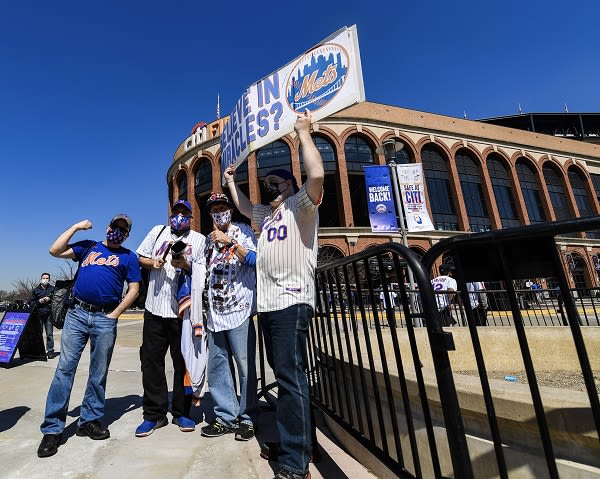
In terms of safety and frequency of game-day service (based on current COVID-19 restrictions), Citi Field informs the MTA of the maximum allowable attendance at games so the agency can set its service levels accordingly.
Marc A. Hermann / MTA New York City Transit
(To kickoff the 2022 baseball season, here's a look at an article we ran at the start of the 2021 baseball and MLS soccer seasons)
After an almost two-year pandemic delay, sports fans are not only back in the stands, but they’ve made a return nationwide to transit buses, trains, and paratransit vehicles.
With Major League Baseball and other sports leagues hosting games and venues ramping up fan attendance, transit operators are working overtime to get riders hyped up for safer and more efficient travel.
“As you’ll see, the common theme is welcoming fans back, reminding them of the public transit options available to the ball game, and why it is not only the most cost-effective way, but environmentally friendly,” said Michael Cortez, a media relations analyst for New York’s Metropolitan Transportation Authority (MTA). “There have only been a few April games [with fans in attendance] so far, but there has been a decent increase, along with ridership overall.”
Last month, in an effort to encourage baseball fans to take public transit to Citi Field ahead of the New York Mets’ home opener on April 8, MTA Chairman and CEO Patrick Foye and Long Island Rail Road (LIRR) President Phil Eng held the agency’s first-ever rolling news conference, aboard a Citi Field-bound train and LIRR train to see who would arrive first.
In addition to the rolling news conference, MTA Chairman Foye appeared on the Citi Field jumbotron with a message reminding riders to take public transit. (Watch the PSA below.)
“The PSA was designed to welcome fans back to the stadiums since they were not allowed in last year and was created to promote mass transit usage to get around the city as well as to games,” Cortez told METRO.
While there are no plans to create additional PSAs at this time, the MTA recently launched a broader “#TakeTheTrain, #TakeTheBus” campaign on May 16, with the idea of supporting events that take place throughout the city with transit service but not including paid sponsorships to offer service.
In terms of safety and frequency of game-day service (based on current COVID-19 restrictions), Citi Field informs the MTA of the maximum allowable attendance at games so the agency can set its service levels accordingly and account for social distancing.
For the home opener on April 8, the capacity at Citi Field was set at 20%, with 8,384 fans permitted into the stadium.
“The higher the attendance,” Cortez says, “the more trains we’ll run.”
In addition to following social distancing protocols, fans are required to adhere to MTA’s health and safety guidelines as well as those outlined on the Mets’ website.
Cortez said riders can feel more “empowered” by relying on real-time capacity trackers installed on some of MTA’s vehicles, as the technology allows them to choose cars that have more available seating/space.
On May 10, the MTA recorded its highest single-day ridership totals since the start of the pandemic in New York, and for buses, since front-door boarding resumed on Aug. 31.
Meanwhile, in California, the Los Angeles County Metropolitan Transportation Authority (L.A. Metro) is focusing on the continuation of its Dodger Stadium Express bus service to transport fans. Last year, the service was cancelled for the first time in 11 years due to the pandemic.
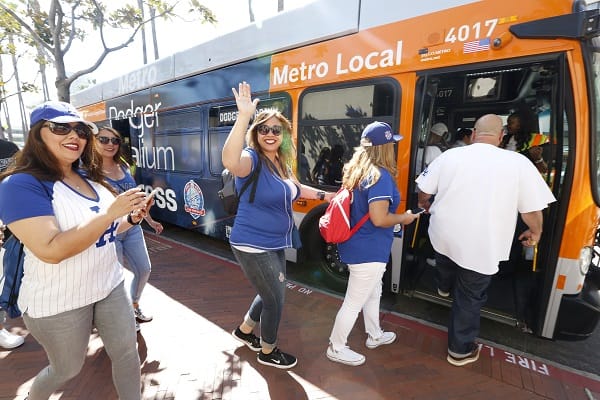
In 2019 — the last full year L.A. Metro conducted its Dodger Stadium Express bus service — the agency transported more than 150,000 baseball fans.
L.A. Metro
During the Dodgers home opener on April 9, L.A. Metro began operating its Dodger Stadium Express service on a modified level, according to Rick Jager, the agency’s communications manager. Approximately 15,000 fans were in attendance for the home opener.
“In 2019, the last full year we conducted the service, we transported more than 150,000 baseball fans,” Jager told METRO. “This year, we’re not seeing that type of ridership being reflected just yet.”
The service is still operating like previous years, running from Union Station in downtown L.A. and the Harbor Gateway Transit Center every 20 minutes, and free for all riders who have tickets to the game. The only thing different this year, Jager said, is a more “unusual season,” as more safety protocols and precautions are in place.
Like many other transit agencies across the U.S., L.A. Metro is working to boost its ridership back up to pre-pandemic levels and promoting the safety of public transit among its riders.
“Right now, L.A. Metro is operating at about 80% of its pre-pandemic service,” Jager said. “We’ll continue monitoring game attendance to determine our services for the Dodger Express. Our board is also looking into plans for a fareless transit system, which would start in August, dedicated to students and low-income riders.”
If the fareless transit plan is successful, Jager said the agency would look into adopting a fareless transit system for all its riders, including those looking for game-day service.
More Management

METRO Opens Submissions for 2026 Motorcoach Awards
Nominations are now being accepted for METRO Magazine’s Operator of the Year and Innovative Operator of the Year awards.
Read More →
New York MTA Advances Final Contract for Second Avenue Subway Expansion
Contract Four is the largest in the Second Avenue Subway Phase 2 project and includes construction of station infrastructure, tracks, and signals for the subway expansion, MTA officials said. Work on Contract Four will begin in 2027.
Read More →
Transit Agencies Highlight Safety Gains at National Summit
Leaders from 15 major transit systems shared crime-reduction results and safety initiatives while discussing the role of continued federal support.
Read More →

NITA Names New Leadership, Expands Reduced-Fare Program at First Board Meeting
The new regional transit authority appointed its first board chair and interim executive director while extending reduced fares across CTA, Metra, and Pace for eligible riders.
Read More →
Beyond the Checklist: A Structured Approach to Transit Maintenance
Reliability-Centered Maintenance helps transit agencies move beyond routine checklists to focus limited resources on the assets and failures that have the greatest impact on safety, reliability, and service.
Read More →
APTA 2026 Nominating Committee Selects Leadership Slate, Names Chair and Vice Chair Nominees
Leadership changes will help shape the association’s priorities and its representation of the transportation industry during the 2026–2027 term.
Read More →
DART Launches Major Security, Fare Enforcement Initiative
The 90-day demonstration will deploy coordinated security teams at five light rail stations while testing controlled access and gathering data to guide future investments.
Read More →
Advancing Fare Collection Through Technology and Innovation
Learn about delivering 1300 gates at 91 stations while managing fare evasion. Explore the large scale deployment, solution customization and real-world results that affect the region. Prepare for deployment in your region now.
Read More →
Game Day in Motion: Moving Millions During the 2026 World Cup
Between packed transit stations and team motorcoaches, see how agencies and operators across North America tackled the transportation demands of the 2026 FIFA World Cup.
Read More →
Surface Transportation Extension Averts Shutdown, Leaves Transit Funding Gap
The stopgap keeps federal transportation programs moving, but missing advance funding could complicate the transit and rail projects agencies are planning next.
Read More →