




Miss This? VTA Board Approves Contractor Change for BART Silicon Valley Extension
VTA Reports Massive Crane at Work on BART Silicon Valley Extension
With one of the largest cranes in the U.S. now at work, the BART Silicon Valley Phase II project enters a pivotal stage.
October 29, 2025
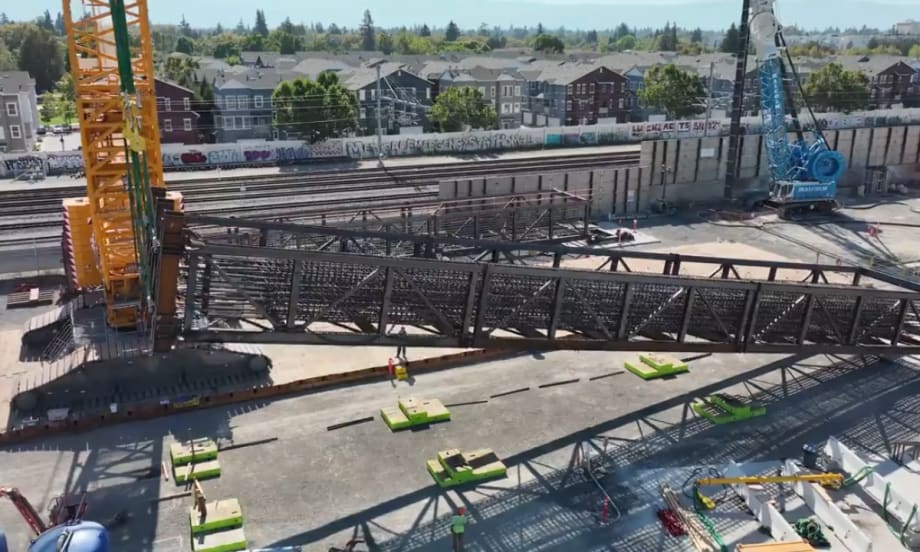
One of only four cranes of its kind in the country lifts massive rebar cages at the BART Silicon Valley Extension site.
Photo: Santa Clara VTA
3 min to read
A towering 217-ft. crane, one of only four in the U.S. and the only one currently operating on the West Coast, has been deployed for the BART Silicon Valley Phase II (BSVII) project, marking a new chapter in the system’s expansion.
The BSVII extension will add six miles of track and four new stations, connecting Berryessa through downtown San Jose and into Santa Clara. According to an agency release, the project is now entering a critical construction phase: installing massive steel rebar cages deep into drilled shafts, the structural cores of BSVII’s future foundations.
Currently stationed at the project’s West Portal Tunnel Boring Machine (TBM)/tunnel launch structure, the crane plays a key role in preparing for future tunneling operations. To deliver this engineering giant to the site, 39 semi-trucks were required, underscoring the scale and logistical complexity of the operation.
“This is a rare machine and seeing it in action is like witnessing the muscle behind modern infrastructure,” said Sarah Wilson, director of construction for BSVII. “Its presence signals one of the most exciting and transformative stages of the project, vertical construction.”
Installation of Massive Steel Structures
Working in tandem with one of the most innovative tools on the project, the crane will use a custom-built tripping frame, which is specialized to safely lift massive rebar cages, some of which extend over 140 ft. long and weigh more than 300,000 lbs. (roughly the size of 12 school buses), and lower them into vertical shafts.
The tripping frame is essential to this process, enabling the safe, controlled movement of these massive steel structures that would otherwise be impossible to handle. Each installation takes about 26 hours. Once in place, the cages are filled with concrete to form reinforced columns that will support underground walls and infrastructure, which will be necessary to launch the Tunnel Boring Machine in the future.
“We are using one of the largest cranes available to install heavy steel loads into our launch structure walls, all while keeping our crews and nearby rail lines safe,” Wilson added.
Significance of Specialized Equipment for BART
The use of such rare, specialized equipment underscores both the scale and complexity of BSVII. According to the release, with only four cranes of this size and type in the country, and just this one operating on the West Coast, its deployment highlights the national significance of this infrastructure project.
Over the coming weeks, residents and visitors will see this engineering giant in action, a dramatic symbol of progress rising above the construction zone. The shift from underground work to visible vertical construction marks a pivotal step toward the future of Bay Area transit.
BSVII will enhance connectivity, ease regional congestion, and promote sustainable transportation. With cutting-edge equipment, innovative tools like the tripping frame, and highly skilled crews, the project continues to advance with safety, precision, and long-term community benefit at its core.
More Management

METRO Opens Submissions for 2026 Motorcoach Awards
Nominations are now being accepted for METRO Magazine’s Operator of the Year and Innovative Operator of the Year awards.
Read More →
New York MTA Advances Final Contract for Second Avenue Subway Expansion
Contract Four is the largest in the Second Avenue Subway Phase 2 project and includes construction of station infrastructure, tracks, and signals for the subway expansion, MTA officials said. Work on Contract Four will begin in 2027.
Read More →
Transit Agencies Highlight Safety Gains at National Summit
Leaders from 15 major transit systems shared crime-reduction results and safety initiatives while discussing the role of continued federal support.
Read More →

NITA Names New Leadership, Expands Reduced-Fare Program at First Board Meeting
The new regional transit authority appointed its first board chair and interim executive director while extending reduced fares across CTA, Metra, and Pace for eligible riders.
Read More →
Beyond the Checklist: A Structured Approach to Transit Maintenance
Reliability-Centered Maintenance helps transit agencies move beyond routine checklists to focus limited resources on the assets and failures that have the greatest impact on safety, reliability, and service.
Read More →
APTA 2026 Nominating Committee Selects Leadership Slate, Names Chair and Vice Chair Nominees
Leadership changes will help shape the association’s priorities and its representation of the transportation industry during the 2026–2027 term.
Read More →
DART Launches Major Security, Fare Enforcement Initiative
The 90-day demonstration will deploy coordinated security teams at five light rail stations while testing controlled access and gathering data to guide future investments.
Read More →
Sponsored•September 9, 2026
Advancing Fare Collection Through Technology and Innovation
Learn about delivering 1300 gates at 91 stations while managing fare evasion. Explore the large scale deployment, solution customization and real-world results that affect the region. Prepare for deployment in your region now.
Read More →
Game Day in Motion: Moving Millions During the 2026 World Cup
Between packed transit stations and team motorcoaches, see how agencies and operators across North America tackled the transportation demands of the 2026 FIFA World Cup.
Read More →
Surface Transportation Extension Averts Shutdown, Leaves Transit Funding Gap
The stopgap keeps federal transportation programs moving, but missing advance funding could complicate the transit and rail projects agencies are planning next.
Read More →