



Seattle's Sound Transit Names New CEO
Dow Constantine has extensive experience leading large transit agencies, namely King County Metro, one of the largest agencies in the U.S.

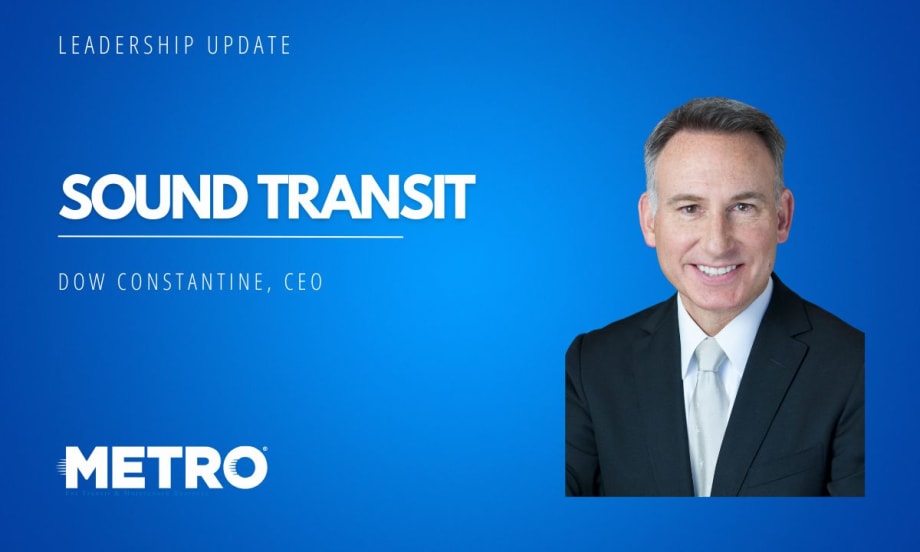
Dow Constantine was elected King County Executive in 2009 and is serving a record fourth term as leader of one of the nation's largest and most dynamic metropolitan regions.
Photo: King County Metro
The board at Seattle’s Sound Transit approved the choice of King County Executive Dow Constantine to serve as the agency’s next CEO. Constantine’s start date as CEO will be April 1.
“For every large organization, time is money, and we don’t have time or money to waste delivering on the promise of a truly regional mass transit system,” said Sound Transit Board Chair Dave Somers. “Dow can hit the ground running and intimately knows the inner workings of Sound Transit. He has proven his ability to oversee large organizations, run a major transit agency, and maintain crucial partnerships locally, regionally, and nationally that will be necessary to complete the central spine. Our economy and environment will benefit from the success of Dow and Sound Transit.”
Sound Transit’s New Man
The board’s action followed the recommendation of the board’s Executive Committee, which solicited input on priorities and reviewed 60 applicants from around the world, 15 of whom were interviewed.
The final selection process included candidate interviews with multiple panels representing a wide range of regional interests.
“It is an honor to be chosen as the next CEO of Sound Transit,” said Constantine. “Much of my service as an elected official has been devoted to building the world-class transit system our region has long needed and creating vibrant, transit-connected communities throughout Central Puget Sound. I can think of nothing I would rather do than lead this agency into the future, and I thank the board for their vote of confidence.”
Constantine was elected King County Executive in 2009 and is serving a record fourth term as leader of one of the nation's largest and most dynamic metropolitan regions.
He has extensive experience leading large transit agencies, namely King County Metro, one of the largest agencies in the U.S., and an agency voted in 2018 as the Best Large Transit Agency in North America by the American Public Transportation Association (APTA).
In the wake of COVID, recession, inflation, and workforce shortages that were holding back transit service, Constantine led Metro back to an era of growth, efficiency, strong ridership recovery, and a full workforce.
Intimate with Sound Transit
As member of Sound Transit’s board since 2006, Constantine has been intimately involved in the successes and challenges of the agency during an unprecedented period of growth.
He led the 2014-2015 process to conceive of, draft, and present Sound Transit 3 to voters, the largest transit capital expansion project in North American history.
Constantine led the 2014-2015 process to update the Long-Range Plan, adopt a system plan and ultimately conceive of, draft, and present Sound Transit 3 to voters. His leadership led to passage of the largest transit capital expansion project in North American history.
Under the terms of the proposed contract, Constantine’s initial term will run through Dec. 31, 2026, with two successive one-year renewals available at the board’s discretion through Dec. 31, 2028. His annual base salary will be $450,000.
Interim CEO Goran Sparrman will continue to serve as the acting CEO or as an advisor, as requested by Constantine, until May 2, 2025.
More Management

METRO Opens Submissions for 2026 Motorcoach Awards
Nominations are now being accepted for METRO Magazine’s Operator of the Year and Innovative Operator of the Year awards.
Read More →
New York MTA Advances Final Contract for Second Avenue Subway Expansion
Contract Four is the largest in the Second Avenue Subway Phase 2 project and includes construction of station infrastructure, tracks, and signals for the subway expansion, MTA officials said. Work on Contract Four will begin in 2027.
Read More →
Transit Agencies Highlight Safety Gains at National Summit
Leaders from 15 major transit systems shared crime-reduction results and safety initiatives while discussing the role of continued federal support.
Read More →

NITA Names New Leadership, Expands Reduced-Fare Program at First Board Meeting
The new regional transit authority appointed its first board chair and interim executive director while extending reduced fares across CTA, Metra, and Pace for eligible riders.
Read More →
Beyond the Checklist: A Structured Approach to Transit Maintenance
Reliability-Centered Maintenance helps transit agencies move beyond routine checklists to focus limited resources on the assets and failures that have the greatest impact on safety, reliability, and service.
Read More →
APTA 2026 Nominating Committee Selects Leadership Slate, Names Chair and Vice Chair Nominees
Leadership changes will help shape the association’s priorities and its representation of the transportation industry during the 2026–2027 term.
Read More →
DART Launches Major Security, Fare Enforcement Initiative
The 90-day demonstration will deploy coordinated security teams at five light rail stations while testing controlled access and gathering data to guide future investments.
Read More →
Advancing Fare Collection Through Technology and Innovation
Learn about delivering 1300 gates at 91 stations while managing fare evasion. Explore the large scale deployment, solution customization and real-world results that affect the region. Prepare for deployment in your region now.
Read More →
Game Day in Motion: Moving Millions During the 2026 World Cup
Between packed transit stations and team motorcoaches, see how agencies and operators across North America tackled the transportation demands of the 2026 FIFA World Cup.
Read More →
Surface Transportation Extension Averts Shutdown, Leaves Transit Funding Gap
The stopgap keeps federal transportation programs moving, but missing advance funding could complicate the transit and rail projects agencies are planning next.
Read More →